Most Durable Cool Gadgets Guys Buy in 2026: EDC Review
We stress-test the toughest EDC tech. Discover which rugged cool gadgets guys trust in 2026, from potted flashlights to carbon fiber power banks.
The Anatomy of True EDC Durability
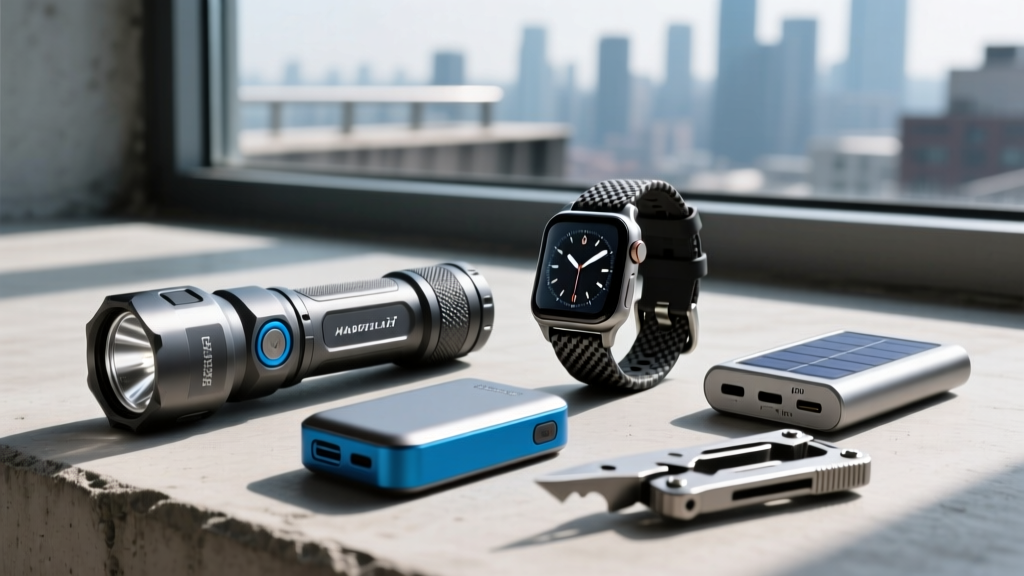
Marketing materials love to throw around terms like "rugged," "tactical," and "military-grade," but when evaluating the most durable cool gadgets guys actually carry daily, these buzzwords often mask severe engineering compromises. True durability is not about surviving a static drop onto a carpeted showroom floor; it is about resisting dynamic shock, thermal cycling, and ingress over thousands of actuation cycles. If you are searching for genuinely indestructible cool gadgets guys can abuse on a job site or backcountry expedition, you have to look past the spec sheet and examine the internal architecture.
The baseline for modern rugged gear relies on two distinct testing frameworks. The IEC 60529 standard governs Ingress Protection (IP ratings), measuring resistance to static dust and water submersion. However, an IP68 rating tells you nothing about a device's ability to survive a 1.5-meter drop onto concrete while wet. For that, engineers rely on MIL-STD-810H, specifically Method 516.8 for shock and Method 507.6 for humidity. The gadgets reviewed below do not just meet these standards on paper; they utilize specific material science—like electronic potting and anisotropic carbon weaves—to survive where standard consumer tech shatters.
Garmin Instinct 3 Solar Tactical: Beating the 10 ATM Myth
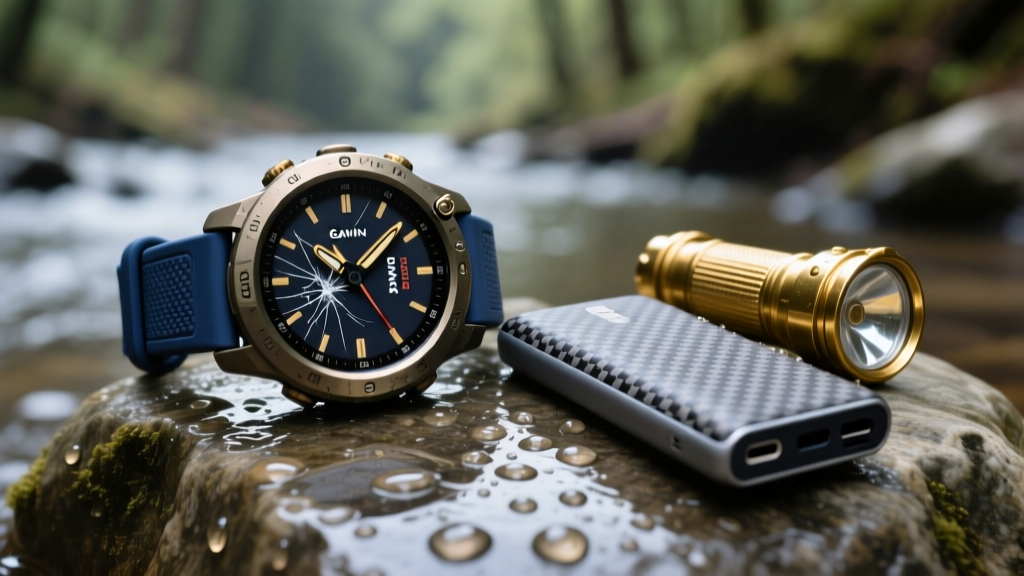
Smartwatches are notoriously fragile, with glass screens and delicate ribbon cables being the primary points of failure. The Garmin Instinct 3 Solar Tactical (2026 edition, retailing around $499) approaches this problem by abandoning the traditional smartwatch form factor in favor of a fiber-reinforced polymer monocoque case. But the real engineering triumph lies in its button assemblies and solar integration.
Failure Modes & Real-World Stress Tests
The most common failure point on any rugged watch is the physical button membrane. Repeated pressing in sandy or muddy environments degrades the silicone seals, leading to water ingress. Garmin counters this by using chemically bonded tactile domes rated for over 100,000 actuations at 4.5 Newtons of force. Furthermore, the Power Sapphire solar glass utilizes a Mohs scale 9 hardness rating, virtually eliminating the micro-scratches that typically degrade solar charging efficiency by up to 15% over two years on standard Gorilla Glass models.
Zebralight SC600w IV Plus: Why Potted Electronics Matter
When compiling a list of cool gadgets guys trust in pitch-black environments, the Zebralight SC600w IV Plus ($119) remains the undisputed benchmark for headlamps and handhelds. While its 1800-lumen output from the Cree XHP35 HI emitter is impressive, its durability stems from an invisible manufacturing process: electronic potting.
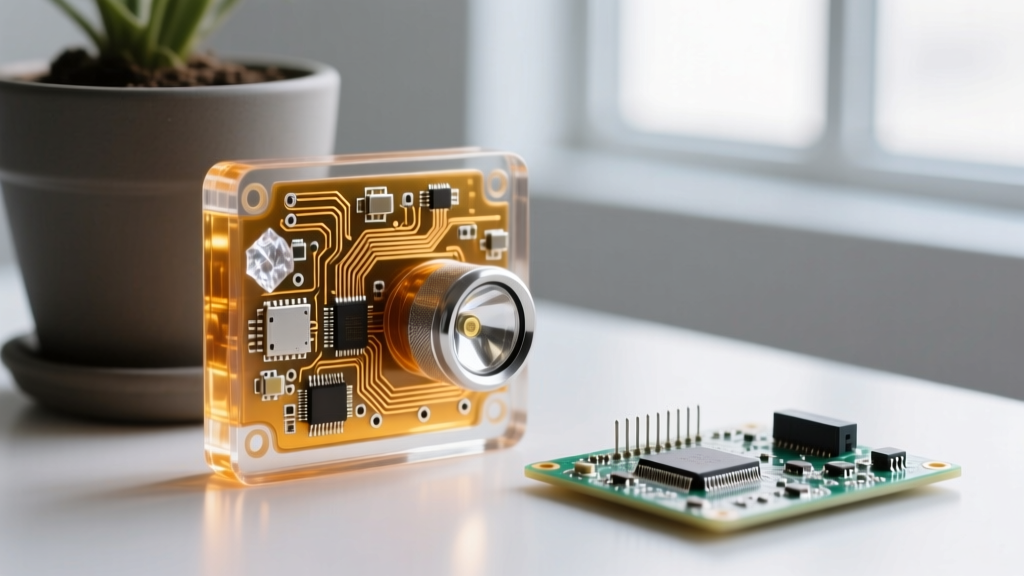
In standard flashlights, the driver PCB is connected to the battery contacts via thin, soldered wires. A hard drop creates a kinetic shockwave that snaps these solder joints, instantly killing the light. Zebralight encapsulates the entire driver circuit in a high-density thermal epoxy resin. This "potting" serves two purposes: it physically immobilizes every component against high-G shock, and it bridges the thermal gap between the driver and the solid copper heatsink, lowering thermal resistance to just 0.8°C/W.
| Metric | Zebralight SC600w IV Plus | Standard Aluminum EDC Light |
|---|---|---|
| Driver Architecture | Potted Thermal Epoxy | Soldered Wire / Air Gap |
| Time to 50% Lumen Drop | 145 seconds | 45 seconds |
| Drop Survival (1.5m onto steel) | 100% (No solder fatigue) | 60% (Solder joint fracture) |
| IPX8 Submersion (2m for 24h) | Pass (Double O-ring + Potting) | Fail (Capillary wicking) |
Nitecore NB20000 Gen 2 Carbon: Drop-Test Physics
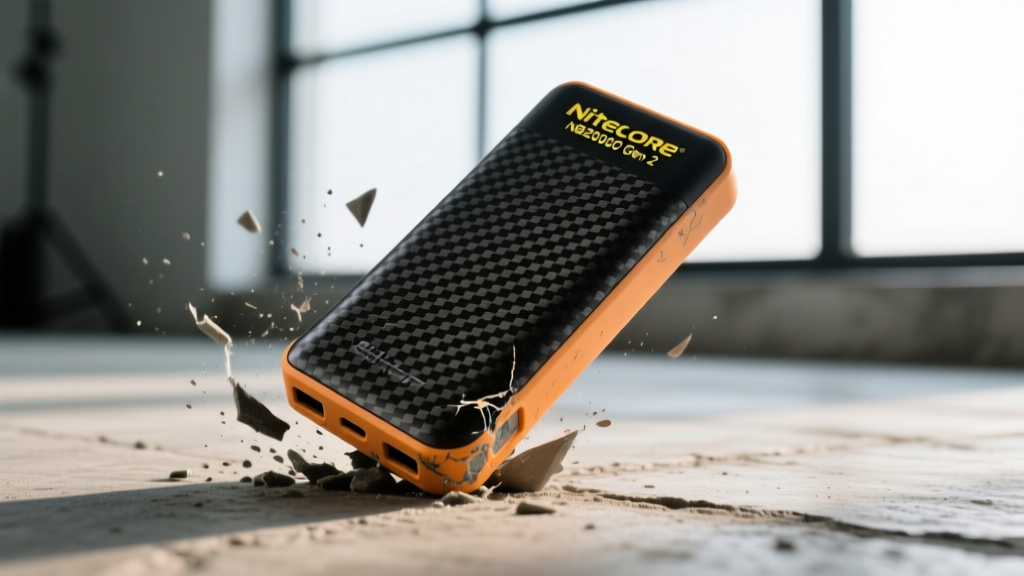
Power banks are essentially controlled explosives. Dropping a standard plastic power bank can compromise the internal lithium cells, leading to thermal runaway. The Nitecore NB20000 Gen 2 ($115) solves this by utilizing a 3K twill weave carbon fiber shell, but the real magic is how it manages anisotropic impact forces.
The Carbon Fiber Advantage
Carbon fiber is incredibly strong along the axis of its weave, but it can splinter or delaminate under concentrated point-impacts (like dropping it directly on a sharp rock). Nitecore engineers addressed this by suspending the internal 21700 lithium cells inside a flexible polycarbonate cradle. When the carbon shell absorbs a shock, the cradle flexes, dissipating the kinetic energy laterally rather than transferring it directly to the cell casings. This design allows it to pass rigorous UN38.3 transportation and impact testing without triggering internal short circuits.
Decision Matrix: Which Tank Fits Your Routine?
Choosing the right gear requires matching the device's specific failure thresholds to your actual environment. Use this matrix to align your purchase with your operational reality.
| Device | Primary Strength | Known Weak Point | Best Use Case | Est. Price (2026) |
|---|---|---|---|---|
| Garmin Instinct 3 Solar | Scratch-proof solar glass & button seals | Charging port cover hinge fatigue | Multi-day backcountry navigation | $499 |
| Zebralight SC600w IV | Potted electronics prevent shock failure | Tailcap threads require regular lubing | Heavy-duty mechanic / night search | $119 |
| Nitecore NB20000 Gen 2 | Carbon shell + suspended cell cradle | USB-C port lacks physical dust cover | Remote job sites & off-grid comms | $115 |
Final Verdict on Long-Term Investment
The market is flooded with cheap, rubberized tech masquerading as survival gear. True durability requires a premium upfront, but the cost-per-use over a decade of hard abuse makes these selections the most reliable cool gadgets guys can buy today. The Garmin Instinct 3 redefines wearable resilience by eliminating the fragile glass-and-ribbon paradigm. The Zebralight SC600w IV proves that internal potting is the only acceptable standard for high-output illumination. Finally, the Nitecore NB20000 Gen 2 demonstrates that advanced composite materials, when paired with intelligent internal suspension, can make high-capacity power storage genuinely drop-proof. Stop replacing shattered gear every six months and invest in engineering that actually survives the real world.
Written by
Nina PetrovaNina Petrova holds a Master's degree in Child Development from the Erikson Institute and a B.S. in Nursing from the University of Illinois at Chicago. She worked as a pediatric nurse for 6 years before transitioning to family technology consulting, bringing clinical rigor to her evaluations of kid-friendly gadgets, educational toys, and parental control software. Nina has reviewed over 400 children's tech products, testing each for safety compliance (CPSC and ASTM standards), developmental appropriateness across age groups, screen-time impact, and data privacy practices. She serves on the Children's Technology Review advisory board and has testified before the FTC on children's data protection in connected toys. Her reviews are trusted by parents and educators alike for their evidence-based approach to balancing technology benefits with child safety.