Small RV Kitchen Tips and Gadgets for Home Pastry Bakers 2026
Discover 2026's best small RV kitchen tips and gadgets for home bakers. Master pastry making in tight spaces with compact mixers and smart storage.
The Rise of the Nomadic Pâtissier
The intersection of full-time RV living and artisanal baking has created a niche but rapidly growing demographic. According to the RV Industry Association, the shift toward remote work has extended average RV trip durations, turning mobile galleys into primary culinary workspaces. For home bakers, this presents a unique engineering challenge: executing precision pastry work in a kitchen with roughly 15 to 20 inches of usable linear counter space, fluctuating ambient temperatures, and non-standard appliances. Mastering this environment requires abandoning residential baking habits and adopting specialized small RV kitchen tips and gadgets designed for spatial efficiency and thermal volatility.
Space-Saving Dough Prep: Manual vs. Compact Motorized Tools
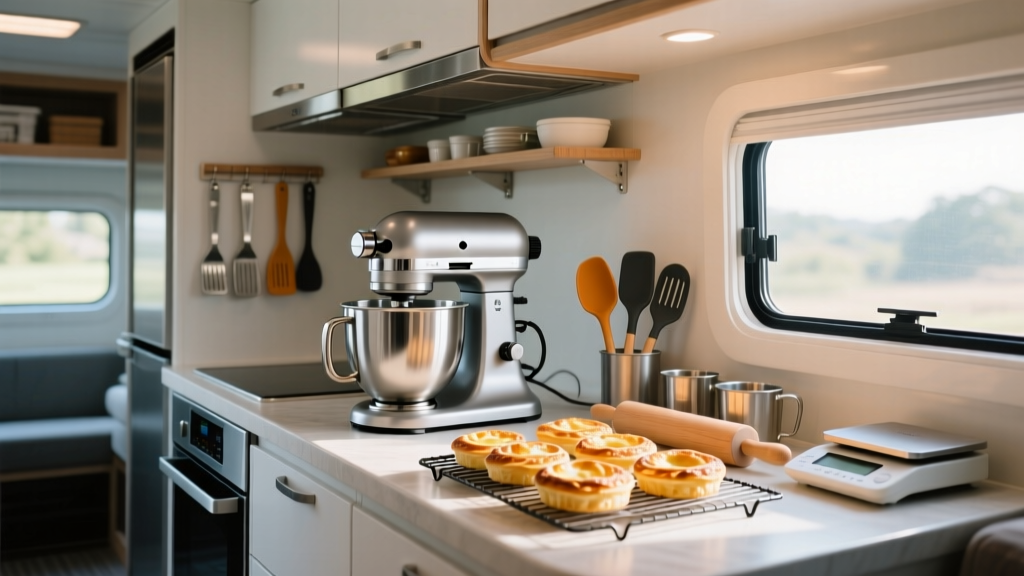
Baking pastry requires precise gluten development, which traditionally demands heavy stand mixers or expansive marble slabs. In an RV, a standard 5-quart mixer is a spatial liability that blocks walkways and exceeds weight limits on upper shelves. The 2026 standard for nomadic bakers is the KitchenAid Artisan Mini 3.5-Quart (Model KSM3316X). Priced around $379, it weighs 18 pounds (nearly 20% lighter than the classic) and features a tilt-head design that clears standard 18-inch RV upper cabinets. It can handle up to 1.5 pounds of dough, which is sufficient for two standard pie crusts or a single loaf of brioche.
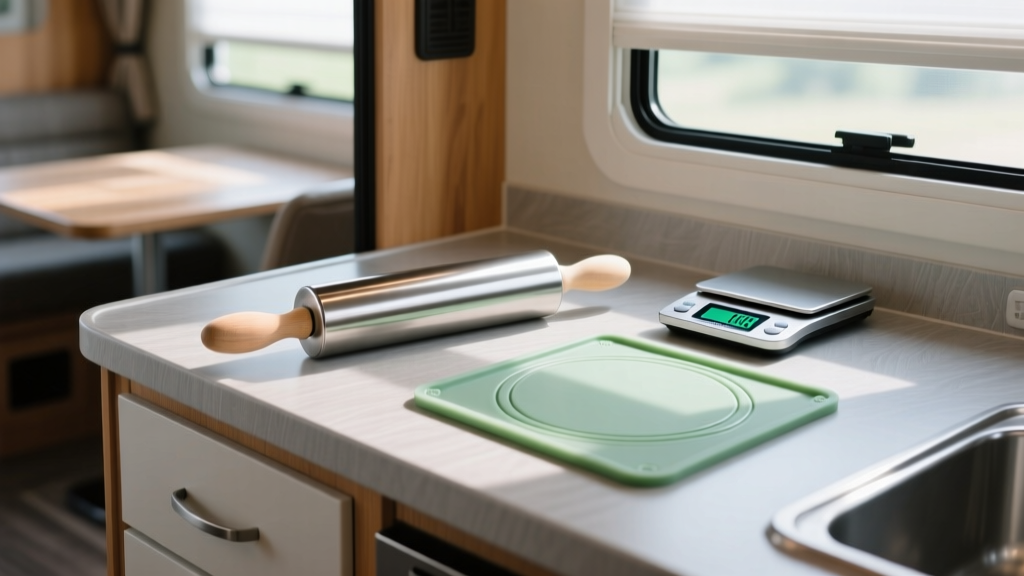
However, motorized tools generate friction heat. For laminated doughs like croissants where butter must stay below 65°F (18°C), manual tools are superior. A Danish dough whisk ($12) cuts through thick, high-hydration batters without trapping heat or requiring a massive bowl footprint. Pair this with a foldable silicone pastry mat (like the Gorilla Grip 16x20 inch model, $14), which provides a non-slip, lightly floured surface that rolls up into a 2-inch cylinder for drawer storage.
| Tool Category | Recommended RV Model | Spatial Footprint | Best Use Case |
|---|---|---|---|
| Motorized Kneading | KitchenAid Artisan Mini 3.5-Qt | 12.3' x 16.5' | Enriched doughs (brioche, challah) |
| Manual Mixing | OXO Good Grips Danish Whisk | 1.5' x 11' | High-hydration sourdough, batters |
| Prep Surface | Gorilla Grip Silicone Mat | 2' cylinder (rolled) | Rolling pie crusts, cutting scones |
Conquering the 17-Inch RV Convection Oven
RV ovens are notoriously volatile. Most modern rigs utilize 17-inch convection microwaves, such as the Furrion or Dometic models. These units rely on a rear-mounted fan to circulate air, which accelerates Maillard browning but can rapidly desiccate delicate pastries. As detailed in King Arthur Baking's convection guidelines, you must reduce the baking temperature by 25°F and check for doneness 20% earlier than the recipe dictates to prevent scorched exteriors and raw interiors.
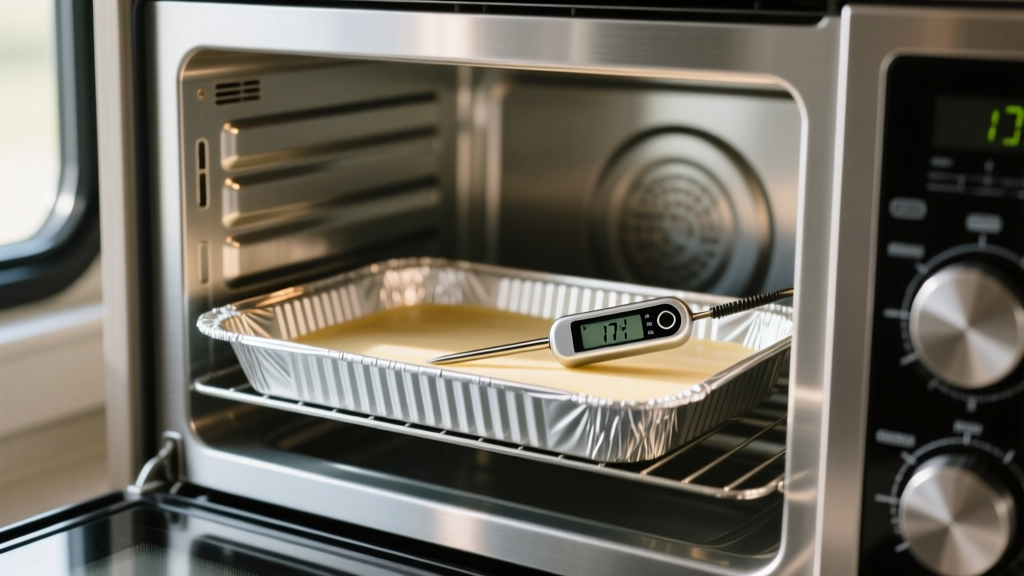
Furthermore, RV ovens suffer from severe radiant hot spots due to thin wall insulation and proximity to the propane burner or heating element. To combat this, bypass the built-in dial and use a ThermoWorks DOT ($49). Leave the probe resting on the oven floor to monitor the true ambient thermal mass. Place a $15 ceramic pizza stone on the bottom rack to act as a heat sink, stabilizing temperature swings when the RV door is opened or when wind hits the exterior vent.
Ingredient Preservation: Vacuum Sealing and Climate Control
Flour and butter are highly susceptible to the extreme humidity and temperature fluctuations inherent in RV travel. A 5-pound bag of all-purpose flour left in a standard RV pantry will absorb ambient moisture, drastically altering the hydration ratio of your pastry dough and resulting in tough, dense crusts. Vacuum sealing is non-negotiable for long-term dry storage. The FoodSaver FM2000 ($89) is compact enough to store in a lower exterior compartment and removes 99% of air from bulk flour bags, protecting them from both moisture and pantry moths.
For daily access, transfer 500g of flour into an OXO Good Grips POP Container (1.1 Qt). The airtight silicone seal prevents moisture ingress, and the flat lid allows for stacking in shallow 12-inch deep RV cabinets.
Butter presents an even greater challenge. RV refrigerators typically run between 42°F and 45°F, which is warmer than the FDA-recommended 37°F for residential fridges. At 45°F, butterfat begins to soften, ruining the distinct layers required for puff pastry. Store your lamination butter in the RV fridge's dedicated dairy drawer (usually the coldest zone) and keep it wrapped in its original foil, placed inside a sealed glass container to block ambient food odors and stabilize the micro-climate.
Future Outlook: 2026 and Beyond for Compact Baking Tech
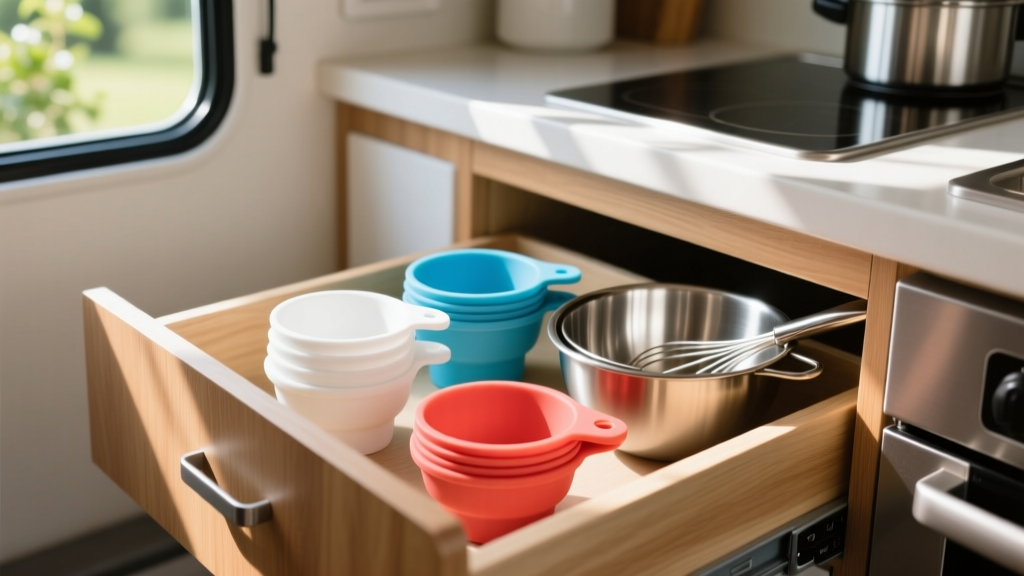
What does the future hold for compact baking technology? According to equipment analysts at America's Test Kitchen, the next generation of small-space tools prioritizes modularity and multi-functionality over simple miniaturization. We are currently seeing the emergence of magnetic nesting mixing bowls that adhere directly to the RV's metal backsplash to free up counter space, and collapsible silicone measuring spoons that snap entirely flat.
'The constraint of a 15-inch countertop is forcing manufacturers to rethink tool geometry. We expect the next wave of baking gadgets to integrate measuring, mixing, and pouring into single, collapsible vessels, eliminating the need for a traditional nested bowl set entirely.' — Equipment Testing Team, America's Test Kitchen
By 2027, expect to see high-wattage induction-powered portable convection ovens designed specifically for the RV market. These units will bypass the rig's standard 17-inch cavity entirely, plugging directly into a 1500W exterior outlet or a high-capacity solar inverter system, allowing for high-BTU pastry baking without heating the rig's interior living space during summer boondocking.
The Ultimate RV Pastry Toolkit Checklist
If you are outfitting your rig for serious baking, ensure these specific items are in your galley:
- ThermoWorks DOT Thermometer ($49): Essential for true oven calibration and monitoring internal bread temperatures.
- Nordic Ware Quarter-Sheet Pans ($18 each): Measuring exactly 9x13 inches, they fit perfectly in 17-inch RV ovens with 1 inch of clearance on all sides for mandatory convection air circulation.
- Stainless Steel Bench Scraper with Ruler ($12): Doubles as a dough portioning tool and a ruler for measuring your limited counter depths before rolling out large crusts.
- Thermapen ONE or Silicone Spatula Thermometer ($35-$100): Crucial for tempering chocolate or measuring butter temperature while creaming, ensuring you don't accidentally melt the fat in a warm RV kitchen.
- Microplane Zester ($16): Takes up virtually zero drawer space and is vital for adding citrus oils to shortbread and scones without adding excess liquid that disrupts dough hydration.
Written by
Lena ChenLena Chen earned her M.S. in Human-Computer Interaction from Carnegie Mellon University and a B.S. in Electrical Engineering from the University of Washington. She has spent the past decade specializing in smart home architecture and IoT ecosystems, helping over 200 homeowners design fully connected living spaces. Lena is a certified Matter protocol consultant and has published peer-reviewed research on voice-first interface design in the ACM Digital Library. Her reviews of smart home products combine deep technical analysis with real-world usability testing, evaluating everything from Zigbee mesh stability to Alexa skill responsiveness. She regularly speaks at CEDIA Expo and CES smart home panels.