7 Unique Kitchen Gadgets for Compact Coffee & Tea Prep
Discover 7 unique kitchen gadgets for compact coffee and tea prep. Maximize tiny counters with space-saving espresso makers, grinders, and brewers.
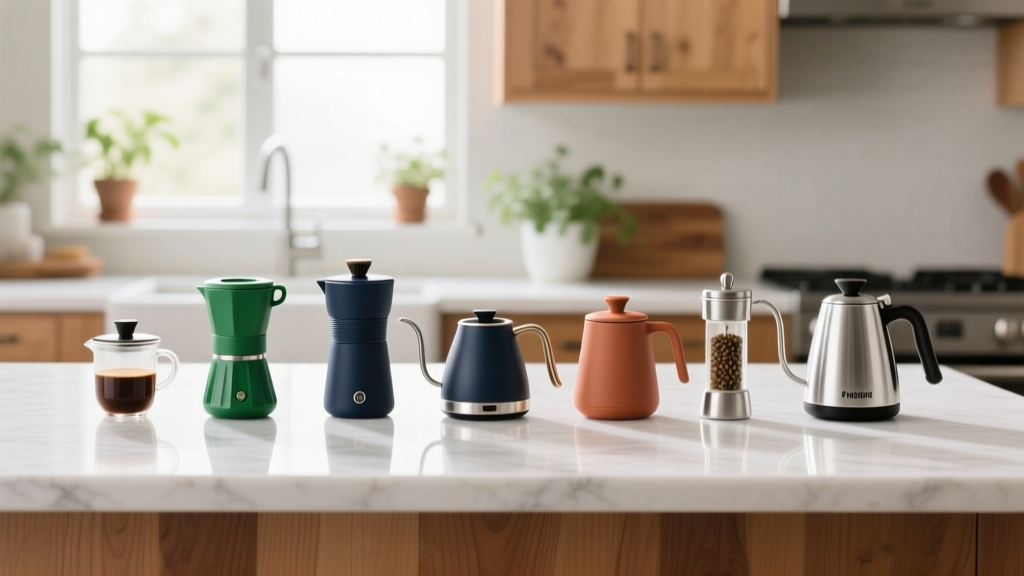
The Micro-Kitchen Dilemma: Quality vs. Counter Space
When hunting for unique kitchen gadgets that solve the micro-apartment dilemma, coffee and tea enthusiasts face the harshest constraints. Traditional espresso machines demand 15 inches of vertical clearance and 12 inches of width, while electric kettles and burr grinders quickly consume what little prep space remains. According to the National Coffee Association (NCA), over 40% of specialty coffee consumption now happens at home, yet urban kitchen footprints continue to shrink. The solution is not to downgrade your brew quality, but to adopt high-density, multi-functional tools engineered specifically for tight spatial tolerances.
The Compact Espresso Matrix: Heat, Pressure, and Footprint
Achieving true espresso (9 bars of pressure and 195°F to 205°F water) without a massive thermoblock requires innovative engineering. Below is a comparison of the leading ultra-compact espresso makers available on the market today, evaluated on their spatial footprint and thermal capabilities.
| Device | Dimensions (Inches) | Heating Mechanism | Pressure | Price Range |
|---|---|---|---|---|
| Outin Nano | 3.5 x 3.5 x 8.6 | Internal 7500mAh Battery | 20 Bar | $149 |
| Wacaco Picopresso | 4.1 x 3.1 x 2.8 | None (Requires external hot water) | 18 Bar (Manual) | $130 |
| Flair Neo Flex | 9.0 x 5.0 x 12.0 (Assembled) | None (Requires external hot water) | 10 Bar (Manual) | $100 |
4 Unique Kitchen Gadgets for Space-Starved Baristas
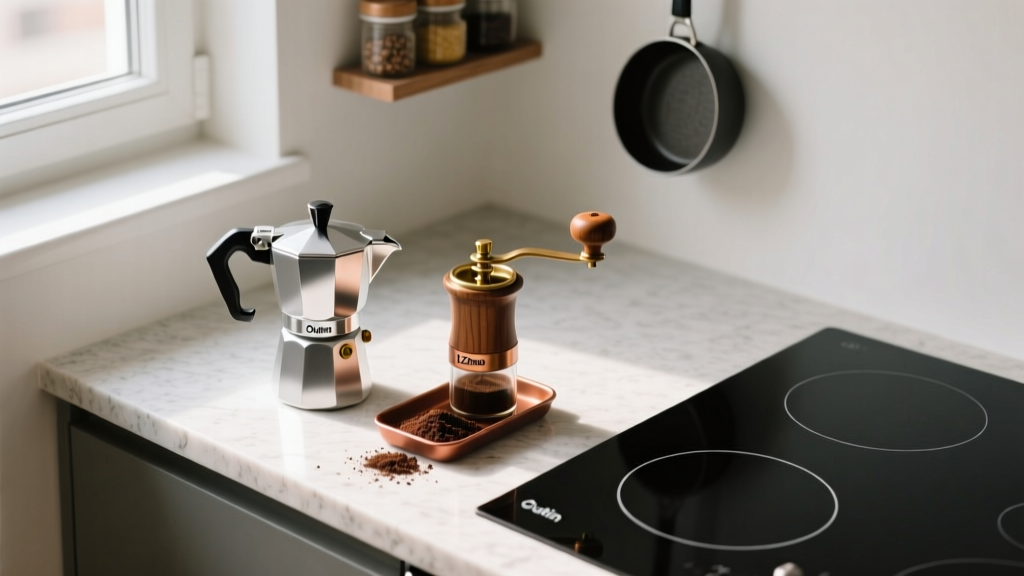
1. Outin Nano Portable Electric Espresso Maker
The Outin Nano eliminates the need for a stovetop or microwave to heat water. Weighing just 1.5 lbs, its internal 7500mAh battery heats 50ml of room-temperature water to 194°F in roughly 200 seconds, then immediately extracts the coffee at 20 bars of pressure. Edge Case Warning: Heating cold water drains the battery rapidly, yielding about 3 to 4 shots per charge. If you pre-fill it with boiling water from a compact kettle, you can pull up to 100 shots on a single charge. This dual-mode thermal flexibility makes it the ultimate gadget for RVs and dorms.
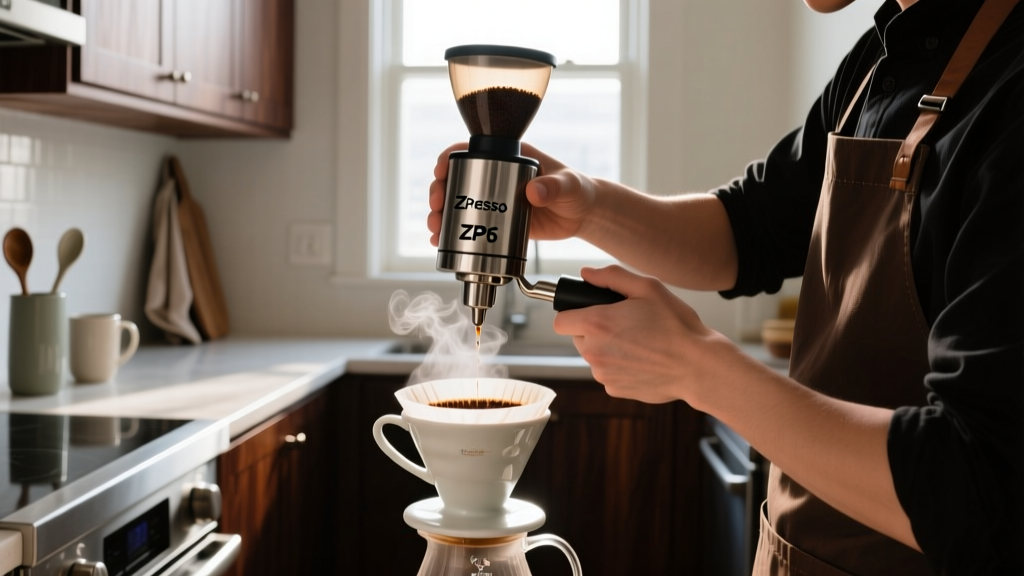
2. 1Zpresso ZP6 Special Hand Grinder
Electric grinders like the Baratza Encore require a 12x6 inch footprint and generate massive static cling. The 1Zpresso ZP6 Special collapses into a 2x6 inch cylinder. It utilizes 38mm heptagonal burrs specifically calibrated for pour-over and AeroPress extraction. The Specialty Coffee Association (SCA) emphasizes grind uniformity for optimal Total Dissolved Solids (TDS); the ZP6 produces exceptionally low fines, preventing the muddy, over-extracted flavors common in small, immersion-style brewers. At $139, it outperforms electric grinders triple its price and stores easily in a drawer.
3. Cosori 0.8L Mini Gooseneck Kettle
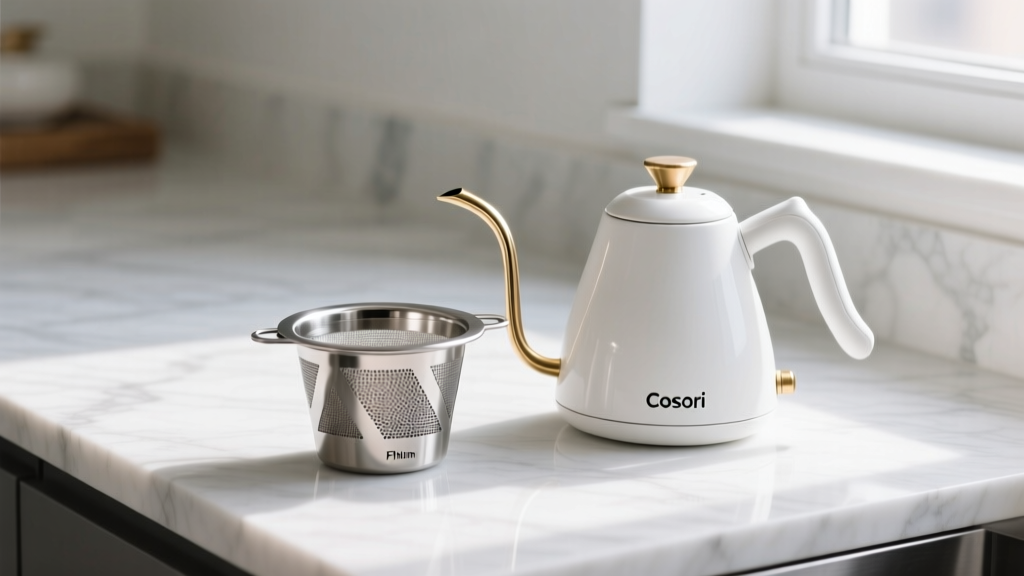
Standard 1.0L or 1.2L gooseneck kettles are overkill for single-cup pour-overs and dominate the stovetop. The Cosori 0.8L Mini (approx. $45) features a precision swan-neck spout but scales the base down to a 5.5-inch diameter. Its 1200W heating element brings 400ml of water to 200°F in under three minutes. Pro Tip: Because of the smaller water volume, scale buildup from hard water will trigger the auto-shutoff sensor much faster than in larger kettles. Descale with a 1:1 citric acid solution every 30 uses to maintain sensor accuracy.
4. Tricolate No-Bypass Dripper
Traditional conical drippers (like the V60) require a tall carafe underneath, which often fails to fit beneath low cabinets or inside compact travel sinks. The Tricolate is a flat-bottom, cylindrical brewer that sits directly on top of almost any standard mug. Its unique shower screen ensures zero water bypass, meaning you can use a coarser grind and a lower coffee dose (12g instead of 15g) to achieve the same extraction yield, saving both physical space and coffee bean storage.
Tea Preparation in Tight Quarters
Tea brewing requires precise temperature control and adequate leaf expansion room, which is difficult when restricted to a single mug. The UK Tea & Infusions Association notes that restricted leaf movement severely limits the extraction of volatile aromatic compounds. To solve this without buying a massive countertop tea maker, rely on high-efficiency micro-infusers.
"The geometry of a tea filter dictates extraction. Basket-style filters that allow 360-degree water circulation are mandatory for whole-leaf oolongs and tightly rolled greens, which expand up to 400% of their dry volume."
Finum Permanent Filters & Ember Mug 2
Ditch disposable paper tea sacks. The Finum Hot Tea Maker Basket uses a micro-mesh stainless steel screen that folds entirely flat when not in use, slipping into a silverware drawer. Pair this with the Ember Mug 2. Instead of using a stovetop kettle to reheat tea that has gone cold, the Ember Mug maintains your exact target temperature (e.g., 175°F for delicate white teas, 205°F for Assam black teas) for up to 80 minutes via its internal battery, eliminating the need for a warming plate or microwave.
Space-Saving Storage Frameworks
The Vertical Tension Rod Hack
Do not store compact kettles and hand grinders in deep cabinets where they become buried. Install cheap, spring-loaded tension rods vertically inside your cabinet doors. Use S-hooks to hang the 1Zpresso grinder, the Cosori kettle handle, and pour-over drippers. This utilizes the negative space on the inside of cabinet doors, freeing up your actual shelves for food storage.
Warning: Magnetic Interference
If you store your hand grinder or portable espresso maker on the side of a refrigerator using magnetic strips, be aware that the strong neodymium magnets can magnetize the stainless steel burrs of your grinder. This will cause coffee fines to stick to the burrs, leading to clogging and inconsistent extraction. Always store grinders in wood or canvas rolls.
Troubleshooting Compact Brewing Failures
- Symptom: Outin Nano stops heating at 160°F.
Cause: High altitude or severe limescale on the internal thermistor.
Fix: Run a descaling solution through the heating cycle. If at high altitude, manually pre-heat the water and use the device strictly as a pump. - Symptom: Picopresso yields sour, fast-flowing shots.
Cause: The 52mm basket requires a much finer grind than standard 58mm commercial baskets. Your ZP6 grinder is set too coarse.
Fix: Adjust the ZP6 dial to the 10-15 click range (specifically calibrated for pressurized portable baskets) and ensure a strict 18g dose. - Symptom: Cosori Mini Kettle shuts off before boiling.
Cause: The bimetallic strip at the base is coated in mineral scale, misreading the temperature.
Fix: Fill with 200ml water and 10g citric acid. Boil, let sit for 20 minutes, and rinse thoroughly.
Frequently Asked Questions
Can I use pre-ground coffee in portable espresso makers?
While you can use pre-ground illy or Lavazza tins, the grind size is typically calibrated for pressurized 58mm portafilters. In unpressurized 52mm baskets like the Picopresso, pre-ground coffee will channel aggressively. For true space-saving setups, a hand grinder is non-negotiable for quality extraction.
Are battery-powered kettles viable for small kitchens?
Currently, battery-powered kettles (like those used for camping) lack the wattage to heat water efficiently for multiple cups of tea or pour-over coffee. They take up to 8 minutes to boil 300ml. Stick to corded 0.8L mini-kettles for primary kitchen use, and reserve battery-powered heaters strictly for travel or off-grid scenarios.
Written by
Priya SharmaPriya Sharma holds a Ph.D. in Acoustical Engineering from the University of Southampton and a B.Tech in Electronics from IIT Delhi. She has spent 9 years as a consumer electronics journalist, with deep specialization in audio equipment, camera systems, and assistive technology. Priya is an active member of the Audio Engineering Society (AES) and has co-authored papers on spatial audio perception published in the Journal of the Acoustical Society of America. Her reviews of headphones, portable DACs, and studio monitors include objective measurements using Audio Precision analyzers alongside subjective listening tests. She also serves on the advisory board of the Global Accessibility Reporting Initiative (GARI), evaluating mobile devices for users with visual and hearing impairments.