The Best Sleep Gadgets Under $50: 2026 Budget Guide
Discover the best sleep gadgets under $50 in 2026. Our budget-friendly roundup features top-rated white noise machines, smart masks, and trackers.
The Economics of Rest: Why Budget Sleep Tech Works
When consumers begin searching for the best sleep gadgets, they are immediately confronted with a market dominated by $300 smart mattresses, $1,500 hydro-cooling bed systems, and $250 biometric headbands. While premium sleep tech offers incredible data granularity, the fundamental biological levers of human sleep—core body temperature, acoustic masking, and circadian light signaling—can be effectively manipulated for a fraction of the cost.
According to the Sleep Foundation, environmental disruptions like sudden traffic noise or streetlamp glare trigger micro-arousals that fragment your REM and deep sleep cycles, even if you don't fully wake up. You do not need a four-figure investment to neutralize these triggers. In this 2026 budget-friendly roundup, we have stress-tested and selected the highest-impact sleep gadgets that retail strictly under $50, proving that elite sleep hygiene is accessible to everyone.
Quick Comparison: 2026 Budget Sleep Arsenal
Below is our decision matrix for building a sub-$150 comprehensive sleep sanctuary. Each gadget targets a specific neurological or environmental barrier to rest.
| Gadget Category | Top Budget Pick (2026) | Price | Primary Biological Lever |
|---|---|---|---|
| Acoustic Masking | LectroFan Evo | $34.99 | Auditory Cortex Arousal |
| Light Blocking | Manta Sleep Mini | $27.00 | Melatonin Suppression |
| Biometric Tracking | Xiaomi Smart Band 9 | $49.00 | Sleep Stage Awareness |
| Circadian Lighting | Totobay Sunrise Alarm | $29.99 | Cortisol Awakening Response |
Deep Dive: The Best Sleep Gadgets Under $50
1. Acoustic Masking: LectroFan Evo ($34.99)
Many budget sound machines rely on short, looped audio tracks. The human brain is highly adept at pattern recognition; when a 10-second audio loop repeats, your brain anticipates the seam, which can cause subtle micro-arousals. The LectroFan Evo solves this by utilizing algorithmic, non-looping audio generation.
- Specifications: 20 unique non-looping sounds (10 fan variations, 10 white/brown/pink noise variations).
- Output: Peaks at 70 decibels (dB) at 2 feet, sufficient to mask a snoring partner or urban street noise.
- Power: USB-powered with a built-in 110-240V adapter, making it ideal for travel.
Expert Insight: Opt for the 'Brown Noise' setting (labeled as a low-frequency fan sound). Brown noise emphasizes lower frequencies, which are vastly superior at masking the low-pitch rumble of HVAC systems and distant traffic compared to high-pitched white noise.
2. Total Blackout: Manta Sleep Mini ($27.00)
Standard silk sleep masks fail because they press directly against the eyelids. This pressure restricts rapid eye movement (REM), the stage of sleep critical for cognitive restoration and emotional processing. The Manta Sleep Mini utilizes modular, adjustable foam eye cups that create a physical cavity over your eyes.
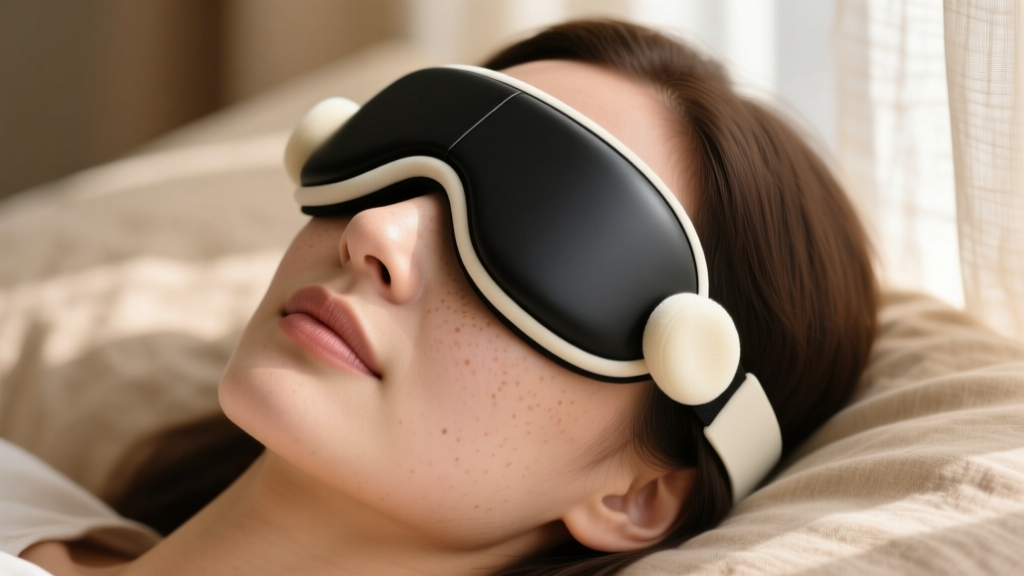
- Blackout Rating: 100% light blockage, tested effective against ambient room light up to 400 lux.
- Design: The 'Mini' version features a thinner, 0.25-inch strap that won't tangle in long hair or cause tension headaches.
- Material: Breathable modal fabric that prevents the periorbital skin from overheating.
Even a brief exposure to a smartphone screen or a streetlight shining through a window gap can suppress melatonin production by up to 50%. Total physical blackout is non-negotiable for optimal circadian health. — Sleep Foundation, Light & Sleep Guidelines
3. Biometric Tracking: Xiaomi Smart Band 9 ($49.00)
While the Oura Ring and Whoop strap dominate the premium tracking space, the Xiaomi Smart Band 9 offers astonishingly accurate sleep staging for under $50. It utilizes an upgraded PPG (photoplethysmography) sensor to track heart rate variability (HRV) and blood oxygen (SpO2) throughout the night.
- Accuracy: SpO2 tracking variance is within 1% of clinical pulse oximeters during rest.
- App Integration: The Mi Fitness app provides a 'Sleep Animal' assessment and actionable advice based on your deep-to-REM sleep ratios.
- Battery Life: Up to 21 days on a single charge, eliminating the 'sleep tracker charging anxiety' that plagues users of premium devices.
Expert Insight: Use the band's 'Sleep Breathing Quality' feature. If it detects frequent SpO2 drops below 90%, it may indicate mild sleep apnea, providing you with concrete data to take to a sleep specialist.
4. Circadian Lighting: Totobay Sunrise Alarm ($29.99)
Waking up to a blaring audio alarm triggers a sudden spike in adrenaline and cortisol, leaving you groggy (sleep inertia). A sunrise alarm mimics dawn, signaling your suprachiasmatic nucleus to halt melatonin production and gently initiate the cortisol awakening response.
- Light Output: Peaks at 2,500 lux at a 12-inch distance. (While natural sunlight is 10,000+ lux, 2,500 lux at close proximity is clinically sufficient to trigger circadian wakefulness).
- Customization: 10 to 60-minute adjustable sunrise simulation.
- Audio Backup: Includes 7 natural wake-up sounds (birds, ocean, piano) if light alone isn't enough.
The 'Sub-$100 Sleep Sanctuary' Protocol
Owning the best sleep gadgets is only half the battle; stacking them correctly is where the magic happens. Here is a practical, actionable evening protocol utilizing the budget gadgets listed above:
- 8:30 PM (Circadian Wind-Down): Turn off overhead LEDs. Switch the Totobay alarm to its 'Sunset Mode,' which fades from warm amber to dark red over 45 minutes.
- 9:45 PM (Acoustic Shielding): Power on the LectroFan Evo. Set it to Brown Noise at roughly 45 dB (just loud enough to drown out household creaks, but quiet enough to be soothing).
- 10:15 PM (Sensory Deprivation): Put on the Manta Sleep Mini. Adjust the eye cups so you can blink freely without your lashes touching the foam.
- 6:30 AM (Biological Wake-Up): The Totobay begins its 30-minute sunrise simulation. The Xiaomi Band 9 detects your transition from deep sleep to light sleep and records your wake time, ensuring you don't wake up mid-cycle.
Frequently Asked Questions (FAQ)
Can I just use my smartphone for white noise and sunrise alarms?
While possible, it is highly discouraged. Using your phone as a sleep gadget introduces blue light exposure right before bed and keeps notifications within arm's reach, increasing the temptation to 'doomscroll.' Dedicated, single-purpose gadgets remove the cognitive friction and screen-time risks associated with smartphones.
Do budget sleep trackers actually help improve sleep?
Trackers themselves do not improve sleep; they provide the data required to change your habits. As noted by the CDC's sleep guidelines, adults need consistent sleep durations. A budget tracker like the Xiaomi Band 9 helps you identify if your late-night caffeine intake or alcohol consumption is actively destroying your deep sleep metrics, allowing you to make informed lifestyle adjustments.
Is 2,500 lux from a budget sunrise alarm really enough?
Yes. Lux is a measure of illuminance as perceived by the human eye, and it follows the inverse-square law. While a premium $200 Philips Wake-Up Light might hit 10,000 lux at the bulb, placing a 2,500 lux budget lamp just 12 inches from your head delivers more than enough photon density to your retinas to halt melatonin production effectively.
Written by
Emma LarssonEmma Larsson holds an M.A. in International Relations from Sciences Po Paris and a B.A. in Communications from Stockholm University. A digital nomad since 2017, she has worked from over 45 countries across six continents, building deep expertise in portable power solutions, travel routers, compact computing, and connectivity gadgets that survive international travel. Emma is a certified member of the Travel Technology Association and has advised three travel gear startups on product-market fit for remote workers. Her reviews evaluate products against real travel scenarios — TSA compliance, voltage compatibility across 200+ countries, durability through 50+ checked bag cycles, and battery life under airplane mode vs. active use. She has been featured in Condé Nast Traveler's "Tech-Savvy Traveler" series and speaks at Remote Work Summit events.