Beginner vs Expert Tech Gadgets Men Upgrade to in 2026
Discover the ultimate beginner vs expert comparison of everyday carry tech gadgets men need in 2026, from high-CRI flashlights to MagnaCut multi-tools.
The EDC Divide: Why Most Guys Buy the Wrong Gear
When evaluating the best tech gadgets men actually carry daily, a distinct fault line emerges between entry-level purchases and enthusiast-grade equipment. Beginners typically optimize for price and brand recognition, resulting in gear that performs adequately in controlled environments but fails under sustained field use. Experts, conversely, optimize for specific metallurgical properties, thermal management, and protocol compatibility. The price gap between a beginner and expert everyday carry (EDC) loadout is rarely just about prestige; it reflects fundamental differences in component architecture. This guide breaks down three core EDC categories, contrasting entry-level staples with their expert-tier 2026 upgrades, detailing exactly where the extra capital yields measurable performance gains.
Illumination: Pocket Dump Flashlights vs. High-CRI Enthusiast Emitters
The most common mistake in beginner EDC lighting is chasing maximum lumen output while ignoring Color Rendering Index (CRI) and thermal regulation. A beginner flashlight might blast 2,000 lumens for 45 seconds before thermal step-down reduces output to a dim 300 lumens. Expert lights utilize advanced drivers and high-CRI LEDs to prioritize usable, color-accurate light over raw, unsustainable output.
| Specification | Beginner: Sofirn SC31 Pro ($30) | Expert: Emisar D4SV2 ($95) |
|---|---|---|
| LED Emitter | Cree XHP50.2 (Cool White, 6500K) | Nichia 519A (Neutral White, 4000K) |
| CRI Rating | ~70 CRI (Washes out colors) | 90+ CRI (True color rendering) |
| Driver Architecture | Basic buck converter | 7135+FET with NarsilMCU firmware |
| Thermal Management | Aluminum body, aggressive step-down | Copper/Titanium, sustained high output |

Real-World Failure Modes
Entry-level flashlights frequently suffer from 'parasitic drain' when left in a bag for weeks, due to poorly isolated tail-cap switches. The Emisar D4SV2 mitigates this via an electronic lockout function (three rapid clicks) and a physical disconnect by slightly loosening the tailcap. Furthermore, expert lights allow users to customize the UI ramping and thermal ceiling via the BudgetLightForum community-developed NarsilMCU firmware, preventing the sudden, blinding step-downs characteristic of beginner models.
Multi-Tools: Magnetic Flippers vs. MagnaCut Titanium Powerhouses
The multi-tool market has shifted dramatically. While beginners still default to legacy stainless steels that rust and chip, experts have moved to powdered metallurgy super-steels. According to comprehensive testing by Wired's EDC experts, the cutting edge retention of modern multi-tools is now dictated by carbide volume and matrix toughness.
Steel Metallurgy: 420HC vs. CPM MagnaCut
The beginner standard, Leatherman's legacy 420HC or even 154CM steel, requires frequent sharpening and is prone to micro-chipping when cutting abrasive materials like zip-ties or heavy cardboard. The expert upgrade, the Leatherman ARC ($229), utilizes CPM MagnaCut. Developed specifically for knife applications, MagnaCut eliminates chromium carbides in favor of vanadium and niobium carbides. This microstructural shift yields the edge retention of a high-wear steel like S90V, but with the toughness of a shock-resistant steel like 4V.
"The transition to MagnaCut in premium multi-tools means you can cut through 500+ linear feet of heavy-duty packing tape before noticing any degradation in slicing performance, a feat impossible with standard 420HC blades."
— BladeForums Metallurgy Consensus, 2025
Hardware and Tolerances
Beyond the blade, the ARC features titanium handles and an interchangeable bit driver with a magnetic hex bit retention system. Beginner tools rely on friction-fit bit holders, which strip out and lose bits over time. The expert tier integrates Neodymium magnets in the bit driver, ensuring zero bit loss during overhead or inverted use.
Power Delivery: Lipstick Batteries vs. Transparent GaN Smart Chargers
Portable power is where the gap between novice and expert gear is most financially quantifiable. Beginners buy 10,000mAh 'lipstick' power banks that charge a phone once but cannot output enough wattage to sustain a laptop under load. Experts invest in bidirectional, high-wattage GaN (Gallium Nitride) power stations with telemetry.
Beginner: Anker Nano 10K ($35)
- Capacity: 10,000mAh (36Wh)
- Max Output: 20W (USB-C PD3.0)
- Limitation: Cannot charge laptops; trickle-charges tablets; lacks pass-through telemetry.
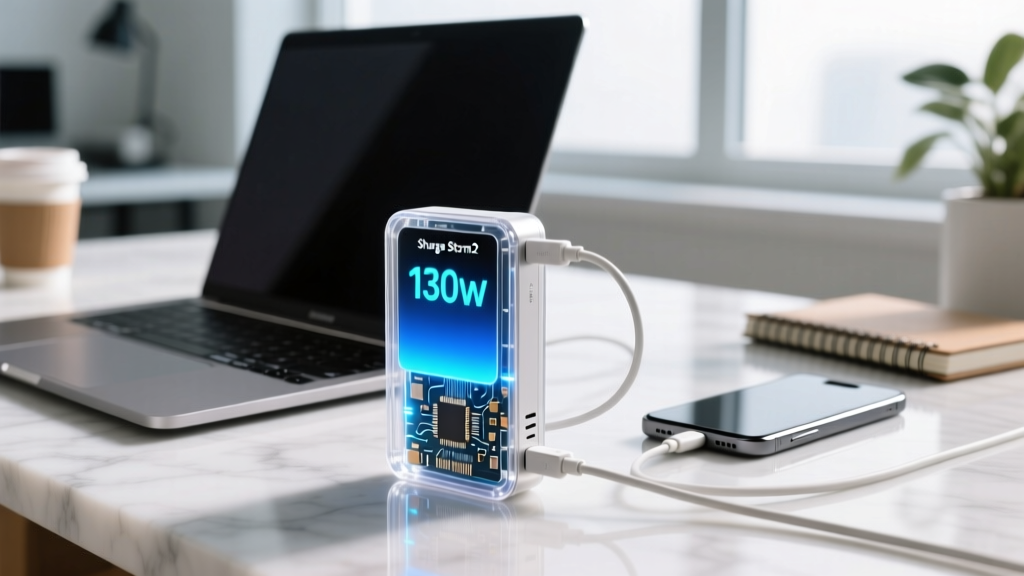
Expert: Sharge Storm2 130W ($149)
- Capacity: 25,600mAh (93.5Wh - Flight Safe)
- Max Output: 130W (USB-C PD3.1)
- Advantage: IPS display showing real-time voltage/amperage; charges a 16-inch laptop at full speed.
The critical differentiator here is the USB Power Delivery protocol. As detailed in CNET's portable power guides, PD3.0 caps out at 100W (and practically 20W-30W for budget banks). The expert-tier Sharge Storm2 utilizes the newer PD3.1 standard, enabling 130W output. This specific wattage threshold is vital: it allows a 16-inch MacBook Pro or high-end Windows workstation to run complex rendering tasks without draining the internal battery, effectively turning the power bank into an active UPS (Uninterruptible Power Supply) rather than a passive trickle-charger.
The Upgrade Decision Framework
Do not blindly buy expert gear if your use case does not demand it. Use this decision matrix to allocate your EDC budget effectively:
- If you work in an office and only need to open boxes: Stick to the beginner multi-tool. The 420HC steel is perfectly adequate for tape and zip-ties, and the $150 savings can be reallocated.
- If you do field work, automotive repair, or electrical diagnostics: Upgrade the flashlight immediately. The 90+ CRI of the Nichia 519A is a safety requirement for accurately identifying color-coded wiring and distinguishing between oil, coolant, and water leaks in low light.
- If you travel for work with high-performance laptops: The beginner power bank is dead weight. Upgrade to a PD3.1 130W GaN bank to ensure your workstation remains operational during transit and in airports lacking wall outlets.
Frequently Asked Questions
Is a 2,000-lumen beginner flashlight actually useless?
Not useless, but highly inefficient. A beginner 2,000-lumen light will generate massive heat due to poor thermal mass and basic drivers, forcing the firmware to step the output down to 400 lumens within a minute to prevent the LED from burning out. An expert light with a copper core and FET driver will sustain 1,200+ lumens for the duration of the battery's high-drain cycle.
Will MagnaCut steel rust in my pocket?
CPM MagnaCut is highly corrosion-resistant, outperforming standard 420HC in salt-spray tests. However, it is not entirely impervious. If you work in marine environments or handle highly acidic materials, you should still wipe the blade down with a silicone cloth weekly. For absolute zero-maintenance rust immunity, experts look to H1 or LC200N nitrogen-based steels, though these sacrifice some edge retention compared to MagnaCut.
Can I take a 25,600mAh power bank on an airplane?
Yes. The FAA and IATA restrict lithium-ion batteries to 100 Watt-hours (Wh) for carry-on luggage without airline approval. The expert Sharge Storm2 sits at 93.5Wh, specifically engineered to maximize capacity while remaining strictly legal for global air travel. Always keep these banks in your carry-on; they are strictly prohibited in checked luggage due to thermal runaway risks in the unmonitored cargo hold.
Written by
David OkaforDavid Okafor is an ASE (Automotive Service Excellence) Master Certified Technician with 15 years of professional experience in vehicle diagnostics, aftermarket electronics installation, and fleet management. He holds an Associate Degree in Automotive Technology from Universal Technical Institute and certifications in mobile electronics (MECP Certified Installer). David has installed and reviewed over 800 car tech products — from OBD2 scanners and dash cams to full infotainment system retrofits — in vehicles ranging from economy compacts to luxury SUVs. His popular YouTube channel "AutoTech David" has over 150,000 subscribers and features detailed installation tutorials and product teardowns. He is a regular contributor to the SEMA Show's aftermarket technology showcase and advises two automotive tech startups on product development.