Top Gadgets for Musicians in 2026: Studio & Stage Buyer's Guide
Discover the best gadgets for musicians in 2026. Our buyer's guide covers audio interfaces, MIDI controllers, field recorders, and stage monitoring.
The Modern Musician's Tech Stack
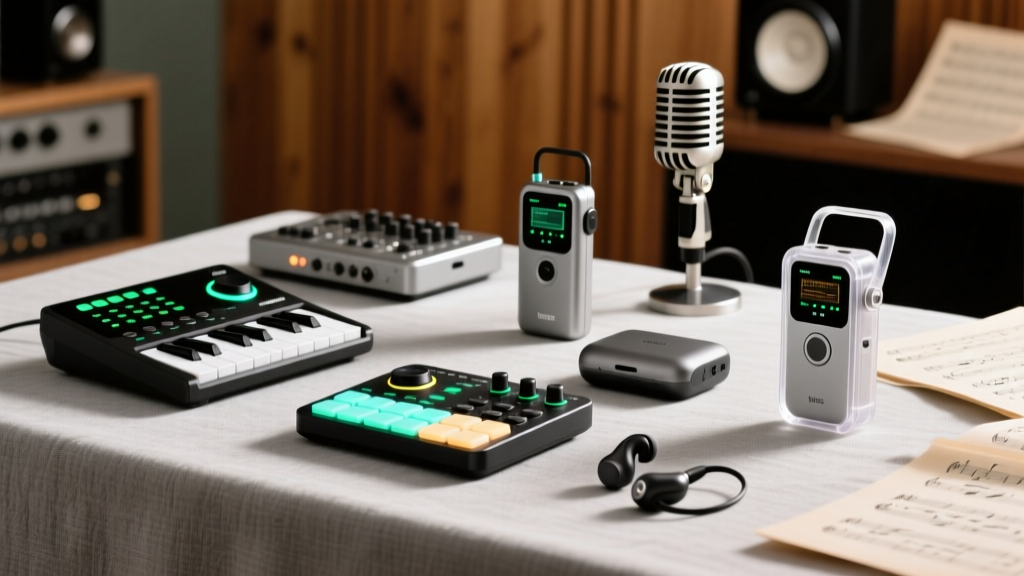
Building a reliable hardware ecosystem requires moving beyond generic recommendations and understanding the precise technical bottlenecks in digital audio workflows. In 2026, the demarcation between studio production and live performance has dissolved; the gadgets for musicians must now handle high-channel-count DSP processing, ultra-low latency monitoring, and rigorous RF coordination simultaneously. This guide dissects the current market's most critical hardware categories, focusing on exact specifications, failure modes, and practical deployment strategies for working professionals.
Core Audio Interfaces & DSP Hubs
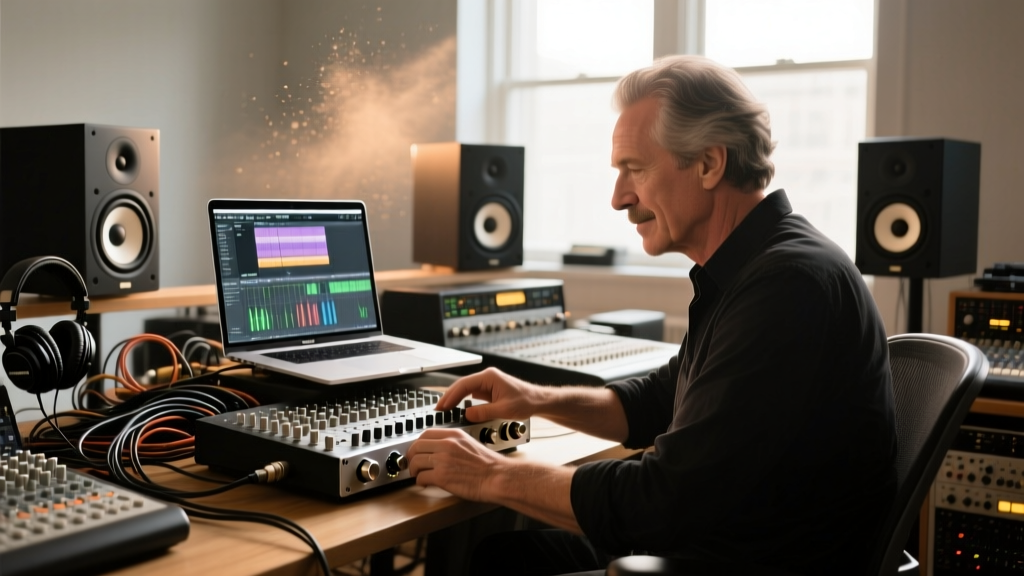
The audio interface remains the central nervous system of any rig. The primary decision point in 2026 is whether to offload processing to native CPU cores or rely on dedicated DSP chips. The Universal Audio Apollo x4 ($1,999) utilizes UAD-2 Quad Core processing to run near-zero latency Unison preamp emulations and console-grade compressors. This is critical for tracking vocalists who require zero-latency compression in their headphones, a feat that native processing struggles to achieve below a 64-sample buffer at 96kHz.
Conversely, if your workflow demands absolute phase coherence and ultra-low jitter for complex drum miking or classical ensemble recording, the RME Babyface Pro FS ($899) is the superior choice. It features RME's SteadyClock FS technology, which reduces jitter to femtosecond levels (12ns measured), ensuring pristine AD/DA conversion that outperforms interfaces costing three times as much. However, it lacks onboard DSP, meaning all monitoring effects must be handled by your DAW or a separate hardware mixer.
Interface Selection Decision Matrix
| Model | AD/DA Conversion | DSP Architecture | Preamp Topology | Optimal Use Case |
|---|---|---|---|---|
| Universal Audio Apollo x4 | ESS Sabre (127 dB DNR) | UAD-2 Quad Core | Unison (Variable Impedance) | Vocal tracking, mix-ready stems |
| RME Babyface Pro FS | Custom AKM (115 dB DNR) | None (FPGA Routing) | Discrete Class-A | Acoustic ensembles, live playback |
| MOTU 828es | ESS Sabre (123 dB DNR) | None (CueMix DSP) | Standard Transformerless | High I/O count studio routing |
Smart MIDI Controllers & Expressive Instruments
Standard 88-key weighted controllers are insufficient for modern cinematic scoring and sound design, which demand continuous multidimensional control. MIDI Polyphonic Expression (MPE) allows individual notes to transmit independent pitch bend, timbre, and pressure data. The MIDI Association's official MPE specification has driven a new generation of expressive hardware.
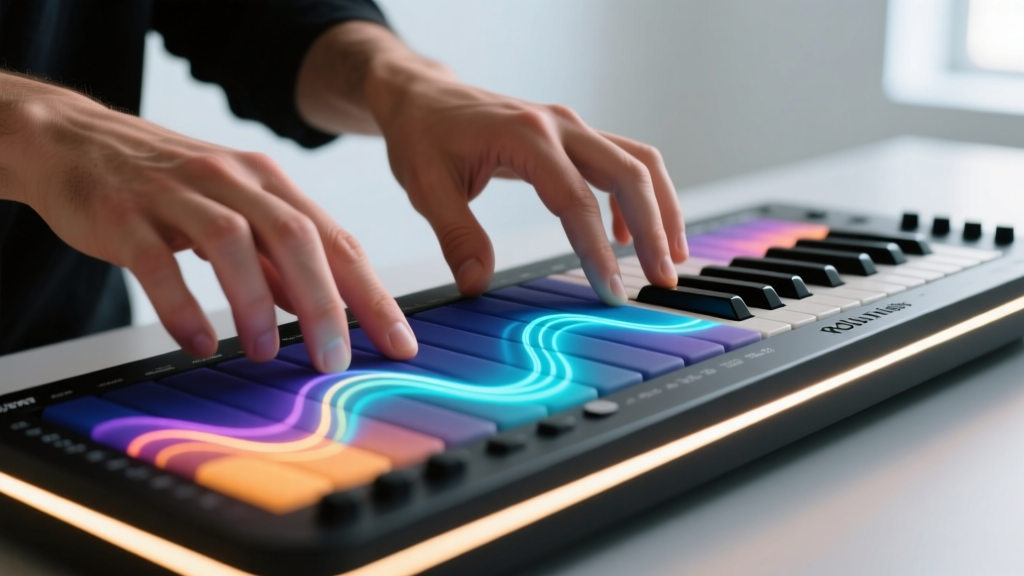
The ROLI Seaboard RISE 2 49-key ($899) replaces traditional keys with a continuous silicone 'Keywave' surface. It captures five dimensions of touch: strike, press, glide, slide, and lift. When mapped to a wavetable synthesizer like Serum or Pigments, sliding your finger laterally across a held chord can smoothly morph the wavetable position for each note independently—a physical impossibility on a standard modulation wheel. For producers who require traditional hammer-action keys but still want aftertouch and deep DAW integration, the Arturia KeyLab 88 MkII ($999) offers a Fatar TP/100LR keybed and a dedicated CV/Gate output for bridging digital and modular analog environments.
Expert Insight: When using MPE controllers, ensure your DAW's MIDI routing is set to 'MPE Mode' rather than standard multi-channel. Failing to do so will result in overlapping pitch-bend data that causes severe detuning artifacts across all simultaneous notes.
Portable Field Recorders: The 32-Bit Float Revolution
For location recording, podcasting, and sound effects gathering, 32-bit float recording has rendered traditional analog gain staging obsolete. Traditional 24-bit audio offers a theoretical dynamic range of 144 dB. If a transient exceeds 0 dBFS, it clips and distorts permanently. 32-bit float mapping provides a theoretical dynamic range exceeding 1,500 dB. Practically, this means you can record a quiet room tone and a sudden, deafening explosion on the same track without adjusting the input gain knob, and normalize the audio in post-production without introducing digital clipping or raising the noise floor.
The Zoom F6 ($649) is a 6-input 32-bit float field recorder that fits in a jacket pocket. It utilizes dual AD converters per channel, capturing both high and low gain signals simultaneously and merging them into a single 32-bit file. The Sound Devices MixPre-3 II ($799) offers similar 32-bit float capabilities but pairs them with Sound Devices' legendary Kashmir microphone preamps, providing a slightly lower analog noise floor (-130 dBu EIN) which is critical when using low-output ribbon microphones in the field.
Recording six channels of 32-bit float audio at 192kHz generates roughly 138 MB per minute. Standard SD cards will drop frames and corrupt files. You must use V90-rated SDXC cards (minimum 90 MB/s sustained write speed) or record directly to an external SSD via the F6's USB-C port to prevent catastrophic data loss during critical takes.
Stage Monitoring & Wireless IEM Systems
The RF spectrum in 2026 is heavily congested due to expanded 5G and early 6G cellular deployments. Musicians relying on older wireless in-ear monitors (IEMs) operating in the deprecated 600 MHz band frequently experience audio dropouts and intermodulation distortion. Professional touring now mandates narrowband UHF tuning and active RF coordination.
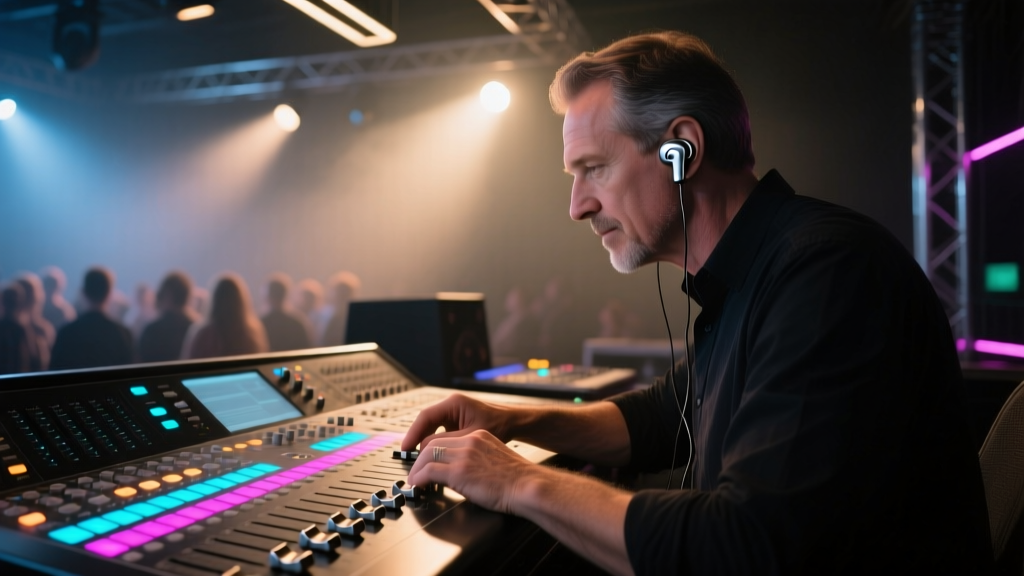
The Shure PSM1000 Twin Transmitter system ($1,399 per bodypack) operates in the UHF band and features a 24-bit digital audio path with a 240 kHz tuning bandwidth. The 'Twin' transmitter design allows a single rack unit to broadcast two separate stereo mixes, saving crucial rack space on tour. To ensure reliable operation, engineers must utilize Shure's wireless frequency coordination guide and software to scan the local RF environment before every show, selecting clean, intermodulation-free frequencies that avoid local TV broadcasts and cellular towers.
Budget Allocation Frameworks
Hardware investments should be weighted toward the points where analog signals are converted to digital, and where the human interface meets the machine. Avoid overspending on cables or acoustic treatments before securing your core conversion and monitoring.
The $2,500 Core Rig
- Interface: RME Babyface Pro FS ($899) - Prioritizing pristine conversion and routing stability.
- Controller: Arturia KeyLab Essential 88 ($399) - Balancing keybed feel with DAW control.
- Monitoring: Audio-Technica ATH-M50x headphones ($149) and a pair of Kali Audio LP-6 V2 monitors ($498).
- Microphone: Shure SM7B dynamic mic ($399) paired with a Cloudlifter CL-1 ($149) for clean gain.
The $7,000 Professional Touring & Studio Rig
- Interface/DSP: Universal Audio Apollo x8p ($3,499) - Maximum I/O and heavy UAD DSP for tracking bands.
- Expressive MIDI: ROLI Seaboard RISE 2 49-key ($899) for cinematic sound design.
- Field Recording: Zoom F6 ($649) plus a Sennheiser MKH 416 shotgun mic ($1,199) for pristine location capture.
- Live IEMs: Shure PSM300 Twin Pack ($1,199) for reliable wireless stage monitoring.
Frequently Asked Questions
Do I need a 32-bit float recorder if I only record in a treated studio?
No. 32-bit float is primarily a safety net for unpredictable live environments and field recording where you cannot control the dynamic range of the source. In a treated studio with a trained vocalist, a high-quality 24-bit interface with proper analog gain staging (like the Apollo x4) will yield identical, if not slightly cleaner, results due to the optimized analog front-end.
Can I use standard Bluetooth headphones for mixing?
Bluetooth headphones introduce latency, apply proprietary EQ curves, and utilize lossy codecs (like AAC or SBC) that alter phase relationships and high-frequency transients. For critical mixing and mastering, you must use wired, open-back reference headphones (such as the Sennheiser HD600) or wired studio monitors to ensure translation across consumer playback systems.
Written by
Nina PetrovaNina Petrova holds a Master's degree in Child Development from the Erikson Institute and a B.S. in Nursing from the University of Illinois at Chicago. She worked as a pediatric nurse for 6 years before transitioning to family technology consulting, bringing clinical rigor to her evaluations of kid-friendly gadgets, educational toys, and parental control software. Nina has reviewed over 400 children's tech products, testing each for safety compliance (CPSC and ASTM standards), developmental appropriateness across age groups, screen-time impact, and data privacy practices. She serves on the Children's Technology Review advisory board and has testified before the FTC on children's data protection in connected toys. Her reviews are trusted by parents and educators alike for their evidence-based approach to balancing technology benefits with child safety.