Great Golf Gadgets in 2026: Beginner vs Expert Buying Guide
Discover the best great golf gadgets for your skill level. We compare beginner-friendly GPS watches to expert-tier swing analyzers and laser rangefinders.
The Skill-Level Divide in Golf Technology
When shopping for great golf gadgets, the most expensive option is rarely the best choice for your current game. The golf technology market in 2026 is more saturated than ever, offering everything from $50 swing tempo trainers to $15,000 commercial launch monitors. However, a gadget's value is entirely dependent on the user's ability to interpret and act upon the data it provides.
A 20-handicap beginner does not need to know their exact spin-axis tilt; they need to know how far they actually hit a 7-iron. Conversely, a scratch golfer looking to shave off their final two strokes requires granular dispersion patterns and stroke-gained analytics. This guide breaks down the best golf gadgets across three major categories—distance finding, swing analytics, and launch monitors—contrasting the ideal tools for beginners against those demanded by experts.
Distance & Navigation: Finding the Fairway
Knowing your exact yardage is the foundation of course management. But how you acquire that data should scale with your ball-striking consistency.
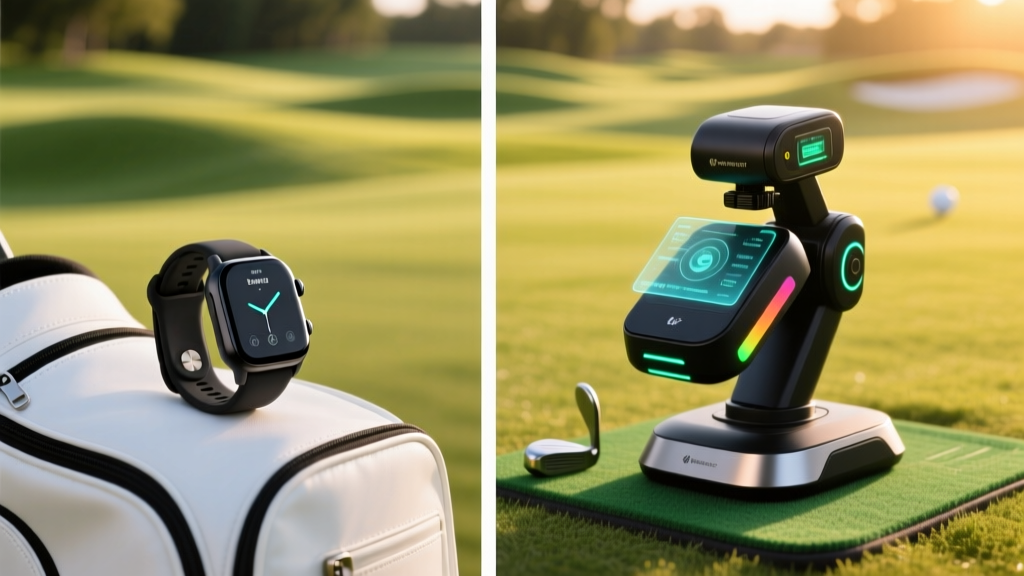
Beginner Pick: Garmin Approach S44 GPS Watch ($349)
For the developing golfer, a GPS watch is superior to a laser rangefinder. Beginners often struggle to identify the exact pin position or accidentally shoot lasers at trees behind the green. The Garmin Approach S44 provides reliable front, middle, and back distances to the green, which is all a high-handicapper needs to select a club. According to Golf Digest's 2026 GPS watch roundup, the S44's bright AMOLED display and straightforward interface prevent the slow-play penalties often caused by fumbling with complex optics.
- Key Metric: Front/Center/Back yardages.
- Why it works: Removes the guesswork of blind doglegs and hidden hazards without requiring a steady hand.
Expert Pick: Bushnell Pro XE Jolt Slope ($599.99)
Experts know their baseline distances; what they need is environmental adjustment. The Bushnell Pro XE Jolt features Slope-Switch technology, calculating the elevation-adjusted distance. If a low-handicapper is hitting a 155-yard shot that plays 10 yards uphill, the Pro XE tells them to play 165 yards. Furthermore, the Visual Jolt and PinSeeker technology ensure the laser has actually locked onto the flagstick, not the hazard behind it.
| Feature | Beginner Needs (GPS Watch) | Expert Needs (Slope Laser) |
|---|---|---|
| Primary Goal | General green proximity & hazard avoidance | Precise pin location & elevation adjustment |
| Data Overload | Low (Simple yardages) | High (Slope, wind, exact pin yardage) |
| Required Skill | Basic course awareness | Steady hands & knowledge of personal carry gaps |
| Price Range | $200 - $350 | $450 - $650 |
Swing Analytics & On-Course Tracking: Fixing the Flaws
Tracking your performance is where the gap between novice and expert gadgetry becomes most pronounced. The wrong data can actually cause a beginner to overthink and develop the dreaded "swing paralysis."
Beginner: Blast Motion Golf Swing Analyzer ($149.99)
Beginners need immediate, actionable feedback on fundamental mechanics, not a spreadsheet of 40 different data points. The Blast Motion sensor attaches to the grip of your club and measures tempo, face rotation, and attack angle. It uses AI-driven video analysis to overlay your swing metrics onto smartphone footage. If a beginner is slicing the ball, Blast Motion will quickly reveal if they are over-the-top or leaving the clubface open, providing specific drills to fix the root cause.
Expert: Arccos Caddie Smart Sensors + AI App ($249.99/year + hardware)
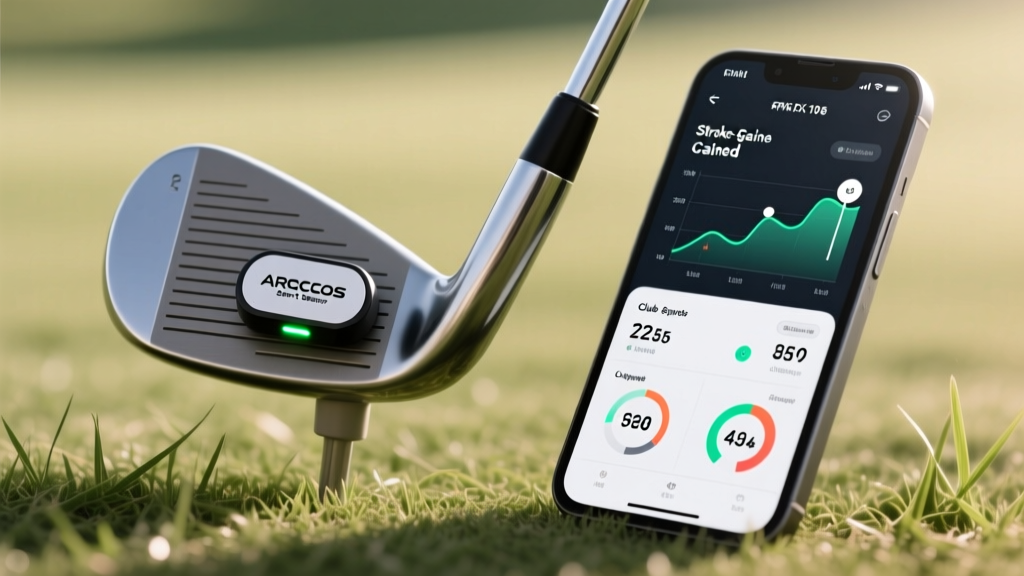
Experts don't need to fix their swing on the first tee; they need to manage their game over 18 holes. Arccos uses 14 ultralight sensors screwed into the grips of your clubs, paired with a smartphone or the Arccos Link, to track every shot via GPS. As highlighted by MyGolfSpy's analytics testing, the true power of Arccos lies in its Strokes Gained algorithm. It tells a scratch golfer exactly where they are losing shots to a PGA Tour benchmark (e.g., losing 1.2 strokes on the green from 8-16 feet) and uses AI to suggest aggressive or conservative club selections based on their historical dispersion patterns.
"Data without context is just noise. A beginner needs actionable mechanical corrections, while an expert needs granular dispersion patterns and strokes-gained analytics to optimize course strategy."
Launch Monitors: The Ultimate Data Dive
Launch monitors have transitioned from tour-only trailers to portable backyard units. However, the radar and photometric technologies used dictate who should buy them.
Beginner/Intermediate: Rapsodo MLM2PRO ($699)
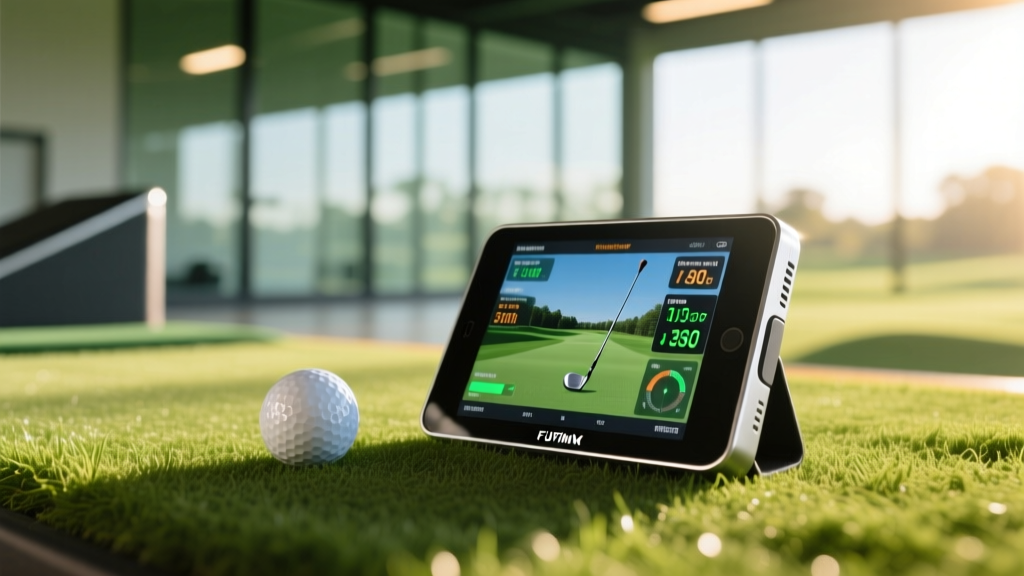
The MLM2PRO uses a combination of Doppler radar and dual-camera vision to provide 13 metrics, including club path and face-to-path. For the mid-to-high handicapper, this is the sweet spot. It provides enough data to understand why a ball hooked or sliced, and the built-in simulation software (via iPad) makes winter practice engaging. The critical failure mode for cheaper radar units is indoor spin-rate inaccuracy; the MLM2PRO solves this with its vision-based spin measurement, making it highly reliable for garage setups.
Expert: FlightScope Mevo+ 2023 Edition ($2,250+)
Low-handicappers and club-fitters require absolute precision on spin axis, smash factor, and angle of attack. The Mevo+ uses 3D Doppler radar to track the ball and clubhead simultaneously. While it requires more space (about 8 feet behind the ball) to read accurately, the data fidelity is tour-level. Experts use this to dial in exact yardage gaps, test different shaft profiles, and measure the precise launch window required to carry a 220-yard water hazard.
Decision Matrix: Where Should You Invest Your Budget?
Use this framework to allocate your gadget budget based on your current handicap index.
- Handicap 15+ (Beginner): Invest 70% in GPS/Navigation and basic tempo trainers. Ignore slope lasers and high-end launch monitors. Focus on finding the green and developing a repeatable tempo.
- Handicap 8-14 (Intermediate): Invest in a mid-tier launch monitor (like the Rapsodo) and upgrade to a slope-enabled laser rangefinder. Start tracking your on-course stats to identify your weakest facet (driving vs. putting).
- Handicap 0-7 (Expert): Invest heavily in Strokes Gained tracking (Arccos) and premium launch monitors. Your margins for improvement are razor-thin; you need data that highlights micro-inefficiencies in your wedge game or putter face control.
Frequently Asked Questions (FAQ)
Do beginners need slope technology in a rangefinder?
No. Beginners rarely have a consistent enough strike to take advantage of a 3-yard elevation adjustment. Furthermore, slope technology is illegal in tournament play unless the feature is physically disabled. Beginners are better served by a reliable, non-slope laser or a GPS watch to speed up play.
Are swing analyzers worth it for high handicappers?
Yes, but only if they provide video integration. Gadgets like the Blast Motion are excellent because they pair mechanical data with video. A high-handicapper won't understand what "-4 degrees attack angle" means, but seeing their swing on video with a graphical overlay makes the flaw immediately obvious.
Can I use my smartwatch instead of a dedicated golf GPS?
While an Apple Watch or Garmin Fenix can download third-party golf apps, dedicated golf watches like the Garmin Approach series offer superior battery life (crucial for 36-hole weekend trips) and specialized features like PlaysLike distance and virtual caddie club recommendations that general smartwatches lack.
Written by
Lena ChenLena Chen earned her M.S. in Human-Computer Interaction from Carnegie Mellon University and a B.S. in Electrical Engineering from the University of Washington. She has spent the past decade specializing in smart home architecture and IoT ecosystems, helping over 200 homeowners design fully connected living spaces. Lena is a certified Matter protocol consultant and has published peer-reviewed research on voice-first interface design in the ACM Digital Library. Her reviews of smart home products combine deep technical analysis with real-world usability testing, evaluating everything from Zigbee mesh stability to Alexa skill responsiveness. She regularly speaks at CEDIA Expo and CES smart home panels.