Compact Cutting Boards: When Funny Kitchen Gadgets Actually Work
Discover how space-saving cutting boards and quirky surface tools prove that funny kitchen gadgets can actually solve micro-apartment layout problems.
The Spatial Paradox of Novelty Prep Tools
Standard galley kitchens typically offer just 36 to 48 inches of clearance between opposing counters, leaving minimal room for a standard 15-by-20-inch cutting board that consumes over 2 square feet of prime real estate. When outfitting micro-apartments or compact RV kitchens, home cooks often gravitate toward novelty items to inject personality into tight spaces. However, the graveyard of forgotten kitchenware is filled with single-use novelties. The real challenge in 2026 is identifying which funny kitchen gadgets actually deliver ergonomic utility without sacrificing blade integrity or food safety.
'A novelty kitchen tool only earns its drawer space if it solves a spatial or mechanical problem better than its traditional counterpart.' — Industrial Design Principle, Small Footprint Living
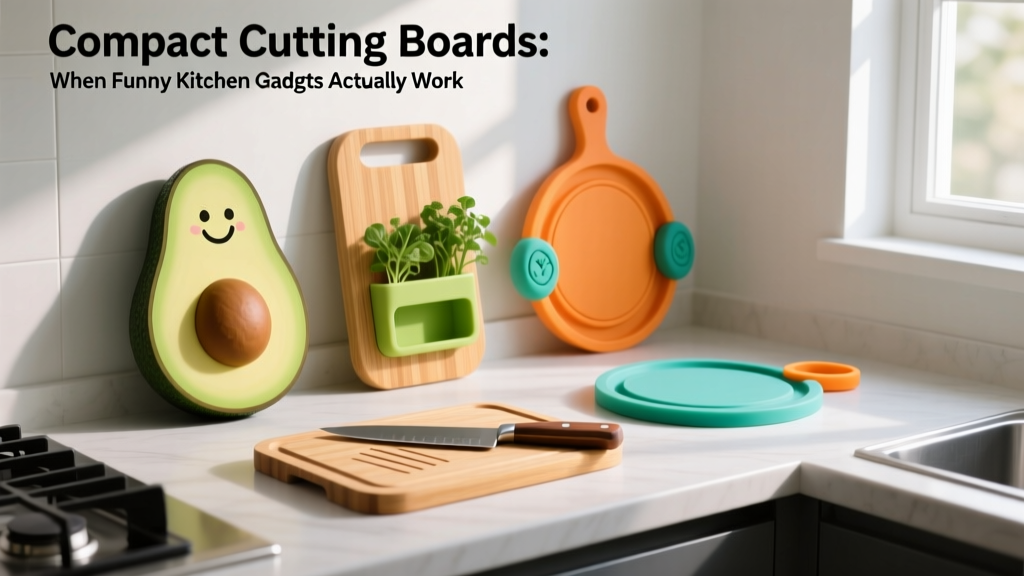
Fortunately, a new wave of space-saving cutting boards and surface tools merges humorous aesthetics with genuine compact-design engineering. Here is how to leverage quirky designs to maximize your prep area.
Over-the-Sink 'Creature' Boards: Zero-Counter Footprint
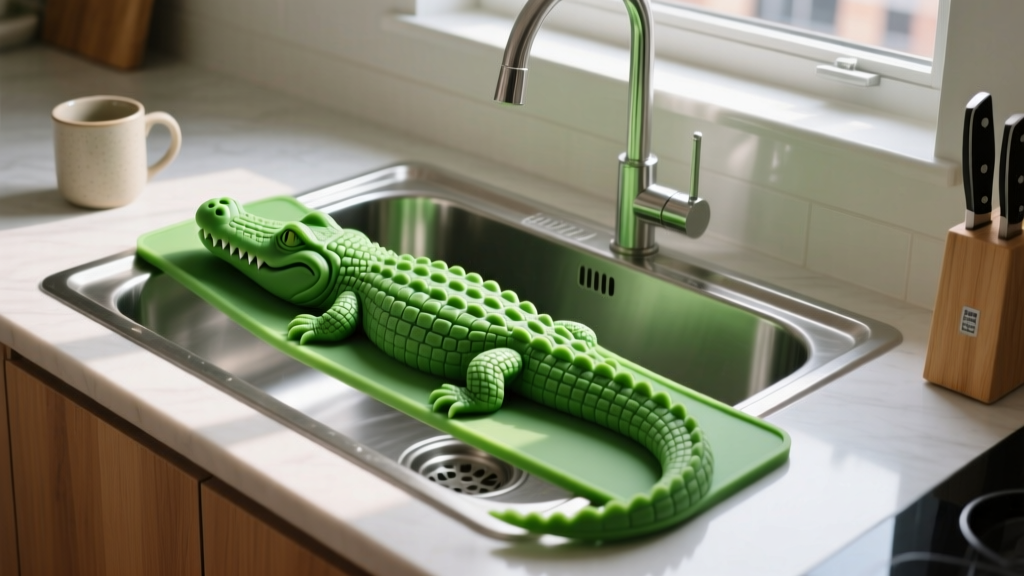
The most effective way to reclaim counter space is to stop using it entirely. Over-the-sink cutting boards span the basin, turning dead space into an active prep zone. While standard bamboo over-sink boards are purely utilitarian, brands like Fred & Friends and Ototo Design have popularized animal-shaped silicone and HDPE (high-density polyethylene) boards that double as sink strainers and splash guards.
Space-Saving Metrics: Over-the-Sink Boards
- Standard Sink Span: 22 to 30 inches (fits 90% of residential under-mount and drop-in sinks).
- Counter Space Reclaimed: 100% of the board's footprint (approx. 2.5 sq ft).
- Best Material: Injection-molded HDPE with a Shore D hardness of 60-65, ensuring it won't dull high-carbon steel knives while remaining rigid enough to span a 24-inch gap without bowing.
The humor in these 'creature' boards—such as crocodile snouts that act as vegetable scrap catchers or octopus tentacles that grip the sink rim—serves a mechanical purpose. The tentacle grips provide the necessary friction to prevent the board from sliding into the basin when applying downward knife pressure, a common failure point in flat, novelty acrylic boards.
Foldable and Modular: When Hinges Meet Humor
If you must store your board in a drawer or cabinet, rigid rectangles are inefficient. Foldable cutting boards, pioneered by the Joseph Joseph Chop2Pot, have spawned a variety of novelty offshoots. Some fold into the shape of a little house, while modular puzzle boards interlock to form whimsical animals when stored.
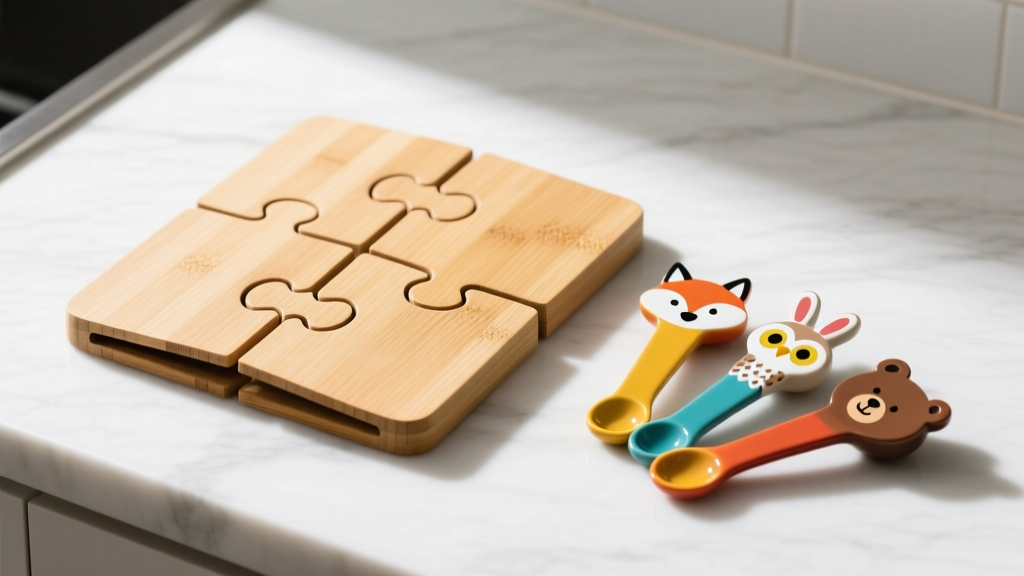
When evaluating folding novelty boards, the hinge mechanism is the critical point of failure. Cheap novelty boards use exposed metal pins that rust and harbor bacteria. Look for co-molded TPU (thermoplastic polyurethane) living hinges. According to FDA guidelines on cutting board sanitation, any crevice or hinge in a food-contact surface must be easily accessible for cleaning to prevent cross-contamination from raw poultry juices.
Compact Board Comparison Matrix
| Design Type | Storage Footprint | Knife Friendliness | Novelty/Utility Balance |
|---|---|---|---|
| Over-the-Sink Animal | Zero (spans sink) | High (HDPE/Silicone) | Excellent (catches scraps) |
| Puzzle Interlocking | 4x4 inches (stacked) | Medium (Bamboo seams) | Good (customizable size) |
| Roll-Up Silicone Mat | 2x15 inches (cylinder) | Low (requires sub-board) | Poor (slips during use) |
| Living-Hinge Foldable | 8x12 inches (folded) | High (TPU/PP blend) | Great (acts as chute) |
Surface Tools: Spatulas and Scrapers with Personality
Cutting boards do not work in isolation; they require bench scrapers, spatulas, and spoons. In a compact kitchen, tools that can sit on the counter without contaminating their working ends are essential. This is where funny kitchen gadgets truly shine in their utility.
Take the Dreamfarm Supoon, for example. Shaped vaguely like a cartoon character or a little person sitting up, its weighted handle and angled silicone head allow it to rest on any flat surface without the scraping bowl touching the counter. This eliminates the need for a spoon rest—a massive win for kitchens with less than 10 linear feet of counter space. Similarly, hedgehog-shaped bench scrapers with bristle-cleaners built into their 'spines' allow you to clean dough off your scraper without walking to the sink.
Material Science: Don't Let the Joke Ruin Your Knife
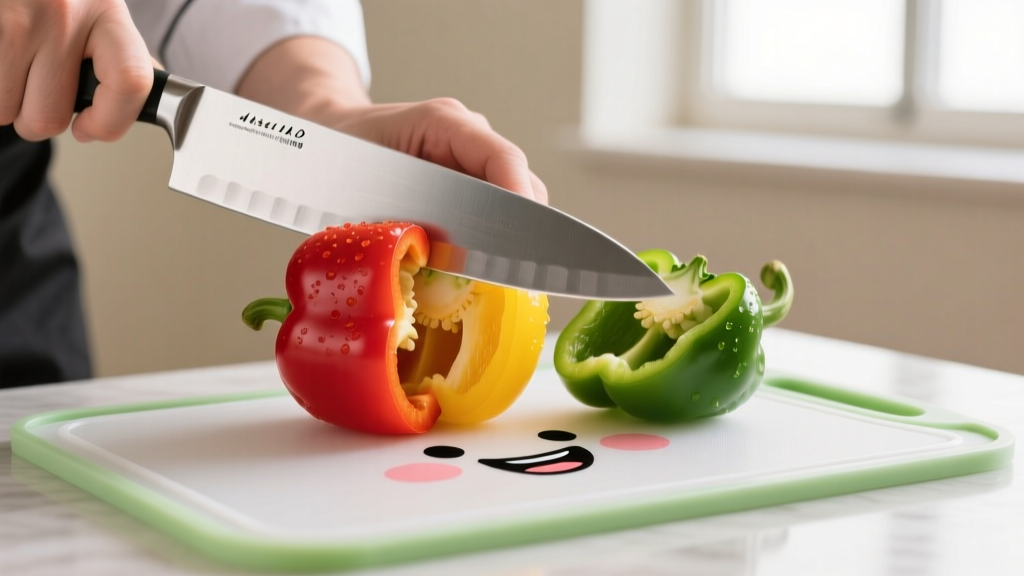
The biggest trap when buying novelty surface tools is prioritizing the visual gag over material science. Many funny kitchen gadgets are manufactured from tempered glass or hard acrylic because these materials accept high-resolution, dishwasher-safe novelty prints.
Never use a glass cutting board, regardless of how clever the printed design is. Glass has a Mohs hardness of 5.5 to 7, while high-carbon kitchen knives sit around 5.5 to 6.5. Cutting on glass will instantly roll or micro-chip your knife's edge. Stick to HDPE, TPU, or end-grain bamboo for novelty boards.
When shopping for printed or uniquely shaped boards, verify the material. Compact kitchen design experts often recommend flexible TPU mats with novelty prints. TPU is gentle on knife edges (Shore A hardness of 85-95) and can be rolled up or hung on a wall hook, turning the tool into temporary kitchen art when not in use.
Maintenance: Keeping Quirky Thin Boards Flat
Space-saving novelty boards are inherently thin—often 2mm to 4mm—to allow for folding or rolling. This thin profile makes them highly susceptible to thermal warping. If you wash a thin HDPE funny kitchen gadget in hot water and leave it to dry vertically, it will curl, rendering it useless for safe chopping.
- The Wet-Sandwich Fix: If your thin board warps, wet both sides evenly with warm water.
- Apply Pressure: Lay it flat on a counter and place a heavy cast-iron skillet or a stack of cookbooks on top.
- Wait 12 Hours: Let it dry completely under the weight. The polymer chains will reset to a flat state.
- Preventative Care: Always wash thin novelty boards in cool or lukewarm water, and store them flat or perfectly vertical in a dedicated rack slot.
Frequently Asked Questions
Can I put funny silicone cutting boards in the dishwasher?
Most food-grade silicone and HDPE novelty boards are top-rack dishwasher safe. However, the high heat of the dishwasher's drying cycle (often exceeding 150°F) can warp thin, space-saving boards. Hand washing with warm soapy water is recommended to maintain their structural flatness.
Do over-the-sink animal boards fit farmhouse sinks?
Farmhouse (apron-front) sinks often have wider, deeper basins ranging from 30 to 36 inches. Standard novelty over-the-sink boards usually max out at 24 inches. For farmhouse sinks, you will need to look for heavy-duty, extendable bamboo over-sink boards, which rarely feature novelty designs due to the weight requirements of spanning a 36-inch gap.
Are puzzle cutting boards sanitary for raw meat?
Puzzle or modular interlocking boards have seams that can trap raw meat juices. While they are excellent for dry prep work like chopping vegetables or kneading dough in a small space, they should not be used for raw poultry or pork unless the individual pieces are immediately disassembled and run through a high-heat dishwasher cycle.
Written by
Emma LarssonEmma Larsson holds an M.A. in International Relations from Sciences Po Paris and a B.A. in Communications from Stockholm University. A digital nomad since 2017, she has worked from over 45 countries across six continents, building deep expertise in portable power solutions, travel routers, compact computing, and connectivity gadgets that survive international travel. Emma is a certified member of the Travel Technology Association and has advised three travel gear startups on product-market fit for remote workers. Her reviews evaluate products against real travel scenarios — TSA compliance, voltage compatibility across 200+ countries, durability through 50+ checked bag cycles, and battery life under airplane mode vs. active use. She has been featured in Condé Nast Traveler's "Tech-Savvy Traveler" series and speaks at Remote Work Summit events.