Inexpensive Kitchen Gadgets: A Buyer's Guide to Bamboo & Wood Tools
Discover why bamboo and wood utensils are the best inexpensive kitchen gadgets. Compare materials, care tips, and top brands for your 2026 kitchen upgrade.
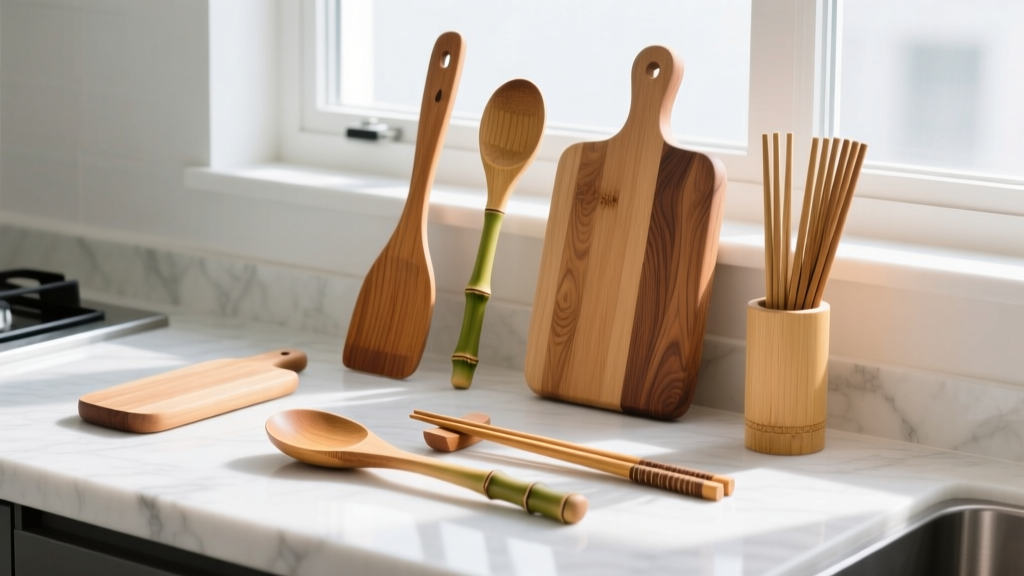
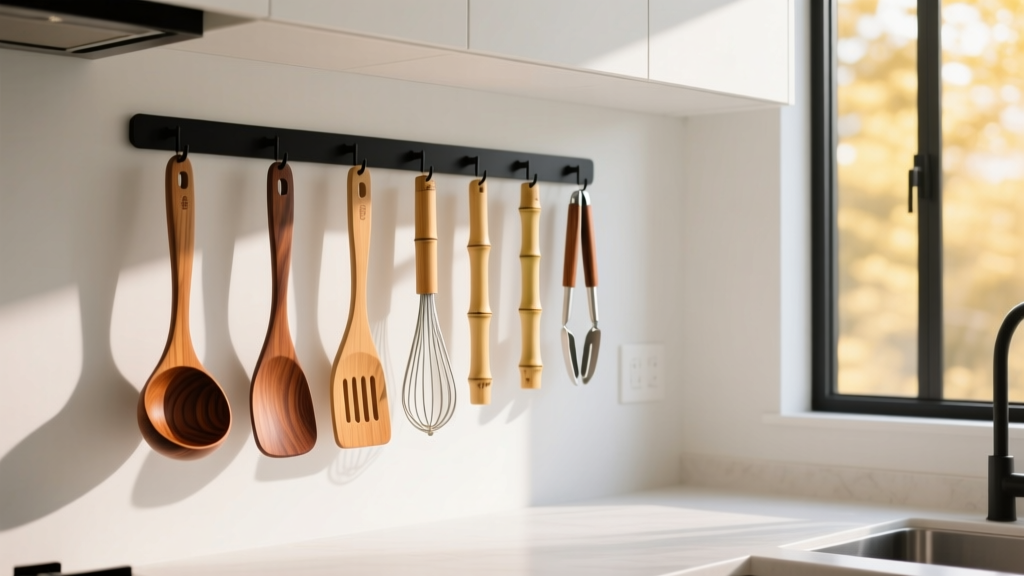
When outfitting a kitchen on a budget, home cooks often chase complex mechanical tools, overlooking the most durable, versatile, and heat-resistant implements available. While many inexpensive kitchen gadgets are manufactured from flimsy plastics, low-grade silicones, or thin stamped metals, wooden and bamboo utensils offer professional-grade performance at a fraction of the cost. A $12 teak spatula will outlast a $40 mechanical flipper, protect your expensive non-stick cookware, and resist bacterial colonization when properly maintained.
This comprehensive buyer’s guide breaks down the material science of wood and bamboo, identifies the highest-value utensil categories for 2026, and provides a precise maintenance framework to ensure your budget-friendly tools last for decades.
The Material Science: Hardwood vs. Bamboo
Not all wood is created equal. The longevity of a wooden utensil is dictated by its Janka hardness rating (resistance to denting and wear), grain porosity (bacterial resistance and moisture absorption), and natural oil content. Bamboo, technically a grass, offers a unique structural profile that makes it a dominant force in the budget utensil market.
| Material | Janka Hardness (lbf) | Grain Porosity | Price Range | Best Use Case |
|---|---|---|---|---|
| Teak | 1,000 - 1,155 | Low (Closed Grain) | $12 - $25 | High-heat sautéing, scraping fond |
| Olive Wood | 2,710 | Very Low | $15 - $35 | Serving, tossing salads, stirring |
| Beech | 1,300 | Medium (Open Grain) | $5 - $12 | General stirring, baking scrapers |
| Bamboo | 1,380 (Average) | Low (Fibrous) | $4 - $10 | Tossing, flipping, lightweight prep |
According to data from The Wood Database, olive wood is exceptionally hard but prone to cracking if subjected to rapid temperature changes. Teak remains the gold standard for cooking due to its high natural silica and oil content, which repels water without heavy chemical sealants. Bamboo is highly sustainable and remarkably stiff, but its fibrous nature means it can splinter if subjected to heavy lateral torque or dishwasher cycles.
Top Bamboo and Wood Utensil Categories to Buy
To maximize your return on investment when shopping for inexpensive kitchen gadgets, prioritize tools that leverage the unique thermal and structural properties of wood and bamboo.
1. The Thin-Edge Fish Spatula (Teak or Bamboo)
Metal fish spatulas are excellent, but they will gouge ceramic and PTFE non-stick coatings. A teak or bamboo fish spatula with a hand-carved beveled edge can slide under delicate proteins without damaging your $200 skillet. Look for brands like Earlywood or Kitchables, which offer teak spatulas in the $14–$18 range with edge thicknesses under 2mm.
2. The Seamless Stirring Spoon (Olive Wood or Beech)
Avoid wooden spoons with glued-on handles or decorative joints; these are failure points where water ingress causes bacterial growth and structural rot. Seek out single-piece, seamless stirring spoons. Le Creuset and OXO Good Grips offer excellent single-piece beech and olive wood options between $8 and $15.
3. Bamboo Cooking Tongs
While metal tongs are standard, bamboo cooking tongs provide superior grip on slippery foods (like noodles or wet vegetables) without crushing them. Because bamboo is lightweight, it reduces hand fatigue during extended prep sessions. Ensure the pivot point uses a rust-proof stainless steel rivet rather than a tension-bent bamboo hinge, which will snap after repeated exposure to heat and moisture.
Not all bamboo is eco-friendly or food-safe. Some ultra-cheap bamboo utensils imported in bulk use formaldehyde-based resins to bind the bamboo fibers. When purchasing bamboo, verify that the manufacturer explicitly states the use of food-safe, FDA-compliant adhesives. The FDA's guidance on Food Contact Substances outlines the safety requirements for materials intended for repeated food contact. Always buy from reputable brands that publish their material safety data.
The Maintenance Matrix: Making Cheap Tools Last a Decade
The primary reason wood and bamboo utensils fail is improper maintenance. Wood is hygroscopic; it absorbs and releases moisture based on ambient humidity and washing habits. When wood swells and shrinks repeatedly, the cellular structure fractures, leading to splintering and deep grain cracks.
The 3-Step Oiling Protocol
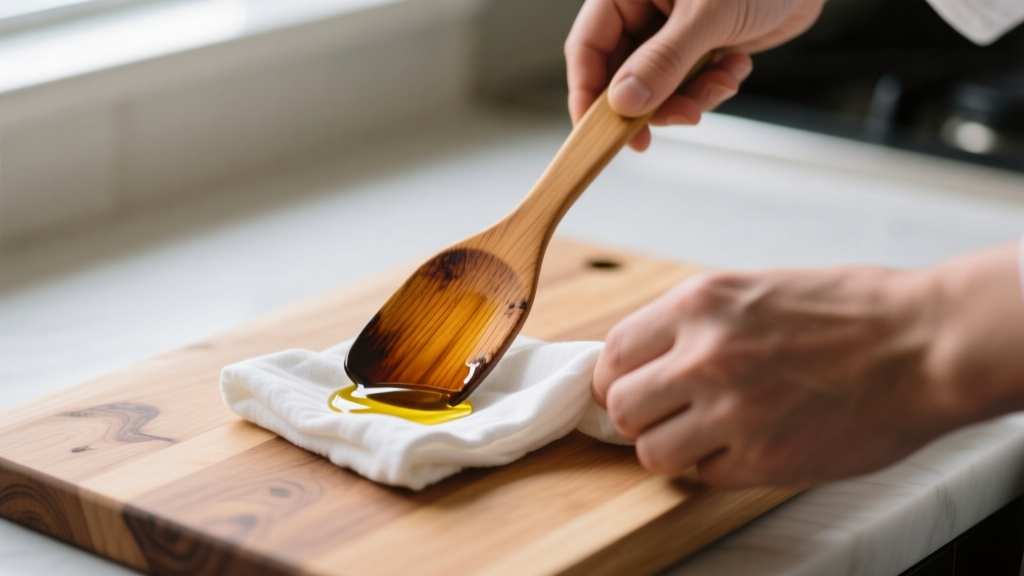
To stabilize the cellular structure, you must polymerize a food-safe oil within the wood grain. Do this every 3 to 4 months, or whenever the wood looks ashy and light in color.
- Clean and Dry: Wash the utensil with mild dish soap and warm water. Let it air-dry completely for 24 hours. Never oil damp wood; you will trap moisture inside and promote mold.
- Apply the Right Oil: Use 100% food-grade mineral oil or a mineral oil and beeswax blend (like Howard’s Butcher Block Conditioner). Never use olive oil, vegetable oil, or canola oil. These non-drying oils will oxidize, turn rancid, and impart a foul odor to your food.
- Wipe and Cure: Rub the oil in the direction of the grain using a lint-free cotton cloth. Let it sit for 6 hours, then wipe off any unabsorbed excess.
Daily Washing Rules
- No Dishwashers: The prolonged heat and harsh alkaline detergents in a dishwasher will strip the wood's natural oils and cause immediate warping.
- No Soaking: Never leave wooden utensils soaking in a pot of water or a full sink. Water ingress causes the wood fibers to swell and eventually split.
- Immediate Drying: Towel-dry immediately after washing and store upright in a well-ventilated crock or on a magnetic strip.
Restoration: Fixing Failure Modes
If you acquire second-hand wooden tools or neglect your own, they can almost always be restored. Here is how to troubleshoot common failure modes:
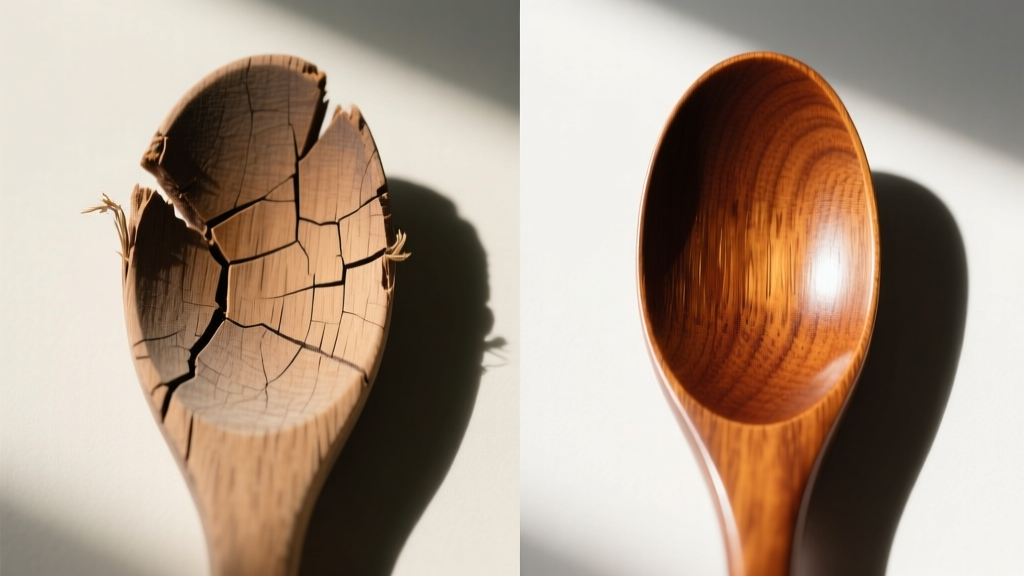
Problem: Surface Fuzz and Splintering
Cause: Dishwasher damage or prolonged water soaking has raised the wood grain.
Fix: Sand the utensil using progressive grits of sandpaper. Start with 120-grit to remove the damaged fibers, move to 220-grit for smoothing, and finish with 400-grit for a glass-like polish. Wipe away all dust with a damp cloth, let dry, and apply the oiling protocol.
Problem: Deep Odor Absorption (Garlic/Onion)
Cause: Open-grain woods like beech absorb volatile sulfur compounds from alliums.
Fix: Create a paste using coarse kosher salt and half a lemon. Scrub the utensil vigorously. The salt acts as a mild abrasive to open the pores, while the citric acid neutralizes the alkaline odor compounds. Rinse and re-oil.
Problem: Black Mold Spots
Cause: Storing damp utensils in dark, unventilated drawers.
Fix: If the mold is superficial, scrub with distilled white vinegar and sand the affected area. If the mold has penetrated deep into a crack, the utensil is structurally compromised and must be discarded for food safety reasons.
Frequently Asked Questions
Are bamboo utensils actually better than wood?
Bamboo is harder, lighter, and more water-resistant than most budget woods like beech or pine. However, it is more brittle. For heavy scraping and deglazing, dense hardwoods like teak or maple are superior. For tossing salads or flipping lightweight items, bamboo is the better choice.
How do I know if a wooden utensil is food-safe?
Look for untreated, raw wood finishes. Avoid wooden utensils coated in polyurethane, lacquer, or varnish, as these chemical finishes can chip off into hot food. Reputable brands will explicitly state that their tools are finished only with food-grade mineral oil or natural waxes.
Can I use wooden utensils on cast iron?
Absolutely. Wood and bamboo are ideal for cast iron. They are stiff enough to scrape up fond (the browned bits at the bottom of the pan) without stripping the polymerized oil seasoning layer the way metal spatulas can.
By shifting your budget toward high-quality, single-piece wooden and bamboo tools, you eliminate the need to constantly replace melted plastics or scratched metals. These inexpensive kitchen gadgets represent the highest utility-to-cost ratio in the culinary world, provided you respect the material science and commit to basic maintenance.
Written by
Lena ChenLena Chen earned her M.S. in Human-Computer Interaction from Carnegie Mellon University and a B.S. in Electrical Engineering from the University of Washington. She has spent the past decade specializing in smart home architecture and IoT ecosystems, helping over 200 homeowners design fully connected living spaces. Lena is a certified Matter protocol consultant and has published peer-reviewed research on voice-first interface design in the ACM Digital Library. Her reviews of smart home products combine deep technical analysis with real-world usability testing, evaluating everything from Zigbee mesh stability to Alexa skill responsiveness. She regularly speaks at CEDIA Expo and CES smart home panels.