Beyond the Basics: 5 Unique Musician Gadgets for 2026 Studios
Discover 5 unique musician gadgets for 2026 that break the mold. From EMF microphones to pocket mixers, upgrade your studio workflow with these cool finds.
Beyond the Standard Signal Chain
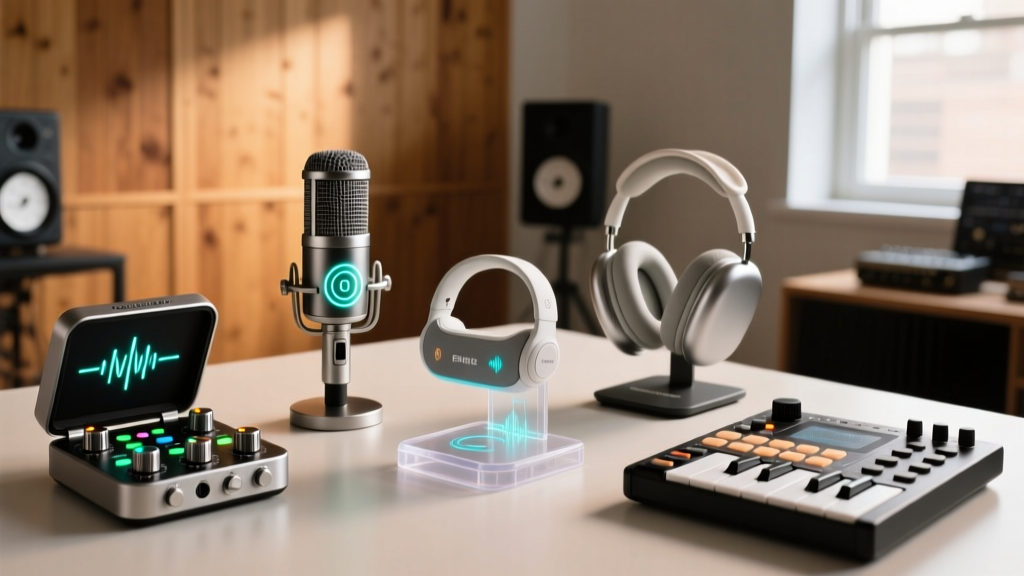
When building a modern music production space, it is remarkably easy to fall into the trap of homogenization. You buy the same audio interface as your peers, the same large-diaphragm condenser microphone, and the same MIDI keyboard. While those foundational tools are essential, true sonic innovation often lives in the margins. As we navigate the gear landscape of 2026, the most exciting musician gadgets are not necessarily the ones that do the standard jobs slightly better; they are the ones that force you to interact with sound in entirely new ways.
Whether you are a sound designer hunting for alien textures, an electronic producer looking for tactile inspiration, or a mix engineer seeking analog chaos, stepping off the beaten path is crucial. Below, we explore five highly unique, boundary-pushing studio gadgets that redefine workflow, complete with exact pricing, integration frameworks, and real-world use cases.
1. SOMA Laboratory Ether: Harvesting the Invisible Spectrum
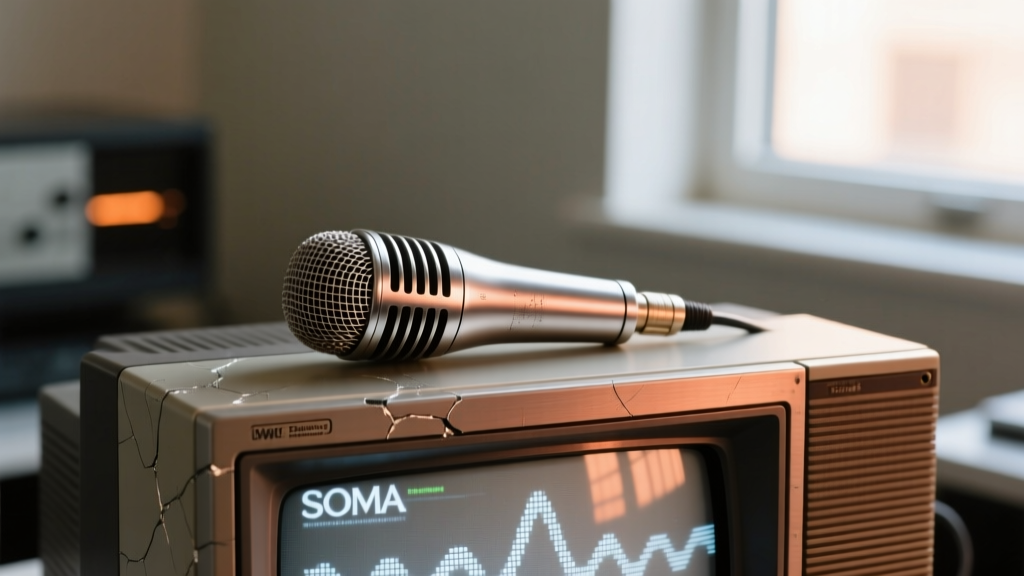
At first glance, the SOMA Laboratory Ether (roughly $550) looks like a steampunk antenna. In reality, it is an acoustic transducer designed to capture the electromagnetic fields (EMF) of the modern world. Unlike a traditional microphone that uses a diaphragm to capture air pressure, the Ether uses a specialized induction coil to translate electromagnetic radiation into an audio signal.
Real-World Sound Design Applications
Why would a producer need this? Because the invisible world is incredibly noisy. By waving the Ether near a Wi-Fi router, a vintage CRT monitor, or the power supply of an analog synthesizer, you capture rhythmic pulses, harsh digital artifacts, and deep, droning hums. It is the ultimate tool for generating organic, unpredictable industrial textures and granular synthesis source material. According to a deep-dive review by Sound on Sound, the built-in preamp is remarkably low-noise, ensuring that the faint whispers of a laptop CPU are captured with studio-grade fidelity.
- Frequency Response: 20Hz to 20kHz (translated from EMF)
- Output: Standard XLR (requires 48V phantom power)
- Best For: Foley artists, granular synth programmers, and ambient producers.
2. Teenage Engineering TX-6: The $1,200 Pocket Mixer
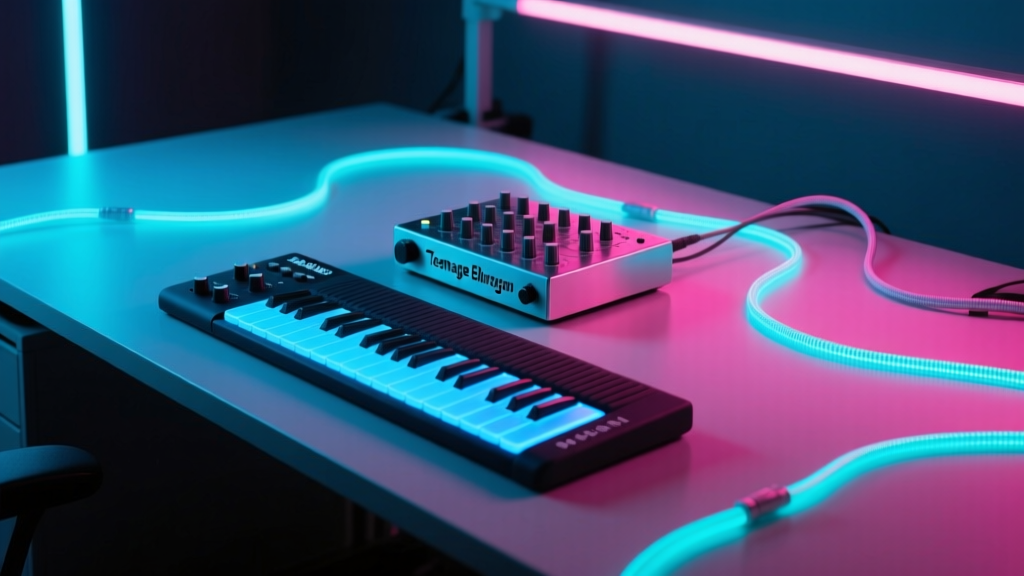
Teenage Engineering is famous for design-first audio gear, but the TX-6 ($1,199) is not just a pretty face; it is a marvel of miniaturized audio engineering. Measuring just 110 x 66 x 22 mm, this 12-channel mixer packs more routing flexibility into the palm of your hand than most half-rack studio mixers.
Specs vs. Traditional Studio Mixers
To understand the value proposition of the TX-6, we have to compare it against a standard compact analog mixer like the Mackie 1202VLZ4. The TX-6 is exponentially more expensive, but it offers digital integration that analog boards simply cannot match.
| Feature | Teenage Engineering TX-6 | Standard 12-Ch Analog Mixer |
|---|---|---|
| Form Factor | Pocket-sized (110x66x22mm) | Desktop (approx. 250x300mm) |
| Audio Interface | Built-in 32-bit float USB-C | None (Requires external interface) |
| Internal DSP | Reverb, Delay, Synth, Drum Machine | Basic 2-band EQ per channel |
| Power | Internal Li-ion (8+ hours) | Wall-wart DC adapter |
| Price (Approx) | $1,199 | $250 - $350 |
As detailed on the official Teenage Engineering product page, the TX-6 features 32-bit float recording directly to a connected USB-C drive. This means you can take it to a field recording session, plug in six contact mics, and capture audio with virtually zero risk of digital clipping. The built-in synthesizer and drum machine also allow it to function as a standalone sketchpad.
3. Polyend Tracker+: The Spreadsheet Groovebox
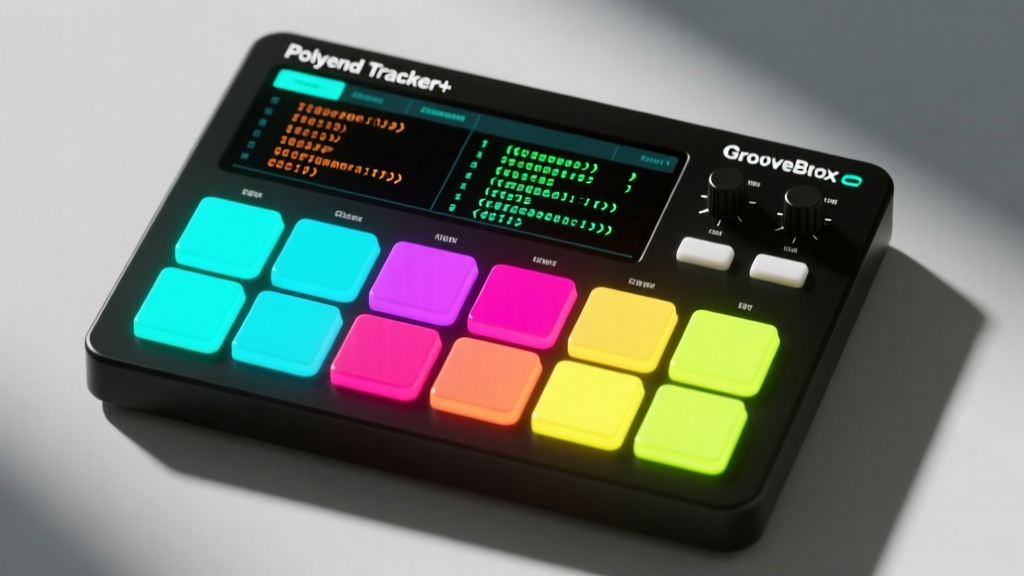
The tracker interface is a relic of the 1990s Amiga demoscene, yet in 2026, it remains one of the fastest, most surgical ways to manipulate samples. The Polyend Tracker+ ($799) takes this niche, hexadecimal-based workflow and wraps it in a premium, standalone hardware package.
'The moment you stop thinking in piano rolls and start thinking in vertical timelines and effect commands, your rhythmic programming becomes infinitely more complex and glitch-driven.'
The Tracker+ Workflow Advantage
Unlike traditional grid-based grooveboxes, the Tracker+ forces you to program music top-to-bottom, line-by-line. You trigger samples using hexadecimal values (e.g., C-4 for middle C) and apply effects using command columns (e.g., 05xx for pitch slides). The 'Plus' model upgrades the original with 12 stereo tracks, 48kHz/24-bit audio conversion, and full MIDI 2.0 support via USB. According to the Polyend official specs, the ability to instantly export multi-track stems via USB-C makes it a deadly weapon for producers who want to generate chaotic breakbeats in hardware and mix them in a DAW.
4. OTO Machines BIM BAM: The French Delay Matrix
Guitar pedals are common studio tools, but the OTO Machines BIM BAM (approx. $349) is a stereo delay and filter unit that operates more like a modular synthesizer module. Hand-built in France, this pedal is designed for producers who want to degrade their pristine digital signals with intentional, crusty artifacts.
Bit-Crushing Meets Analog Filtering
The magic of the BIM BAM lies in its switchable bit-depth architecture. You can toggle the delay line between 24-bit, 16-bit, and 12-bit modes. Dropping to 12-bit doesn't just add noise; it introduces aggressive aliasing and Nyquist folding, turning a simple snare hit into a metallic, ringing industrial clang. Furthermore, the analog dry path ensures your original signal remains punchy and intact, while the feedback loop can be pushed into self-oscillation and then tamed by the onboard multimode filter. It is an essential gadget for dub techno producers and lo-fi hip-hop beatmakers looking for authentic hardware degradation.
5. ROLI Seaboard RISE 2: The 5D MPE Canvas
Standard piano keyboards are essentially 128 on/off switches. The ROLI Seaboard RISE 2 ($1,199) replaces keys with a continuous, squishy silicone surface divided into 'equilateral keywaves.' It is the undisputed king of MPE (MIDI Polyphonic Expression).
Understanding 5D Touch
The Seaboard tracks five dimensions of touch per note: Strike (velocity), Press (aftertouch), Glide (horizontal pitch bend), Slide (vertical timbre modulation), and Lift (release velocity). This allows a synth patch to behave like a cello or a saxophone, where the physical manipulation of the note continues long after the initial attack. The RISE 2 model introduces improved haptic feedback and a customizable touch-sensitive strip for macro control. While it requires compatible MPE synths (like UVI Falcon, Serum 2, or Ableton's Drift) to shine, the expressive data it generates is virtually impossible to replicate with a mouse and keyboard.
| Expression Metric | Traditional MIDI Keybed | ROLI Seaboard RISE 2 |
|---|---|---|
| Pitch Bending | Global (Mod Wheel) | Per-note (Glide on X-axis) |
| Filter Modulation | Global (Mod Wheel/CC) | Per-note (Slide on Y-axis) |
| Aftertouch | Channel or Poly (rare) | Continuous Polyphonic Press |
| Physical Feedback | Mechanical springs/hammers | Continuous silicone surface |
The Integration Framework: How to Choose Your Weird Gear
Buying unique musician gadgets is easy; integrating them into a cohesive studio ecosystem is the real challenge. Before pulling the trigger on unconventional gear, apply this three-step decision framework:
- Identify the Bottleneck: Is your music too sterile? Buy the OTO BIM BAM or SOMA Ether to inject analog chaos and unpredictable textures. Is your workflow too slow and DAW-dependent? The Polyend Tracker+ will force you out of the browser and into a tactile, limitation-based headspace.
- Check the Routing: Ensure your audio interface has enough physical inputs/outputs to accommodate hardware loop-backs. Gadgets like the BIM BAM require dedicated outboard routing (or a high-quality re-amp box) to function properly in a hybrid setup.
- Verify Protocol Support: If you are investing in MPE gear like the ROLI Seaboard, audit your plugin library. Ensure your primary synthesizers support MIDI Polyphonic Expression, otherwise, you are just playing a very expensive, squishy keyboard.
Final Thoughts on Studio Innovation
The best studio gear doesn't just record your ideas; it generates them. By stepping away from the standard audio interface and MIDI controller paradigm, and embracing the weird, hyper-specialized tools available in 2026, you carve out a sonic signature that no sample pack or preset bank can replicate. Whether you are harvesting the electromagnetic hum of your refrigerator or slicing breakbeats in hexadecimal, the right gadget turns the act of production into an act of discovery.
Written by
Marcus WebbMarcus Webb served as a U.S. Army logistics officer for 8 years, where he managed field equipment procurement and tactical gear evaluation across three combat deployments. After honorable discharge, he earned a certification from the Professional Knife Makers Association and became a certified Wilderness First Responder (WFR). Marcus has tested over 500 EDC products in extreme environments — from -40°F in Alaska to 120°F in the Mojave Desert — using military-spec testing protocols. His reviews of multi-tools, tactical flashlights, and survival gear are known for their rigorous methodology: controlled drop tests from 6 feet, 120-minute water submersion at 2 meters, and lateral torque testing at 45 Nm. He is a member of the Blade Show judging panel and contributes to OutdoorGearLab.