Top Garage Gadgets for 2026: Seasonal Car & Outdoor Essentials
Upgrade your workspace with top garage gadgets for 2026. Discover seasonal car storage, EV charging, and climate control essentials for vehicles.
Why Seasonal Garage Prep Demands Specialized Tech
The modern garage has evolved far beyond a simple concrete box for parking. In 2026, it serves as a critical transition zone for seasonal vehicle storage, outdoor gear staging, and electric vehicle (EV) energy management. Whether you are winterizing a weekend sports car, prepping an overlanding rig for spring trails, or managing the humidity that threatens your automotive electronics, relying on outdated methods like basic tarps and standard jack stands is no longer sufficient.
Upgrading your space with targeted garage gadgets not only preserves your vehicles but also optimizes your energy footprint. From smart dehumidifiers that prevent chassis oxidation to advanced tire preservation ramps, the right tools pay for themselves by preventing thousands of dollars in seasonal wear-and-tear. Below, we break down the essential technology required to weatherproof and optimize your garage for any season.
The Ultimate Climate & Power Matrix for 2026
Temperature fluctuations and uncontrolled humidity are the silent killers of stored vehicles. Leather interiors crack, brake rotors warp, and electrical contacts corrode when relative humidity swings wildly. According to the Environmental Protection Agency (EPA), keeping indoor relative humidity between 30% and 50% is critical for preventing mold and structural degradation.
To achieve this in an uninsulated or semi-conditioned garage, you need high-capacity, smart-enabled climate control paired with reliable backup power.
| Gadget Category | Top 2026 Model | Key Specs & Pricing | Best Use Case |
|---|---|---|---|
| Smart Dehumidifier | Dreo DR-HSE006S | 50-Pint, Wi-Fi enabled, ~$280 | Continuous moisture extraction during humid summers or wet winters. |
| Backup Power Station | EcoFlow Delta 2 Max | 2kWh capacity, 2400W output, ~$1,699 | Keeping climate gadgets running during grid outages to prevent mold. |
| Smart Thermostat Hub | Ecobee SmartThermostat Premium | Remote sensors, ~$249 | Monitoring ambient garage temps via secondary remote sensors. |
Pro Tip: When installing a high-capacity dehumidifier like the Dreo 50-Pint, always route the continuous drain hose to a floor drain or utility sink. Relying on the internal water bucket will result in automatic shut-offs within 12 hours, leaving your classic car vulnerable to overnight condensation.

Tire & Suspension Preservation: Beyond Basic Jack Stands
One of the most common mistakes enthusiasts make during seasonal storage is using standard jack stands to lift the vehicle. While this takes the weight off the suspension, it leaves the suspension geometry fully extended, which can prematurely dry out bushings and shock seals over a 4-to-6 month storage period.
Flat-Spot Prevention Tech
Instead of lifting the car, the industry standard for 2026 is using curved polyurethane tire cradles. The Race Ramps FlatStoppers (approx. $140 per pair) are engineered with a 10.75-inch width and a 6,000-pound weight capacity per pair. The curved design perfectly matches the natural radius of the tire, distributing the vehicle's weight evenly across the contact patch. This prevents the flat-spotting that plagues low-profile summer tires when exposed to freezing concrete for extended periods.
Smart TPMS Hubs for Stored Vehicles
Tires naturally lose about 1 PSI per month. In a sealed garage, you won't notice the drop until spring. Pairing a smart Tire Pressure Monitoring System (TPMS) hub, like the FOBO Tire Plus 2 ($139), allows you to monitor the exact PSI of your stored vehicle via Bluetooth. The hub sends an alert to your smartphone if pressure drops below your customized threshold, ensuring you never roll out in April on under-informed rubber.
'Never store a vehicle with tire sealants or aerosol inflators in the system. Over a six-month winter storage period, the propellants can separate and permanently ruin the TPMS sensors inside the valve stems.' - Master Automotive Technician Guidelines
Outdoor Gear & EV Charging Integration
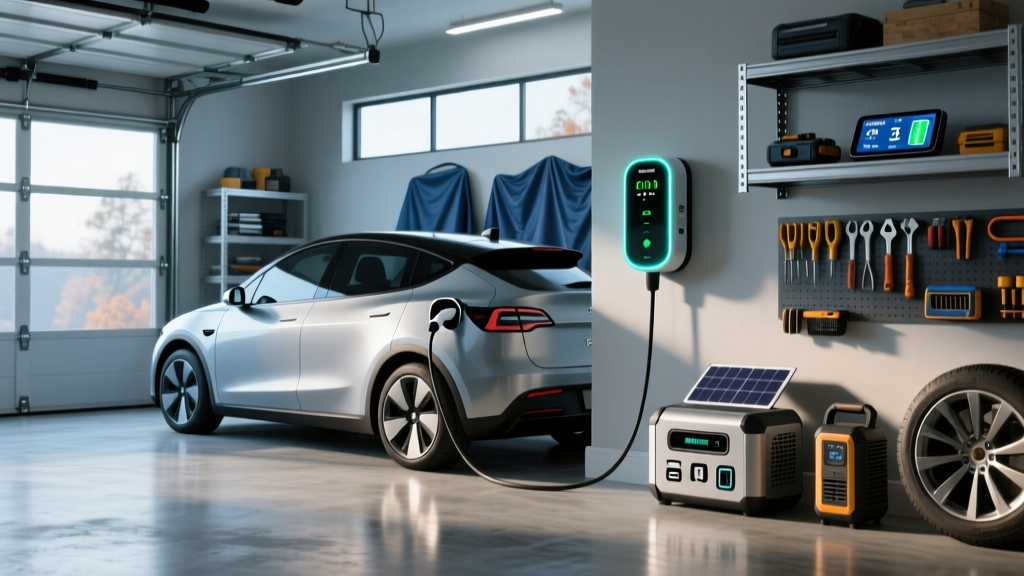
As electric vehicles and plug-in hybrids dominate the 2026 automotive landscape, the garage's electrical infrastructure must adapt. The U.S. Department of Energy emphasizes that Level 2 charging is the backbone of daily EV usability, but integrating this with seasonal outdoor gear requires smart load management.
Weatherproof Smart EV Chargers
For garages that double as mudrooms or outdoor gear staging areas, you need a charger that can handle dust, moisture, and physical impacts. The Emporia VUE Smart EV Charger ($399) is a standout choice. It delivers up to 48 Amps of continuous current and requires a dedicated 240V, 60-Amp breaker (NEMA 14-50 receptacle or hardwired).
- Load Balancing: If your garage also houses a 220V welder or heavy-duty air compressor, the Emporia app allows you to set hard amperage limits so you don't trip the main panel when running multiple tools.
- Off-Peak Scheduling: Sync the charger with your local utility's time-of-use rates to charge your EV or electric ATV only when grid demand (and cost) is lowest.
- Solar Integration: If your home utilizes rooftop solar, the VUE can dynamically adjust charging speed based on real-time solar overproduction.
Moisture & Pest Defense Systems
When the temperature drops, rodents seek out warm, enclosed spaces. A garage housing a vehicle with soy-based wiring insulation is an all-you-can-eat buffet for mice. Traditional snap traps are messy, and poison poses a severe risk to household pets.
Ultrasonic & Electromagnetic Repellents
The Bell + Howell Ultrasonic Pest Repeller (approx. $30 for a 4-pack) utilizes dual-chip technology to emit alternating ultrasonic and electromagnetic frequencies. While ultrasonic waves bounce off walls to disorient rodents, electromagnetic pulses travel through your garage's existing electrical wiring, creating an inhospitable environment inside the walls where pests nest. For maximum efficacy, plug these units into outlets near your vehicle's engine bay and do not block them with large metal toolboxes, which can deflect the sound waves.
Desiccant Alternatives for Tight Spaces
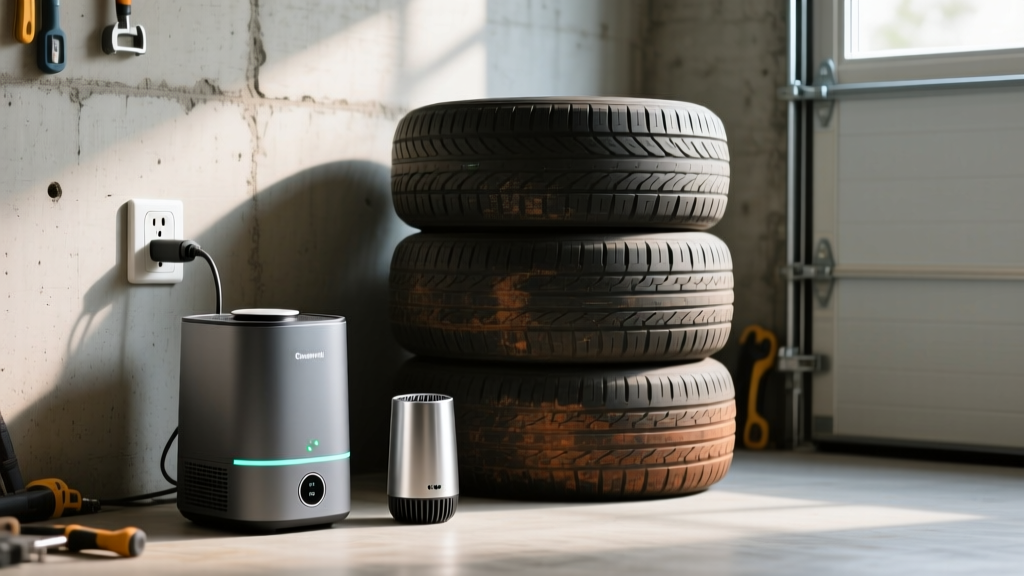
For tool chests, rooftop cargo boxes, or sealed motorcycle helmets stored in the garage, electronic dehumidifiers are overkill. Instead, use renewable silica gel canisters like the Eva-Dry Wireless Mini Dehumidifier ($25). These indicator-bead canisters absorb moisture for up to 60 days and can be 'recharged' simply by plugging them into a wall outlet to heat and dry the silica crystals.
Quick-Reference Seasonal Maintenance Checklist
Use this framework before putting your seasonal vehicles or outdoor rigs into long-term storage:
- Fluids: Top off the gas tank and add a fuel stabilizer (e.g., STA-BIL 360 Protection) to prevent ethanol separation.
- Battery: Connect a smart maintainer like the NOCO Genius GENM2 (12V, 8-Amp) rather than a traditional trickle charger to prevent overcharging.
- Wipers: Lift wiper blades away from the windshield or wrap them in microfiber to prevent the rubber from bonding to the glass.
- Exhaust: Block the exhaust pipe with a stainless steel mesh cap to prevent rodents from nesting in the muffler.
- Climate: Set the Dreo Smart Dehumidifier to maintain exactly 45% relative humidity.
Frequently Asked Questions
Do I need a 240V outlet to use smart garage climate gadgets?
No. While EV chargers and heavy-duty air compressors require 240V (NEMA 14-50 or 6-20) circuits, almost all smart dehumidifiers, pest repellents, and battery maintainers operate on standard 120V, 15-Amp household outlets. However, ensure your garage outlets are GFCI-protected to prevent shock hazards in damp conditions.
Can I store my lithium-powered outdoor tools in an unheated garage?
It is highly discouraged. Lithium-ion batteries (used in modern electric mowers, chainsaws, and e-bikes) suffer permanent capacity degradation if stored in temperatures below freezing (32°F / 0°C). Always remove the batteries from your outdoor power equipment and store them in a climate-controlled indoor environment during the winter months.
How often should I check my stored vehicle's tire pressure?
If you are not using a smart TPMS hub, you should manually check and adjust tire pressure every 30 days. Tires naturally permeate air, and a drop below the manufacturer's recommended PSI can cause irreversible sidewall damage when the vehicle's weight rests on the deflated contact patch for months at a time.
Written by
Marcus WebbMarcus Webb served as a U.S. Army logistics officer for 8 years, where he managed field equipment procurement and tactical gear evaluation across three combat deployments. After honorable discharge, he earned a certification from the Professional Knife Makers Association and became a certified Wilderness First Responder (WFR). Marcus has tested over 500 EDC products in extreme environments — from -40°F in Alaska to 120°F in the Mojave Desert — using military-spec testing protocols. His reviews of multi-tools, tactical flashlights, and survival gear are known for their rigorous methodology: controlled drop tests from 6 feet, 120-minute water submersion at 2 meters, and lateral torque testing at 45 Nm. He is a member of the Blade Show judging panel and contributes to OutdoorGearLab.