Beginner vs Expert: Choosing the Right Cooking Gadgets for Meat
Discover the exact cooking gadgets for meat that separate novices from pitmasters. Compare thermometers, grills, and knives with current pricing and specs.
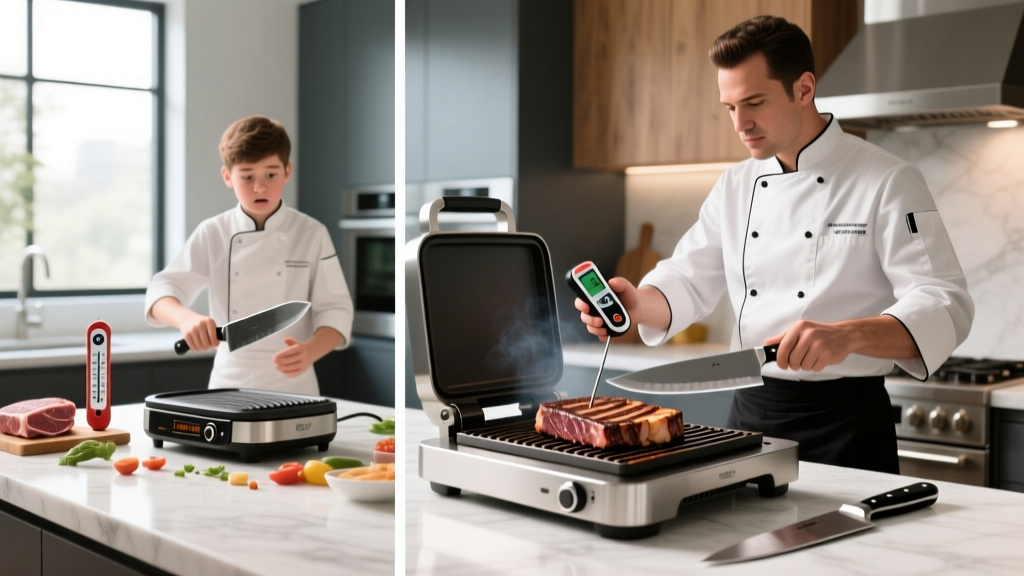
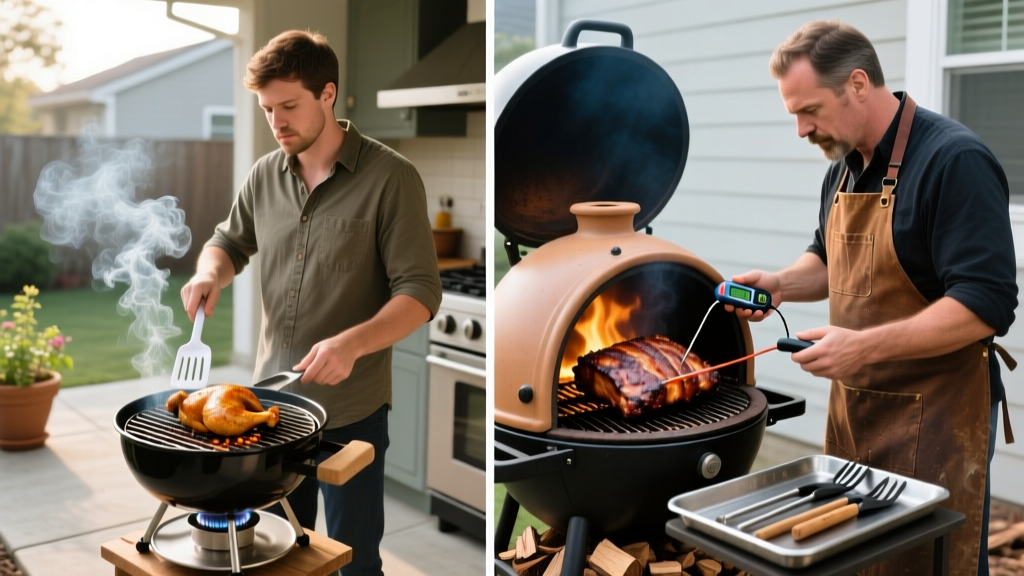
The Meat Gadget Progression Matrix
The gap between an acceptable backyard cookout and a master-level barbecue is rarely about the quality of the raw protein. It is almost entirely dictated by the precision, thermal dynamics, and metallurgy of the tools used to prepare it. When evaluating cooking gadgets for meat, beginners typically prioritize convenience and low upfront costs, while experts invest in thermal mass, predictive data, and specialized edge geometry.
Below is a structural breakdown of how tool selection evolves from novice to pitmaster across the three most critical categories of meat preparation.
| Category | Beginner Setup (Under $150) | Expert Setup ($200 - $2,500+) | Core Failure Mode Solved |
|---|---|---|---|
| Temperature Tracking | ThermoPro TP19 ($30) | FireBoard Spark ($199) | Heat loss from opening the lid to check doneness. |
| Heat Source & Airflow | Weber Spirit II E-310 ($499) | Kamado Joe Classic III ($2,799) | Rapid temperature drops and fuel inefficiency during low-and-slow cooks. |
| Carving & Slicing | Stamped Stainless Carving Set ($45) | Dexter-Russell 12' Scalloped Slicer ($48) | Rendered fat sticking to the blade and tearing the meat's bark. |
Temperature Tracking: Instant-Read vs. Predictive AI
The most abused piece of equipment in a beginner's arsenal is the standard dial thermometer, often built directly into the grill lid. These measure ambient air temperature at the dome, which can be 50°F to 75°F higher than the actual grate-level cooking surface. Upgrading to an instant-read digital thermometer like the ThermoPro TP19 ($29.99) is the mandatory first step for any cook. With a 2-3 second response time and ±0.5°F accuracy, it eliminates the guesswork of visual doneness cues.
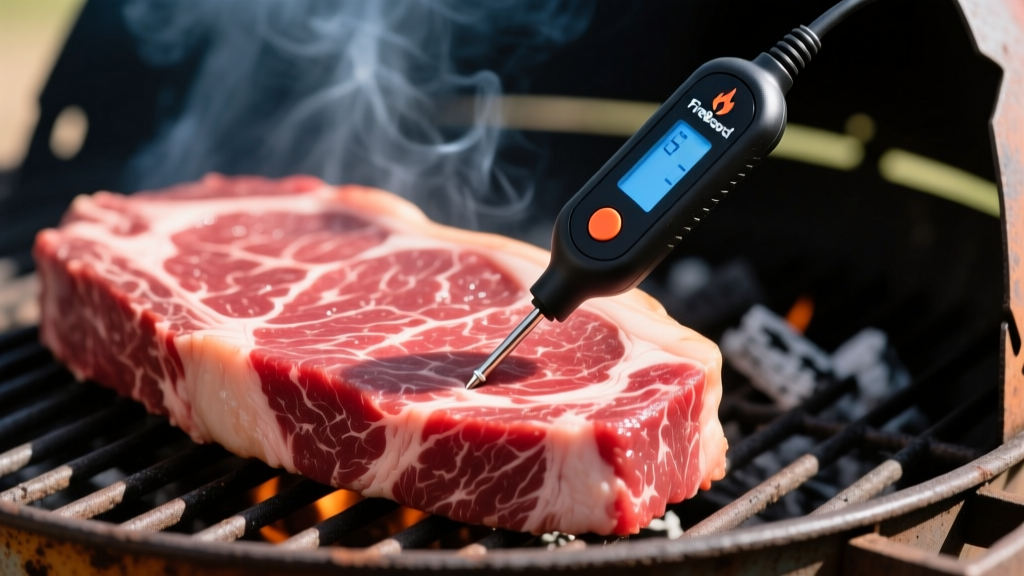
However, the expert tier abandons manual probing entirely in favor of cloud-connected predictive algorithms. The FireBoard Spark ($199) utilizes Wi-Fi and Bluetooth to monitor up to four probes simultaneously. The critical advantage is not just remote monitoring; it is the predictive finish-time AI. By analyzing the rate of temperature rise, the app calculates exactly when a thick cut of meat will hit its target temperature, accounting for the infamous 'stall' in evaporative cooling that plagues brisket and pork shoulder cooks.
The Physics of Carryover Cooking: According to the USDA Food Safety and Inspection Service, meat must reach specific minimum internal temperatures to ensure safety. However, expert cooks know that residual heat continues to migrate from the exterior to the cooler center after the meat is removed from the heat source. A thick, bone-in ribeye can experience a 5°F to 10°F temperature increase during a 10-minute rest. Predictive thermometers allow you to pull the meat precisely when the carryover math aligns with your final target, preventing overcooking.
Heat Retention: Stamped Steel vs. Thick-Walled Ceramic
Beginners often view grills primarily as a heat-generation device. Experts view them as a thermal retention chamber. The Weber Spirit II E-310 ($499) is an exceptional entry-level gas grill, producing 30,000 BTUs across 529 square inches. Yet, its lid and firebox are constructed from thin, porcelain-enameled stamped steel. When a novice opens the lid to flip a steak or check a smoke ring, the thin metal bleeds heat instantly. The grill requires 10 to 15 minutes to recover its thermal equilibrium, leading to uneven cooking and dried-out proteins.
Conversely, expert pitmasters operating in the charcoal and wood domain rely on thick-walled ceramic cookers like the Kamado Joe Classic III ($2,799). The 1.5-inch thick ceramic walls possess massive thermal inertia. Once the ceramic absorbs heat, it radiates it evenly and holds a 225°F steady temperature for 18 to 24 hours on a single load of lump charcoal. Furthermore, the inclusion of the SlōRoller hyperbolic smoke chamber insert alters the airflow dynamics, creating a cyclonic roll that eliminates hot spots and forces smoke to wash continuously over the meat rather than venting straight out the top dumper.
Gas vs. Charcoal: The Moisture Variable
While gas is convenient, combustion of propane (C3H8) inherently produces water vapor as a byproduct. This alters the humidity inside the cooking chamber. For high-heat searing, this is irrelevant. For low-and-slow smoking, the excess moisture can prevent the formation of a proper pellicle on the meat's surface, resulting in a soft, mushy bark instead of a crisp, caramelized crust. This thermodynamic reality is why experts strictly separate their searing stations from their smoking chambers.
Carving Physics: Standard Edges vs. Scalloped Granton Blades
A beginner's kitchen drawer usually contains a standard 8-inch chef's knife or a cheap, stamped stainless-steel carving set with a hollow, unsharpened tip. When slicing a smoked brisket or a prime rib, a short blade requires a sawing motion. Sawing creates friction, which tears the delicate muscle fibers and shreds the carefully cultivated bark. The National Cattlemen's Beef Association emphasizes that slicing against the grain is critical for tenderness, but doing so requires a blade long enough to complete the cut in a single, fluid stroke.
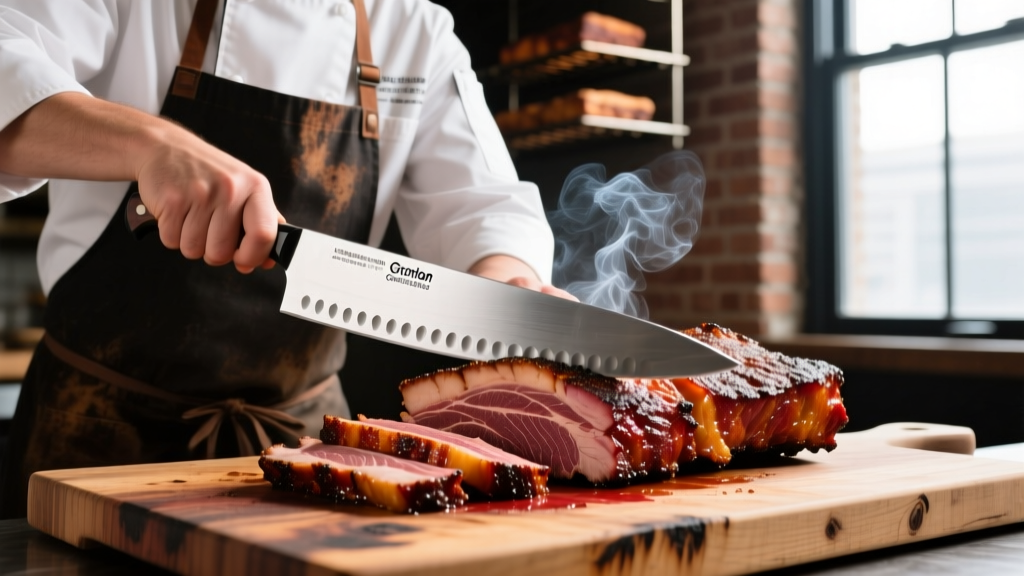
The expert solution is a dedicated 12-inch slicing knife with a scalloped (Granton) edge, such as the Dexter-Russell 12' Sani-Safe Scalloped Slicer ($48). While commercial-grade and lacking the aesthetic appeal of a $200 Japanese Damascus blade, the Dexter-Russell is a functional masterpiece for meat. The 12-inch length allows a full pull-through stroke. More importantly, the scalloped divots ground into the side of the blade create microscopic air pockets between the steel and the meat.
Why the Air Pocket Matters: As you slice through rendered intramuscular fat and sticky barbecue bark, a flat steel blade creates a vacuum seal. The meat suctions to the knife, causing the slices to bunch up and tear. The Granton scallops break this surface tension, allowing paper-thin slices of brisket or ham to fall away cleanly without structural damage. As detailed in extensive culinary testing by Serious Eats, preserving the physical integrity of the slice directly impacts the mouthfeel and juice retention of the final bite.
The Upgrade Decision Framework
Do not upgrade your entire arsenal at once. Follow this sequential framework based on your current cooking frequency and the specific bottlenecks in your meat preparation.
Phase 1: The Data Upgrade (Budget: $30 - $200)
- Trigger: You frequently overcook expensive steaks or undercook poultry.
- Action: Buy the ThermoPro TP19 immediately. Once you are consistently nailing pull-temperatures, upgrade to the FireBoard Spark to manage long, unattended brisket and pork shoulder cooks without opening the lid and ruining the thermal environment.
Phase 2: The Metallurgy Upgrade (Budget: $50 - $150)
- Trigger: Your smoked meats taste great, but the slices look ragged, and the bark tears off when you serve it.
- Action: Retire the carving set. Purchase a 12-inch scalloped slicer and a high-end cutting board with a deep juice groove. The visual and textural improvement in your final presentation will be immediate.
Phase 3: The Thermal Mass Upgrade (Budget: $1,500 - $3,000+)
- Trigger: You are burning through excessive amounts of charcoal, struggling to maintain sub-250°F temperatures in cold or windy weather, or dealing with uneven hot spots on your current grill.
- Action: Invest in a ceramic kamado or a heavily insulated offset smoker. This is the final frontier of meat gadgets, shifting your focus from actively managing a fire to simply steering a massive, self-regulating thermal engine.
Mastering meat is an exercise in controlling variables. By aligning your gadget purchases with the specific thermodynamic and physical challenges of your cook, you transition from merely applying heat to engineering flavor.
Written by
Priya SharmaPriya Sharma holds a Ph.D. in Acoustical Engineering from the University of Southampton and a B.Tech in Electronics from IIT Delhi. She has spent 9 years as a consumer electronics journalist, with deep specialization in audio equipment, camera systems, and assistive technology. Priya is an active member of the Audio Engineering Society (AES) and has co-authored papers on spatial audio perception published in the Journal of the Acoustical Society of America. Her reviews of headphones, portable DACs, and studio monitors include objective measurements using Audio Precision analyzers alongside subjective listening tests. She also serves on the advisory board of the Global Accessibility Reporting Initiative (GARI), evaluating mobile devices for users with visual and hearing impairments.