Best Budget Hiking Gadgets 2026: Top Trail Tech Under $50
Discover the best budget hiking gadgets for 2026. We review top trail tech under $50, including smart scales, water purifiers, and ultralight power banks.
The Ultralight Tech Framework: Why Budget Doesn't Mean Compromise
When assembling a modern outdoor kit, the temptation is to equate high price tags with backcountry reliability. However, the landscape of hiking gadgets has shifted dramatically leading into 2026. Advances in lithium-silicon battery chemistry, miniaturized LED optics, and high-density water filtration membranes mean you no longer need to drop hundreds of dollars to secure life-saving trail tech. For the budget-conscious thru-hiker or the weekend warrior looking to upgrade their daypack, the sub-$50 category is currently the most competitive sector in the outdoor industry.
According to REI Co-op Expert Advice, the most critical factor in selecting budget electronics is the weight-to-utility ratio. A cheap gadget that adds 12 ounces to your base weight is ultimately a liability on a 20-mile push. This roundup strictly filters for gear that punches above its weight class, focusing on exact model numbers, real-world failure modes, and verifiable specifications.
The Golden Rule of Budget Trail Tech: Never compromise on IPX water resistance ratings or cold-weather battery chemistry. A $20 power bank that dies at 30°F is dead weight. Always look for devices utilizing high-density lithium-polymer cells with active thermal management or proven cold-weather track records.
5 Best Budget Hiking Gadgets Under $50 (2026 Edition)
1. Nitecore NU25 UL Headlamp ($39.95)
The Nitecore NU25 UL remains the undisputed king of ultralight illumination. Weighing a mere 1.59 ounces (45g) including the Dyneema headband, it pushes 400 lumens on its highest setting. What makes this one of the most essential hiking gadgets on the market is its dual-beam technology: a wide flood beam for camp chores and a focused spot beam for trail navigation. The inclusion of a high-CRI (Color Rendering Index) red light mode preserves your night vision and prevents blinding your tentmates.
- Weight: 1.59 oz (45g)
- Max Output: 400 Lumens
- Battery: 650mAh Li-ion (USB-C)
- Pros: Insanely lightweight, lockout mode prevents accidental battery drain.
- Cons: The Dyneema band can cause chafing on bare foreheads during high-sweat activities.
2. Nitecore NB10000 Gen 3 Power Bank ($45.00)
Most budget power banks are dense, brick-like monstrosities. The NB10000 Gen 3 utilizes a carbon fiber composite shell, bringing a 10,000mAh capacity down to just 5.36 ounces (152g). It supports 20W USB-C Power Delivery, meaning it can fast-charge your smartphone or GPS unit while you are actively moving. As noted in extensive field tests by OutdoorGearLab, the carbon fiber chassis also provides superior drop protection compared to standard aluminum or plastic casings.
- Weight: 5.36 oz (152g)
- Capacity: 10,000mAh
- Input/Output: 20W USB-C PD
- Pros: Best-in-class weight-to-capacity ratio, rugged carbon shell.
- Cons: Lacks built-in cables; you must carry a separate short USB-C tether.
3. Etekcity Digital Luggage Scale ($12.99)
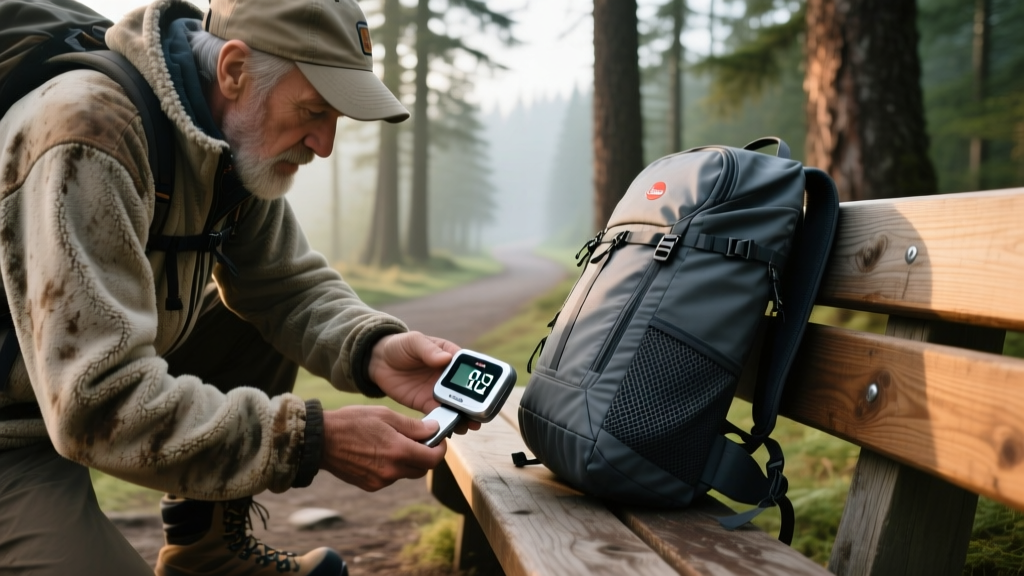
While not an electronic wearable, a digital hanging scale is one of the most vital hiking gadgets for anyone serious about dialing in their base weight. The Etekcity model offers a 110-pound capacity with 0.1-pound accuracy. Weighing your pack at the trailhead allows you to redistribute heavy items to your hiking partner or ditch non-essentials before the ascent begins. The tare function lets you weigh individual stuff sacks by subtracting the weight of the carabiner.
- Weight: 3.5 oz (99g)
- Capacity: 110 lbs / 50 kg
- Accuracy: 0.1 lb
- Pros: Extremely cheap, backlit LCD screen for dim trailheads, auto-off feature.
- Cons: The fabric strap can fray after years of heavy abuse.
4. LifeStraw Peak Squeeze Water Filter ($49.95)
Hydration tech is non-negotiable. The LifeStraw Peak Squeeze system improves upon older squeeze filters by utilizing a more durable, kink-resistant 3-liter collapsible pouch. The filter membrane itself removes 99.999999% of bacteria and parasites down to 0.02 microns. Unlike budget competitors that clog after 200 liters, the Peak Squeeze includes a specialized backflush syringe that extends the filter lifespan to 2,000 liters when maintained properly in silty alpine water sources.
- Weight: 5.6 oz (159g) for full kit
- Filter Pore Size: 0.02 microns
- Lifespan: 2,000 Liters
- Pros: Standard thread fits directly onto Smartwater bottles, excellent flow rate.
- Cons: Freezing the filter will permanently destroy the internal membrane.
5. Olight Perun Mini Right-Angle Light ($45.00)
Headlamps are great, but a right-angle light offers unparalleled versatility. The Olight Perun Mini outputs a staggering 1,000 lumens from a package the size of a AA battery. The magnetic tail cap allows you to snap it to your car hood during trailhead repairs or stick it to a tent pole. According to Backpacker Magazine Gear Reviews, right-angle lights are increasingly preferred by search and rescue professionals for their adaptable beam angles and pocket-friendly profiles.
- Weight: 2.15 oz (61g)
- Max Output: 1,000 Lumens
- Waterproof Rating: IPX8
- Pros: Magnetic base, proximity sensor prevents overheating in pockets.
- Cons: Proprietary charging cable required (no standard USB-C port on the device).
Head-to-Head Comparison Matrix
| Gadget Model | Price (2026) | Weight | Primary Utility | Battery Type |
|---|---|---|---|---|
| Nitecore NU25 UL | $39.95 | 1.59 oz | Night Navigation | Internal Li-ion |
| Nitecore NB10000 Gen 3 | $45.00 | 5.36 oz | Device Charging | 10k Li-Polymer |
| Etekcity Scale | $12.99 | 3.50 oz | Pack Weighing | 2x AAA |
| LifeStraw Peak Squeeze | $49.95 | 5.60 oz | Water Purification | N/A (Mechanical) |
| Olight Perun Mini | $45.00 | 2.15 oz | Camp/Repair Tasks | Internal Li-ion |

The Hidden Costs of Cheap Trail Tech: Failure Modes to Avoid
Not all budget hiking gadgets are created equal. When shopping outside of this curated list, be hyper-aware of the following real-world failure modes that plague sub-$50 outdoor electronics:
1. The IPX Rating Lie
Many cheap gadgets on major e-commerce platforms claim waterproof status without a verifiable IPX rating. For hiking, you need a minimum of IPX4 (splash resistant) for headlamps, and IPX7 (submersible up to 1 meter) for power banks. If the manufacturer does not explicitly state the IPX number, assume it will fail in a sudden alpine downpour.
2. Cold Weather Voltage Sag
Standard alkaline batteries lose up to 80% of their capacity at freezing temperatures. Even cheap lithium-ion cells suffer from severe voltage sag below 20°F (-6°C). Always budget for devices that allow you to keep the battery warm inside your jacket, or invest in lithium AA/AAA batteries (like Energizer Ultimate Lithium) for devices that require removable cells.
3. Micro-USB Obsolescence
In 2026, carrying a Micro-USB cable solely for one cheap gadget is an inefficient use of pack space. Strictly filter your purchases for USB-C charging. If a budget gadget still utilizes Micro-USB, it is likely utilizing outdated, inefficient power management chips that will take 6 hours to recharge via a solar panel.
Frequently Asked Questions
Are budget solar panels worth it for hiking?
Generally, no. Budget solar panels under $50 typically offer 5W to 10W of output, but real-world efficiency under a forest canopy or while moving is less than 15%. You are better off carrying an extra 10,000mAh power bank (like the Nitecore NB10000) which provides guaranteed, reliable power regardless of cloud cover or hiking pace.
How do I maintain my water filter in freezing conditions?
Hollow membrane filters like the LifeStraw Peak Squeeze will permanently break if the residual water inside freezes and expands. In sub-zero conditions, you must sleep with the filter inside your sleeping bag, or switch to chemical purification tablets like Aquamira or Katadyn Micropur as a fail-safe.
Can I use my smartphone instead of dedicated hiking gadgets?
While smartphones have excellent GPS and flashlight capabilities, relying on them exclusively is dangerous. A drop can shatter the screen, and cold weather will drain the battery rapidly. Dedicated hiking gadgets are built with physical buttons that can be operated with gloves, and ruggedized casings that survive impacts on granite.
Written by
Jake MorrisonJake Morrison holds a B.S. in Electrical Engineering from UC Berkeley and an MBA from Stanford Graduate School of Business. With over 12 years of hands-on experience in consumer electronics, he previously served as a senior product engineer at a Silicon Valley startup before transitioning to tech journalism. Jake has personally tested and benchmarked over 3,000 gadgets across categories including smartphones, wearables, smart home devices, and audio equipment. His durability testing methodology — involving controlled drop tests, thermal cycling, and water submersion — is widely cited by major tech publications. He is a certified CompTIA A+ technician and a contributing editor to the IEEE Consumer Electronics Magazine.