Space-Saving Asian Household Gadgets for Home Offices 2026
Discover the best compact Asian household gadgets for small home offices in 2026. Reclaim desk space with these hyper-efficient, minimalist upgrades.
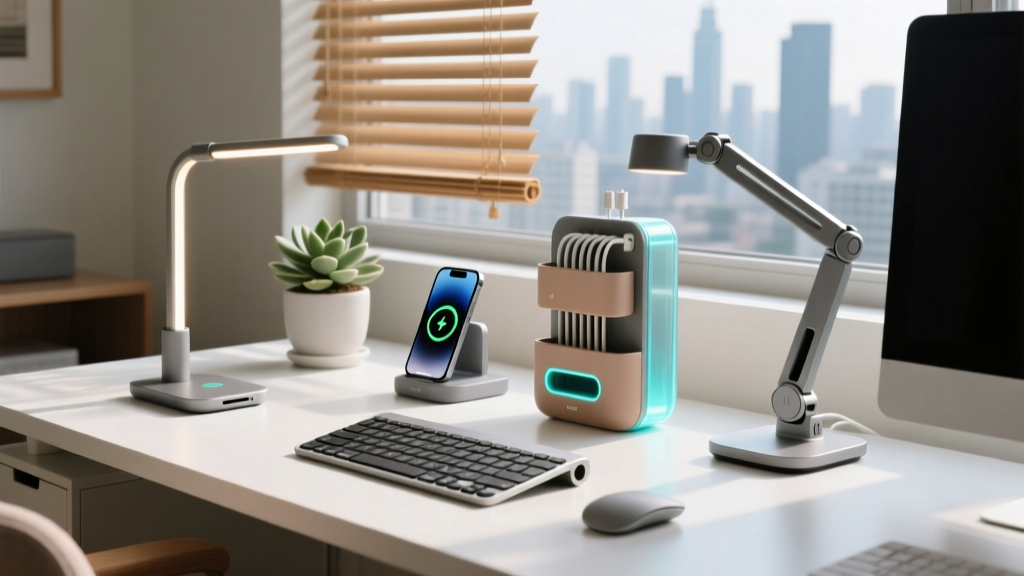
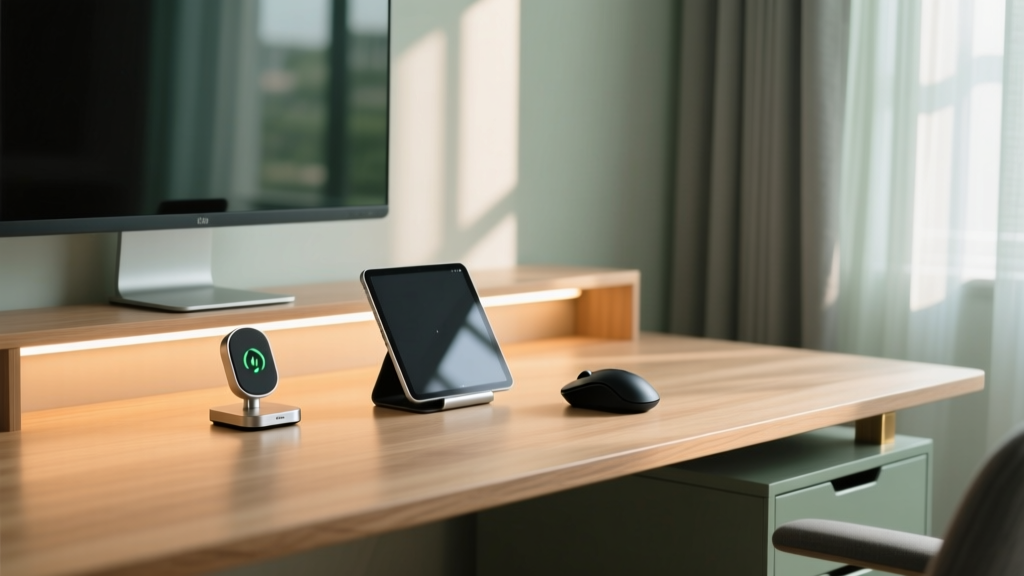
The Urban Density Advantage: Why Asian Gadgets Rule Small Spaces
When it comes to optimizing a cramped home office, Western tech often defaults to 'just buy a bigger desk.' But in hyper-dense urban centers like Tokyo, Seoul, and Singapore, square footage is a luxury. This geographical reality has birthed a unique, highly refined category of tech: asian household gadgets engineered specifically for micro-spaces. In 2026, as hybrid work cements itself and urban apartments shrink, these multi-functional, beautifully minimalist devices are no longer just niche imports—they are essential survival tools for the modern remote worker.
The design philosophy behind these products often draws from the Japanese concept of Ma (negative space) and the Korean principle of Yeobaek (the beauty of emptiness). Instead of adding clutter, the best compact Asian household gadgets are designed to disappear into your environment while delivering maximum utility. Below, we break down the top four space-saving upgrades that will help you reclaim up to 40% of your desk footprint this year.
Top 4 Space-Saving Gadgets for the Compact Desk
1. Xiaomi Mi Computer Monitor Light Bar 1S (2026 Edition)
Desk lamps are notorious space hogs, with heavy bases and articulated arms that eat up valuable keyboard clearance. The Xiaomi Mi Computer Monitor Light Bar completely eliminates the desk footprint by mounting directly to the top bezel of your monitor.
- Footprint Saved: 100% (Zero desk surface area used)
- Key Specs: Asymmetric optical design (prevents screen glare), 2700K-6500K adjustable color temperature, 1000 lux center illumination.
- 2026 Price: $59.99
The 2026 iteration features an upgraded 2.4GHz wireless puck controller. Because the puck is wireless and weighs just 45 grams, you can place it anywhere—or mount it under your desk lip using the included 3M adhesive pad. According to Xiaomi's official monitor light bar specifications, the asymmetric forward projection ensures light hits your keyboard and documents without casting a single reflection on your IPS or OLED panel.
2. Elecom DEFT Pro Wireless Trackball Mouse
A standard mouse requires a 'sweep zone'—typically a 350mm x 250mm mousepad area to navigate a 4K monitor. By switching to a trackball, you eliminate the need for arm movement entirely, allowing you to use a tiny coaster or rest your hand directly on the desk edge.
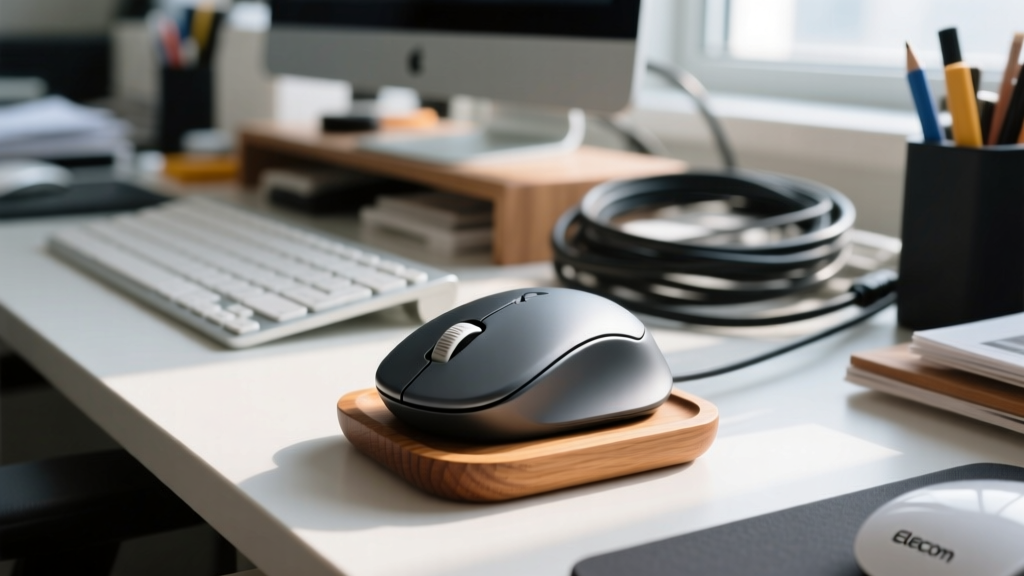
- Footprint Saved: ~130 square inches of desk sweep area
- Key Specs: 44mm artificial ruby bearing trackball, 8 programmable buttons, dual Bluetooth/2.4GHz connectivity.
- 2026 Price: $48.50
As noted in The Verge's comprehensive guide to ergonomic and trackball mice, the DEFT Pro's thumb-operated 44mm ball allows for micro-pixel precision without wrist strain. For small desks where your keyboard and monitor stand are practically touching, the Elecom DEFT Pro is a non-negotiable upgrade.
3. Iris Ohyama Slim Cable Management & Hub Station
Japanese brand Iris Ohyama is famous for 'skima' (gap) storage—products designed to fit into the awkward, unusable crevices of a home. This slim hub station is exactly 1.2 inches thick, allowing it to slide perfectly into the gap behind your monitor stand or under your keyboard tray.
- Dimensions: 9.5 x 3.5 x 1.2 inches
- Key Specs: 4-port USB-C 10Gbps hub, SD/MicroSD reader, integrated magnetic phone stand, hidden cable spool.
- 2026 Price: $34.00
Instead of having a dongle dangling from your laptop and a separate phone stand cluttering your desk, this single slab consolidates your I/O needs while hiding up to 3 feet of excess cable slack inside its silicone-lined spool.
4. Muji Wall-Mounted Bluetooth Speaker & Focus Timer
Why put a speaker or a Pomodoro timer on your desk when you can use the dead vertical space above your monitor? Designed originally by Naoto Fukasawa, the iconic Muji wall-mounted CD player has evolved for 2026 into a sleek Bluetooth 5.3 audio and productivity hub.
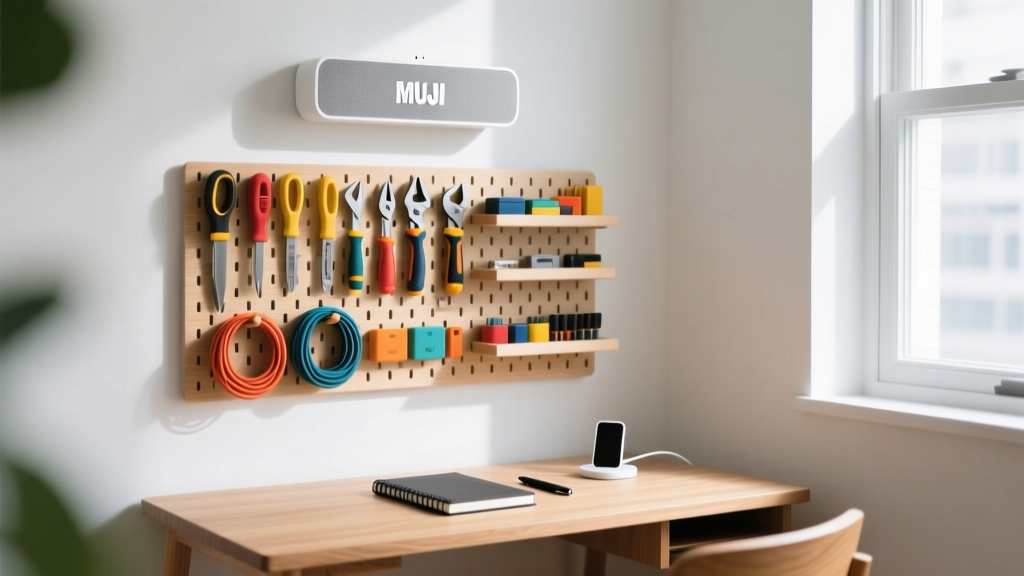
- Footprint Saved: Moves audio/timer entirely off the desk surface
- Key Specs: 10W full-range driver, pull-cord activation, built-in LED Pomodoro projection timer.
- 2026 Price: $89.00
By pulling the physical cord, you activate your focus playlist. A subtle, warm LED ring projects a 25-minute countdown onto the wall behind it. You can explore more of Muji's official wall-mounted audio and home accessories lineup to see how they masterfully blend analog tactile feedback with digital utility.
Footprint Comparison Matrix
To visualize the spatial efficiency of these asian household gadgets, compare their physical impact against traditional Western desk alternatives.
| Gadget Category | Traditional Desk Item | Compact Asian Alternative | Space Reclaimed |
|---|---|---|---|
| Lighting | LED Desk Lamp (Base: 6x6 in) | Xiaomi Monitor Light Bar | 36 sq inches |
| Navigation | Standard Mouse + Pad | Elecom DEFT Pro Trackball | ~130 sq inches |
| Connectivity | USB Hub + Phone Stand | Iris Ohyama Slim Hub | 18 sq inches (Hidden) |
| Audio/Timer | Desktop Speaker + Digital Clock | Muji Wall-Mounted Hub | 25 sq inches (Vertical) |
Implementation Guide: The 3-Step Desk Audit
Buying the right gear is only half the battle. To truly optimize a micro-office, follow this 3-step spatial audit framework:
- The Sweep Test: Sit at your desk and mimic your natural mouse movements. Measure the arc your forearm makes. If it exceeds 12 inches in any direction, your navigation tool is too large for your space. Switch to a trackball immediately.
- Vertical Auditing: Look at the wall space between the top of your monitor and the ceiling, or the side panels of your desk hutch. This is prime real estate for pegboards, wall-mounted audio, or magnetic cable organizers.
- The 'Skima' Gap Search: Identify every gap in your current setup that is wider than 1.5 inches but narrower than 4 inches (e.g., behind the monitor stand, under the desk lip, beside the PC tower). Use ultra-slim Japanese storage solutions to turn these dead zones into active I/O hubs.
Pro Tip for 2026: When importing compact gadgets from Asian markets, prioritize devices powered by USB-C Power Delivery (PD). This bypasses the need for bulky, region-specific AC adapters and allows you to daisy-chain power through a single, high-wattage GaN desktop charger.
Frequently Asked Questions
Are Japanese and Korean gadgets compatible with US/EU power standards?
Historically, importing tech from Asia meant dealing with 100V (Japan) or 220V (Korea/China) power bricks and physical plug adapters. However, in 2026, nearly 95% of compact desktop gadgets from brands like Xiaomi, Iris Ohyama, and Muji rely entirely on USB-C PD. As long as you have a universal 100W+ GaN wall charger, regional voltage differences are completely irrelevant.
How do trackball mice compare for precision design work in small spaces?
There is a persistent myth that trackballs lack precision for CAD or graphic design. Modern iterations like the Elecom DEFT Pro utilize synthetic ruby bearings that eliminate static friction, allowing for 1:1 pixel tracking. While it takes about 7 to 10 days to build the thumb muscle memory, the spatial savings on a cramped desk far outweigh the brief learning curve.
Where is the safest place to buy authentic Asian household gadgets?
Avoid third-party marketplace listings with vague branding. For authentic warranties and 2026 firmware updates, purchase directly from official regional storefronts (like Xiaomi's global site or Muji's US/EU portals) or use trusted Japanese proxy services like Buyee or ZenMarket, which consolidate shipping from domestic Japanese retailers like Yodobashi Camera.
Written by
Marcus WebbMarcus Webb served as a U.S. Army logistics officer for 8 years, where he managed field equipment procurement and tactical gear evaluation across three combat deployments. After honorable discharge, he earned a certification from the Professional Knife Makers Association and became a certified Wilderness First Responder (WFR). Marcus has tested over 500 EDC products in extreme environments — from -40°F in Alaska to 120°F in the Mojave Desert — using military-spec testing protocols. His reviews of multi-tools, tactical flashlights, and survival gear are known for their rigorous methodology: controlled drop tests from 6 feet, 120-minute water submersion at 2 meters, and lateral torque testing at 45 Nm. He is a member of the Blade Show judging panel and contributes to OutdoorGearLab.