The Best Gadget to 3D Print in 2026: 5 Unique Finds
Discover the best gadget to 3D print in 2026. From compliant robotic grippers to custom macro pads, explore 5 unique, functional maker projects.
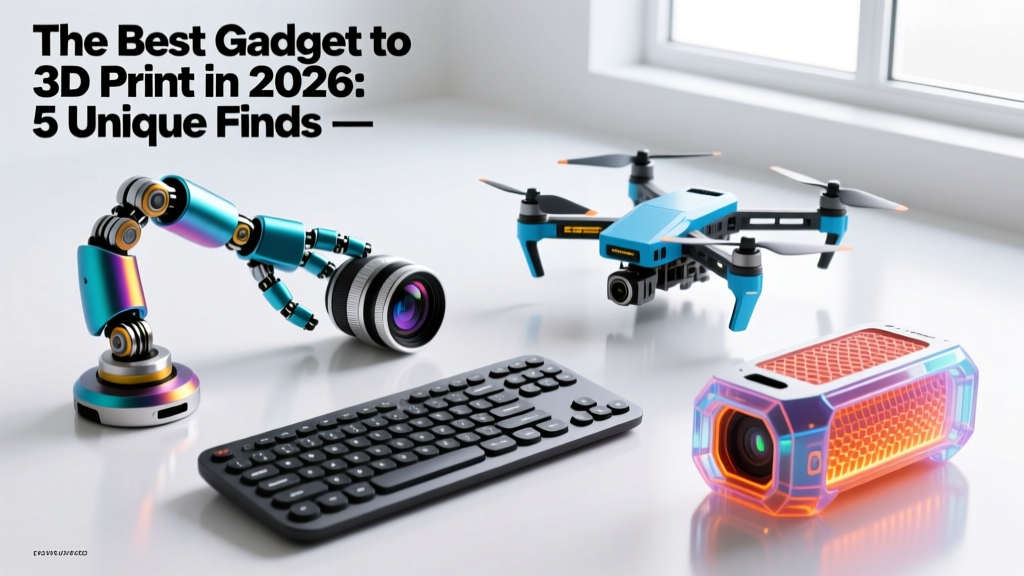

Beyond the Benchy: Defining the Best Gadget to 3D Print
The 3D printing landscape in 2026 has shifted dramatically. While calibration cubes and decorative vases still have their place for testing extrusion flow, the true potential of desktop manufacturing lies in functional engineering. When makers ask us what the best gadget to 3D print actually is, the answer is no longer a single novelty item. It is a category of mechanical, electronic, and acoustic tools that solve real-world problems.
To qualify as a top-tier functional gadget, a print must demonstrate mechanical utility, require precise slicer tolerances, and ideally integrate with off-the-shelf hardware (OTSH) like microcontrollers or servos. Below, we have curated five highly unique, deeply functional gadgets that push the boundaries of FDM and resin printing, complete with exact material requirements and hardware specifications.
1. Print-in-Place Cycloidal Drive Actuator
While planetary gears are common, the cycloidal drive is the undisputed king of high-torque, low-backlash mechanical transmission. A print-in-place cycloidal actuator is arguably the best gadget to 3D print if you want to understand advanced kinematics.
Engineering Deep Dive
- Mechanism: Uses an eccentric bearing to drive a cycloidal disc that meshes with stationary housing pins, achieving reduction ratios up to 87:1 in a single compact stage.
- Slicer Settings: Requires a 0.4mm nozzle with a strict 0.12mm layer height for the bearing tracks. Set your XY hole compensation to +0.05mm to ensure the eccentric shaft rotates freely without binding.
- Material: PLA+ or ABS. Standard PLA will shatter under the sheer stress of the cycloidal lobes. Polymaker PolyLite ABS is highly recommended for its layer adhesion.
Maker Insight: Do not use supports. The beauty of a well-tuned cycloidal print-in-place model is that it relies on precise air gaps (usually 0.15mm) to remain separate. If your printer's flow rate is over-extruding by even 3%, the gears will fuse into a solid brick.
2. Open-Source QMK Macro Pad with Magnetic Hot-Swaps
Custom mechanical keyboards are everywhere, but a fully parametric, 3D-printed macro pad tailored to your specific CAD or video editing workflow is a game-changer. This project bridges the gap between digital fabrication and embedded electronics.
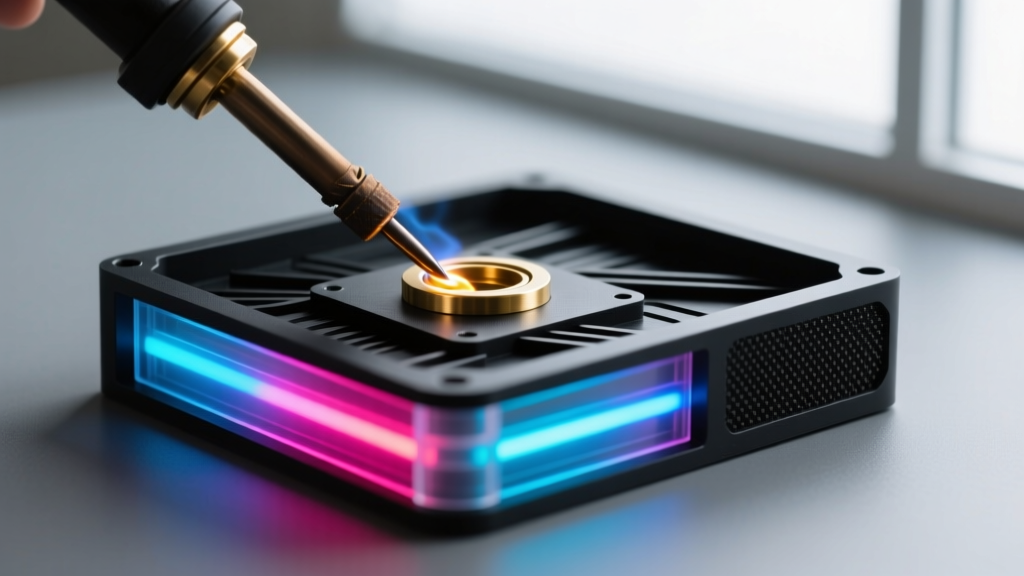
Hardware & Firmware Integration
The brain of this gadget is the SparkFun Pro Micro RP2040. Unlike older ATmega32U4 boards, the RP2040 offers dual-core processing and massive flash memory, allowing you to run complex QMK or VIA firmware layers without hitting memory limits.
- The Enclosure: Print the main chassis in PETG at 100% infill for the mounting posts. PETG's slight flexibility prevents cracking when driving in screws.
- Threaded Inserts: Forget self-tapping screws. Use a soldering iron set to 300°C to press M2x4x3.5 brass heat-set inserts into the PCB mounting holes. This provides machine-grade durability.
- Switches: Populate the board with Kailh hot-swap sockets and Gateron Oil King linear switches for a buttery, tactile-free experience ideal for rapid-fire shortcut execution.
3. Compliant Mechanism Soft Robotic Gripper
Rigid robotic arms are limited by their hard end-effectors. Compliant mechanisms use the elasticity of the material itself to create hinges and joints, eliminating the need for metal pins, springs, or lubricants. A soft robotic gripper is an incredible gadget to 3D print for handling fragile items like fruit, glassware, or irregular PCBs.
Material Science: TPU 95A
This print demands flexibility. You must use a TPU (Thermoplastic Polyurethane) with a Shore hardness of 95A. Brands like NinjaTek NinjaFlex or Bambu Lab TPU 95A HF (High Flow) are ideal.
- Extrusion: Print slowly (max 40mm/s for outer walls) and disable retraction if you are using a Bowden tube setup to prevent filament buckling. Direct drive extruders handle TPU flawlessly.
- Actuation: The gripper is driven by a standard MG90S metal gear micro servo. Fishing line (braided, 50lb test) is routed through the compliant finger joints to act as artificial tendons, pulling the fingers inward when the servo rotates.
Material & Hardware Comparison Matrix
Choosing the right combination of filament and off-the-shelf hardware is critical for functional gadgets. Use this matrix to plan your next build.
| Gadget Type | Primary Filament | Key Hardware Integration | Crucial Slicer Setting |
|---|---|---|---|
| Cycloidal Drive | ABS / ASA | N/A (Print-in-Place) | XY Hole Compensation (+0.05mm) |
| QMK Macro Pad | PETG / Polycarbonate | RP2040 MCU, M2 Brass Inserts | 100% Infill on Screw Posts |
| Soft Gripper | TPU 95A | MG90S Servo, Braided Line | Zero Retraction / Slow Walls |
| Acoustic Diffuser | PETG / PLA | None (Acoustic Mass) | 15% Gyroid Infill (Damping) |
| Gridfinity Bins | ASA / ABS | 42mm Base Grid System | 0.6mm Nozzle / 0.32mm Layers |
4. Acoustic Metamaterial Sound Diffuser
For the audiophile maker, treating a room's acoustics is usually an expensive endeavor involving foam and fiberglass. However, a 3D-printed Schroeder Quadratic Residue Diffuser (QRD) is an elegant, math-driven gadget that scatters mid-to-high frequency sound waves, eliminating harsh flutter echoes without deadening the room's natural energy.
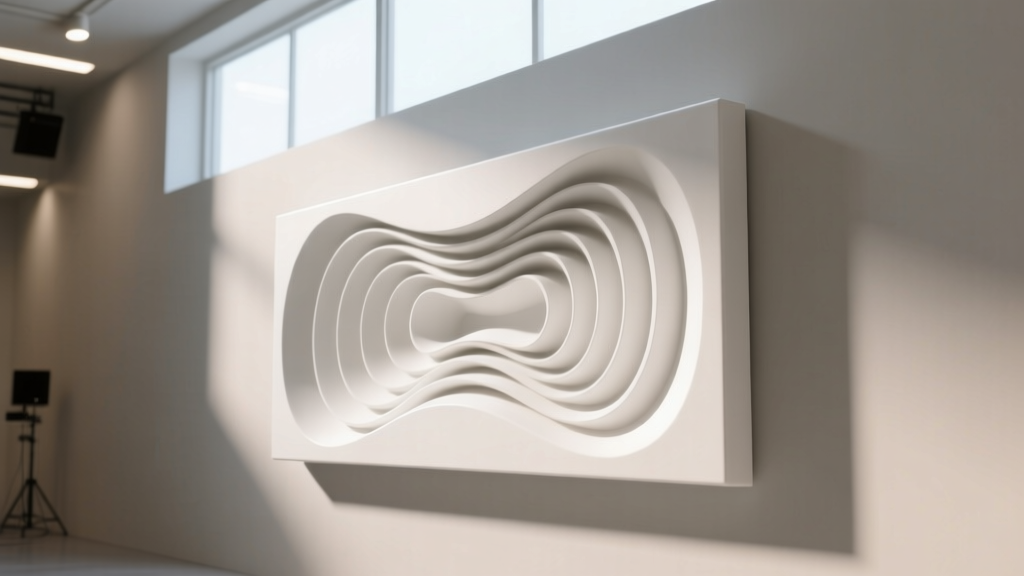
The Physics of the Print
A QRD relies on wells of varying depths, calculated using prime number sequences, to create phase shifts in reflected sound.
- Design Source: You can generate parametric QRD models based on your target frequency (e.g., 1000Hz to 4000Hz) using open-source acoustic calculators found on Hackaday or specialized GitHub repositories.
- Printing Strategy: Print the diffuser in PETG. To save massive amounts of material and time, use a 15% Gyroid infill. The internal gyroid structure actually acts as a secondary acoustic damper, absorbing unwanted micro-resonances inside the plastic wells.
- Mounting: Print the diffuser in modular 150mm x 150mm tiles that interlock via dovetail joints, allowing you to cover a standard 2x4 foot acoustic panel frame seamlessly.
5. Parametric Gridfinity Modular Workshop System
No list of functional maker gadgets is complete without acknowledging the system that has conquered workshops worldwide. Originally created by Zack Freedman, Gridfinity is an open-source, parametric modular storage ecosystem. It is the ultimate organizational gadget to 3D print because it scales infinitely with your workspace.
Optimizing for the Workshop Environment
While many print Gridfinity bins in PLA, a garage or shed environment will subject the plastic to UV degradation and summer heat, causing PLA to warp and soften.
- The ASA Advantage: Print your baseplates and bins in ASA (Acrylonitrile Styrene Acrylate). ASA offers the mechanical strength and heat resistance of ABS but includes UV stabilizers, meaning your tool organizers won't become brittle or yellow after a year in a sunlit garage.
- Speed and Strength: Swap to a 0.6mm nozzle and print at 0.32mm layer height. Gridfinity bins do not require aesthetic perfection; they require structural rigidity and fast print times. A 0.6mm nozzle cuts print time by 40% while creating thicker, stronger walls.
- Magnetic Integration: Design your slicer to pause at layer 4mm to drop in 6x2.5mm neodymium magnets, allowing bins to snap securely to steel workbenches.
Pro-Tips for Printing Functional Gadgets
Transitioning from decorative models to functional engineering requires a shift in mindset. Keep these rules in mind:
- Calibrate for Tolerances, Not Just Flow: A dimensional accuracy test is more important than a temperature tower when printing mechanical parts. Use calipers to measure printed holes and adjust your printer's flow dynamics accordingly.
Respect the Z-Axis Weakness: FDM parts are weakest along the layer lines. When designing or orienting a gadget, ensure that mechanical stress is applied parallel to the layers, not perpendicular to them. - Hardware First, Plastic Second: Always buy your screws, bearings, and servos before you slice the model. Measure the hardware with digital calipers and adjust the CAD clearances. Never trust internet specs blindly.
Frequently Asked Questions
Can I print functional gears in standard PLA?
For low-stress, slow-moving mechanisms like a desk toy, yes. However, for any gadget that transmits real torque or experiences friction, PLA will deform and melt. Use PETG, ABS, ASA, or Nylon for moving mechanical parts.
Where can I find reliable files for these gadgets?
Platforms like Printables and Thingiverse are excellent starting points. Look for models tagged with 'Engineering', 'Functional', or 'Print-in-Place', and always check the maker's notes regarding specific hardware requirements.
Do I need an enclosure to print ASA or ABS gadgets?
Absolutely. ASA and ABS are highly prone to warping and layer delamination due to thermal contraction. An enclosure that maintains an ambient temperature of at least 35°C to 45°C is mandatory for functional parts in these materials.
Written by
Tom ReynoldsTom Reynolds holds a CFA (Chartered Financial Analyst) designation and a B.S. in Finance from the University of Texas at Austin. Before entering tech journalism, he spent 6 years as a quantitative analyst at a hedge fund, building cost-benefit models for consumer product investments. Tom has maintained a proprietary database of over 10,000 tech deals for the past 8 years, developing his signature "penny-per-feature" evaluation framework that calculates the true value proposition of every gadget. His budget gadget reviews are known for their financial rigor — he tracks price history across 15+ retailers, calculates cost-per-use over 3-year lifespans, and identifies the exact inflection point where premium features justify their markup. Tom's deal alerts have saved his readers an estimated .3 million since 2018.