Space-Saving New Gadgets 2025: Compact Tablet & E-Reader Accessories
Discover the best space-saving new gadgets 2025 introduced for e-readers and tablets. Explore ultra-compact cases, magnetic stands, and slim styluses.
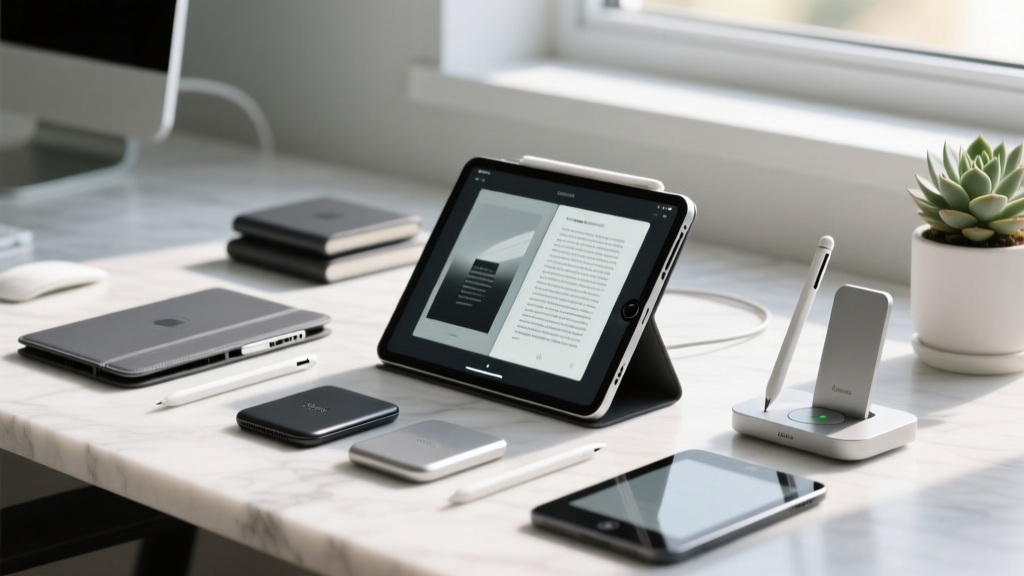
The Shift to Ultra-Compact E-Reader and Tablet Ecosystems
When industry analysts reviewed the new gadgets 2025 brought to market, the prevailing theme wasn't just about raw processing power—it was about extreme spatial efficiency. The release of the M4 iPad Pro and the Kindle Colorsoft shattered thickness records, but hardware is only half the battle. Now, navigating the tech landscape in 2026, we are seeing the true culmination of this space-saving revolution in the accessory market. For tech enthusiasts who travel light, commute daily, or simply despise cluttered desks, bulk is the ultimate enemy.
The latest generation of tablet and e-reader accessories leverages advanced materials like aerospace-grade aramid fiber, N52 neodymium magnetic arrays, and telescopic machined aluminum. These aren't just smaller versions of older products; they are entirely re-engineered solutions designed to reclaim your bag space and desk real estate. Below, we break down the most innovative, space-saving accessories that define the modern minimalist mobile setup.
Top Space-Saving Cases: Protection Without the Bulk
Traditional folio cases add millimeters of thickness and grams of weight, often ruining the sleek profile of modern tablets. The current market leaders prioritize micro-thin profiles while maintaining drop protection through material science rather than sheer mass.
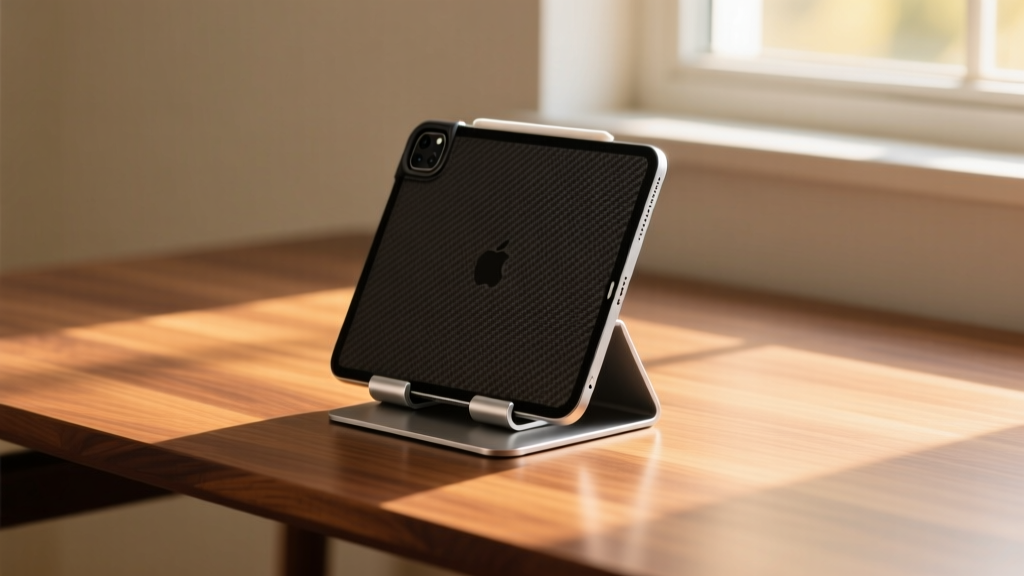
Pitaka MagEZ Case 4 for iPad Pro (11-inch, M4)
Pitaka has long been the gold standard for thinness, but their latest iteration pushes the boundaries of physics. Weighing a mere 89 grams and measuring just 1.1mm thick, this case is crafted from 100% aerospace-grade aramid fiber. It features an embedded MagSafe-compatible magnetic ring, allowing you to snap on accessories without adding a separate magnetic sticker. Priced at $79.99, it is an investment in pure minimalism. According to The Verge's iPad Accessory Guide, aramid fiber cases offer the best strength-to-weight ratio on the market, resisting scratches and micro-abrasions far better than traditional TPU.
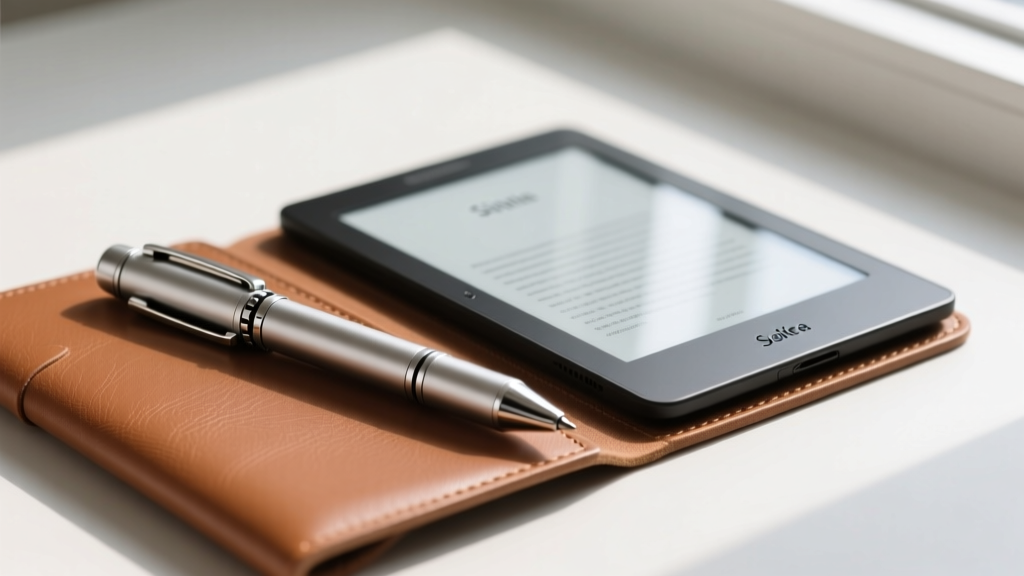
MoKo Ultra-Slim Vegan Leather Case for Kindle Scribe (10.2-inch)
For e-reader enthusiasts, the Kindle Scribe is a powerhouse, but its original leather folio is notoriously heavy. The MoKo Ultra-Slim alternative strips away the excess. At just 145 grams with a 2.5mm bezel, it offers auto wake/sleep functionality and a built-in stylus loop that sits flush against the spine. Costing only $28.50, it’s a fraction of the price of OEM options and saves nearly 40% of the bulk. Tom's Guide frequently highlights MoKo for delivering premium aesthetics without the premium footprint.
Magnetic & Foldable Stands: Reclaiming Desk Real Estate
A tablet is only as good as its viewing angle, but traditional kickstands are cumbersome to pack. The newest magnetic and origami-style stands fold down to the size of a keychain or a deck of cards.
| Stand Model | Folded Dimensions | Weight | Mount Type | Price (Approx) |
|---|---|---|---|---|
| Twelve South Compass Pro | 4.3 x 1.5 x 0.8 in | 95g | Silicone Grip Hinge | $49.99 |
| Lamicall Foldable Aluminum | 5.1 x 2.8 x 0.9 in | 142g | Friction Hinge | $22.99 |
| Grovemade Magnet Stand | 3.5 x 3.5 x 0.4 in | 210g | MagSafe Magnetic | $85.00 |
The Twelve South Compass Pro remains a favorite for travelers. Its tubular aluminum design folds into a tight cylinder that easily slips into a jacket pocket. However, if you want to eliminate physical clamps entirely, the Grovemade Magnet Stand uses high-torque neodymium magnets to hold your tablet in portrait or landscape mode, folding completely flat into a sleek steel puck when not in use. As noted in Wirecutter's Tablet Stand Reviews, magnetic stands drastically reduce the mechanical wear and tear associated with traditional friction hinges.
Stylus Solutions: Tethered, Magnetic, and Telescopic
Digital artists and avid note-takers know the frustration of losing a stylus or dealing with one that pokes a hole in the bottom of a backpack. The space-saving solution? Telescopic engineering and flush magnetic integration.
The MeMo La Telescopic Stylus
While the Apple Pencil Pro is a marvel of technology, its 6.6-inch length makes it awkward for small tech pouches. The MeMo La introduces a twisting telescopic mechanism that collapses the stylus down to a 3.1-inch cylinder when not in use. Machined from anodized aluminum, it features interchangeable nibs and a built-in magnetic strip that snaps directly to the side of your tablet. Priced at $34.99, it is the ultimate pocket-friendly annotation tool.
Flush-Mount Silicone Tethers
For those who prefer the OEM stylus but hate the bulk of a sleeve, ultra-thin silicone tethers (like those from JETech) adhere directly to the back of your tablet case using 3M VHB adhesive. They add less than 0.5mm of thickness to the back of your device while providing a secure, elastic loop that holds the stylus flush against the chassis.
Expert Insight: When optimizing for space, never compromise the center of gravity. A tablet mounted on a lightweight stand with a heavy, off-center stylus attached will tip over on uneven surfaces like airplane tray tables. Always opt for symmetrical magnetic charging or balanced telescopic designs to maintain structural equilibrium.
Power Delivery: Micro-GaN Chargers
No compact setup is complete without a space-saving power brick. The shift to Gallium Nitride (GaN) technology has allowed chargers to shrink dramatically. The Anker Nano 30W GaN Charger features foldable prongs and measures just 1.42 x 1.42 x 1.14 inches. It can simultaneously fast-charge a Kindle Colorsoft and trickle-charge an iPad via a dual-port split, eliminating the need to carry multiple power adapters. At $25.99, it is a non-negotiable inclusion for any minimalist tech kit.
FAQ: Optimizing Your Mobile Tech Footprint
Do ultra-thin cases protect against drops?
Thin cases like the Pitaka MagEZ rely on the tensile strength of aramid fiber to prevent scratches and absorb minor impacts. However, they lack the thick TPU bumpers needed for high-velocity, face-down drops onto concrete. They are designed for urban commuters and careful users, not construction sites.
Are magnetic stands safe for tablets with magnetic sensors?
Modern tablets (2024 and newer) are heavily shielded against magnetic interference. The neodymium magnets used in premium stands are calibrated to trigger the Hall effect sensor for sleep/wake functions without affecting the internal storage or logic board.
How do I clean an aramid fiber case?
Avoid harsh chemical solvents, which can degrade the resin coating. Simply use a microfiber cloth slightly dampened with isopropyl alcohol (70% or lower) to wipe away fingerprints and oils.
Final Verdict: Building Your Minimalist Kit
The narrative surrounding the new gadgets 2025 introduced was largely about hardware thinness, but the 2026 accessory ecosystem has finally caught up, providing the tools necessary to truly embrace a zero-bulk lifestyle. By pairing an aramid fiber case with a telescopic stylus and a folding magnetic stand, you can transform a bulky mobile workstation into a kit that slips effortlessly into a jacket pocket or a slim messenger bag. Space-saving isn't just about shrinking dimensions; it's about intelligent design that respects your physical environment and your daily workflow.
Written by
Tom ReynoldsTom Reynolds holds a CFA (Chartered Financial Analyst) designation and a B.S. in Finance from the University of Texas at Austin. Before entering tech journalism, he spent 6 years as a quantitative analyst at a hedge fund, building cost-benefit models for consumer product investments. Tom has maintained a proprietary database of over 10,000 tech deals for the past 8 years, developing his signature "penny-per-feature" evaluation framework that calculates the true value proposition of every gadget. His budget gadget reviews are known for their financial rigor — he tracks price history across 15+ retailers, calculates cost-per-use over 3-year lifespans, and identifies the exact inflection point where premium features justify their markup. Tom's deal alerts have saved his readers an estimated .3 million since 2018.