9 Cool RV Gadgets to Upgrade Your Rig for 2026 Road Trips
Discover 9 cool RV gadgets for 2026 that transform your rig. From smart water monitors to off-grid cooling, get exact specs and installation tips.
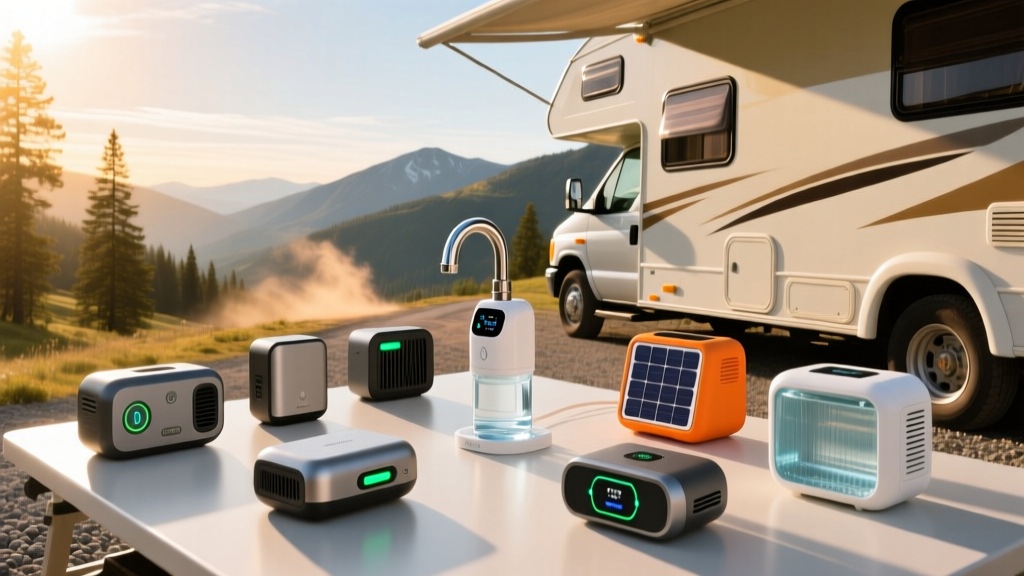

Modern RVing requires balancing off-grid self-sufficiency with smart-home convenience. According to the RV Industry Association, over 40% of RV owners now prioritize boondocking capabilities, driving a massive surge in 12V DC-native appliances and ultrasonic monitoring systems. If you are still relying on analog tank sensors, noisy generator-dependent air conditioners, or physical keys, your rig is operating a decade behind the curve. Below are highly specific, field-tested upgrades that deliver measurable improvements to power efficiency, security, and climate control.
The Connectivity & Power Revolution
Starlink Mini with 12V DC Step-Down Conversion
The Starlink Mini is a game-changer for remote work from the backcountry, drawing between 25W and 40W during active use. However, plugging it into your RV’s 120V AC inverter wastes roughly 15% to 20% of your battery capacity in DC-to-AC-to-DC conversion loss. The optimal setup involves purchasing a third-party 12V DC to 56V POE (Power over Ethernet) injector cable (typically $35-$45). By wiring the injector directly to your 12V fuse block using 12 AWG marine-grade wire and a 5-amp inline fuse, you bypass the inverter entirely. This configuration reduces total system draw to under 3 amps, allowing you to stream and work for 10+ hours on a standard 100Ah LiFePO4 battery.
BMPRO JHub Smart Battery Management System
Standard shunt-based battery monitors only measure current flow, often miscalculating the state of charge (SoC) on lithium batteries due to voltage curve flattening. The BMPRO JHub replaces your dumb shunt with a Bluetooth-enabled BMS that communicates directly with compatible lithium batteries. It tracks individual cell health, temperature, and exact remaining capacity to within 1%. The companion app allows you to set custom low-voltage disconnects, preventing your $800 lithium bank from being permanently damaged by deep discharge if you accidentally leave the awning lights on.
Comparison Matrix: Power Draw & Installation Metrics
| Gadget | Primary Function | Max 12V Amp Draw | Approx. Cost | Install Time |
|---|---|---|---|---|
| Starlink Mini (12V Mod) | Off-grid Wi-Fi | 3.5 Amps | $599 + $40 cable | 1.5 Hours |
| BMPRO JHub | Battery Telemetry | 0.05 Amps | $180 | 2 Hours |
| EcoFlow Wave 2 | Portable Cooling | 50 Amps (Peak) | $899 | 15 Minutes |
| MaxxFan Deluxe 07500K | Ventilation / Exhaust | 5 Amps | $315 | 3 Hours |
| SeeLeveL 709-P | Tank Monitoring | 0.1 Amps | $260 | 4 Hours |
Climate & Comfort Upgrades
EcoFlow Wave 2 Portable Air Conditioner
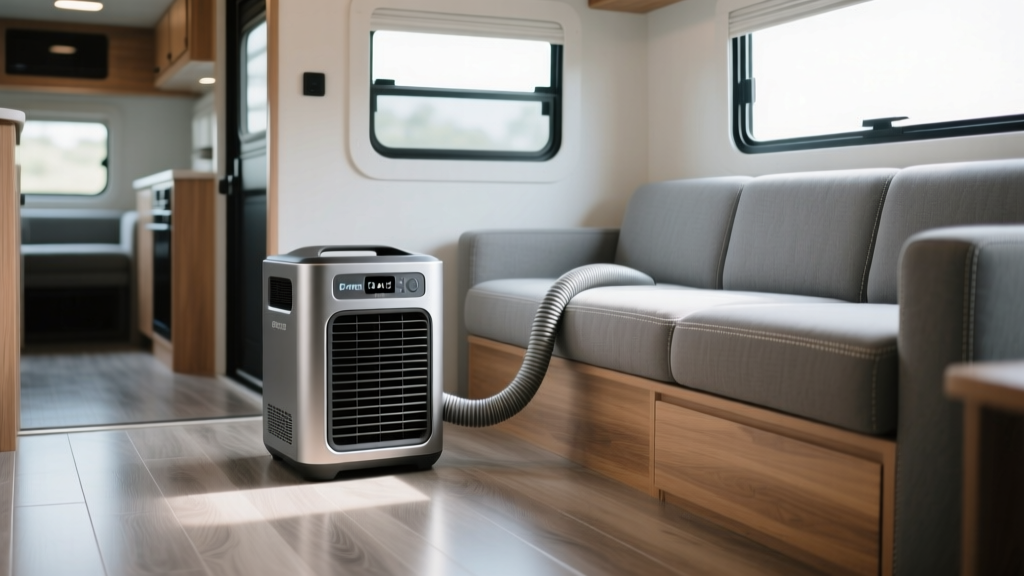
Running a standard 13,500 BTU roof AC requires a massive inverter and a generator or a 5kWh+ battery bank. The EcoFlow Wave 2 offers 5,100 BTUs of cooling using R290 eco-friendly refrigerant, specifically designed for small spaces like RV bedrooms or van builds. In Sleep Mode, it draws roughly 300W continuously. To run this for an 8-hour night, you need a portable power station like the EcoFlow Delta 2 Max (2kWh capacity) or a dedicated 200Ah 12V server-rack lithium battery. A critical installation detail: always route the hot exhaust hose through a custom-sealed acrylic window insert rather than cracking a sliding window, which creates a negative pressure vacuum that pulls hot outside air through your RV’s floor seals.
MaxxAir MaxxFan Deluxe (Model 07500K)
The 07500K model features an integrated rain cover and a remote-controlled motorized lift. Unlike standard roof vents that require you to close them during a downpour, the MaxxFan’s rain sensor and sealed canopy allow it to exhaust hot air or pull in cool night air regardless of the weather. On high, the 12V motor pulls 5 amps, but the real value is in the 10-speed setting, which draws less than 0.5 amps—perfect for continuous, whisper-quiet air circulation while sleeping off-grid.
Utility & Space-Saving Hacks
SeeLeveL 709-P Ultrasonic Tank Monitors
Factory-installed tank sensors use internal metal probes that inevitably become coated in black tank sludge or gray tank grease, rendering them useless within six months. The SeeLeveL 709-P system eliminates this failure point by using ultrasonic sensors that adhere to the *outside* of your polyethylene holding tanks. The sensors read the fluid level through the plastic wall with 98% accuracy. The 709-P control panel supports up to three tanks and integrates into standard RV cutouts. Installation requires dropping the corrugated plastic underbelly to access the tanks, but the time saved diagnosing phantom full-tank readings makes it an essential upgrade for dry campers relying on boondocking best practices.
RV Lock 4.0 Keyless Entry System
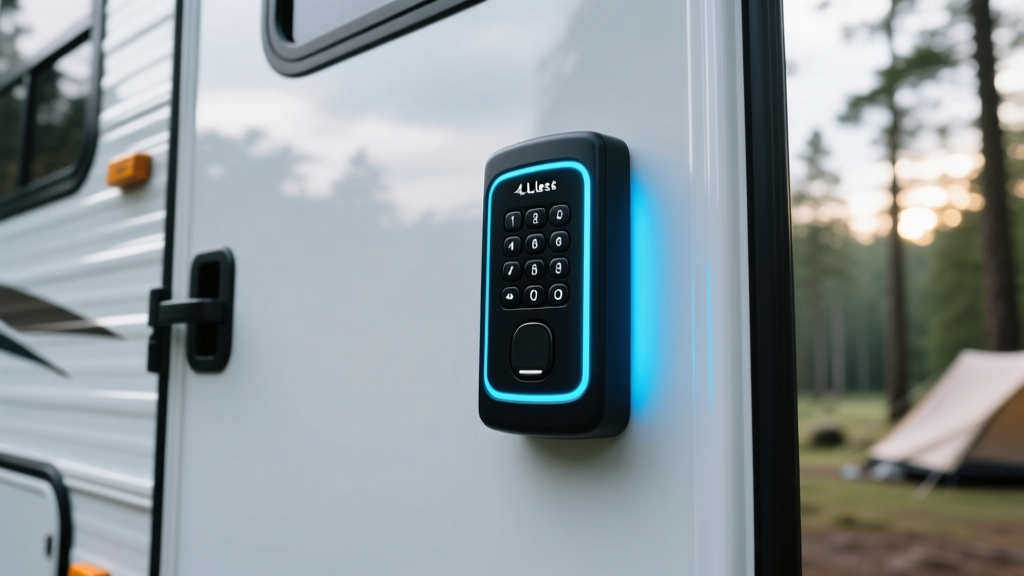
Fumbling with physical keys while carrying groceries or dealing with a sticky barrel lock in freezing rain is a relic of the past. The RV Lock 4.0 replaces your standard TriMark or Bauer entry handle with a motorized deadbolt and backlit capacitive keypad. The standout feature is the auto-lock function, which engages the deadbolt automatically 15 seconds after the door closes. It operates on 4 AA batteries that last roughly 12 months, and includes a physical override key hidden behind a magnetic faceplate in case of total power failure.
Frequently Asked Questions
Will installing these gadgets void my RV manufacturer warranty?
Under the Magnuson-Moss Warranty Act, manufacturers cannot void your entire warranty simply because you installed aftermarket 12V accessories. However, if your BMPRO JHub is wired incorrectly and causes a DC bus short that fries your converter, that specific electrical repair will not be covered. Always use marine-grade tinned wire, heat-shrink ring terminals, and proper fusing to ensure your modifications meet ABYC (American Boat and Yacht Council) standards, which RV manufacturers recognize as safe.
How do I manage power for the EcoFlow Wave 2 without a massive solar array?
The Wave 2 is best utilized as a "pre-cool" device or for targeted bedroom cooling. Run your RV’s roof AC on shore power or generator during the afternoon to drop the ambient interior temperature to 72°F. Then, switch to the Wave 2 on Sleep Mode (300W draw) at night to maintain that temperature using a standard 200Ah lithium battery bank, which easily handles the 2.4kWh overnight requirement.
Are ultrasonic tank monitors affected by cold weather?
Ultrasonic sensors like the SeeLeveL can experience slight calibration drift if the tank exterior drops below freezing, as the acoustic impedance of the plastic changes. If you frequently winter camp in sub-zero temperatures, apply a small 12V heating pad to the sensor area or rely on manual calculation (tracking gallons used via your Shurflo pump’s flow rate) during deep freezes.
Written by
Tom ReynoldsTom Reynolds holds a CFA (Chartered Financial Analyst) designation and a B.S. in Finance from the University of Texas at Austin. Before entering tech journalism, he spent 6 years as a quantitative analyst at a hedge fund, building cost-benefit models for consumer product investments. Tom has maintained a proprietary database of over 10,000 tech deals for the past 8 years, developing his signature "penny-per-feature" evaluation framework that calculates the true value proposition of every gadget. His budget gadget reviews are known for their financial rigor — he tracks price history across 15+ retailers, calculates cost-per-use over 3-year lifespans, and identifies the exact inflection point where premium features justify their markup. Tom's deal alerts have saved his readers an estimated .3 million since 2018.