Essential Compact Gear for the Gadget Traveller 2026
Maximize carry-on space with our 2026 compact gear guide for the gadget traveller. Discover GaN chargers, modular routers, and space-saving tech.
The Reality of 2026 Carry-On Limits
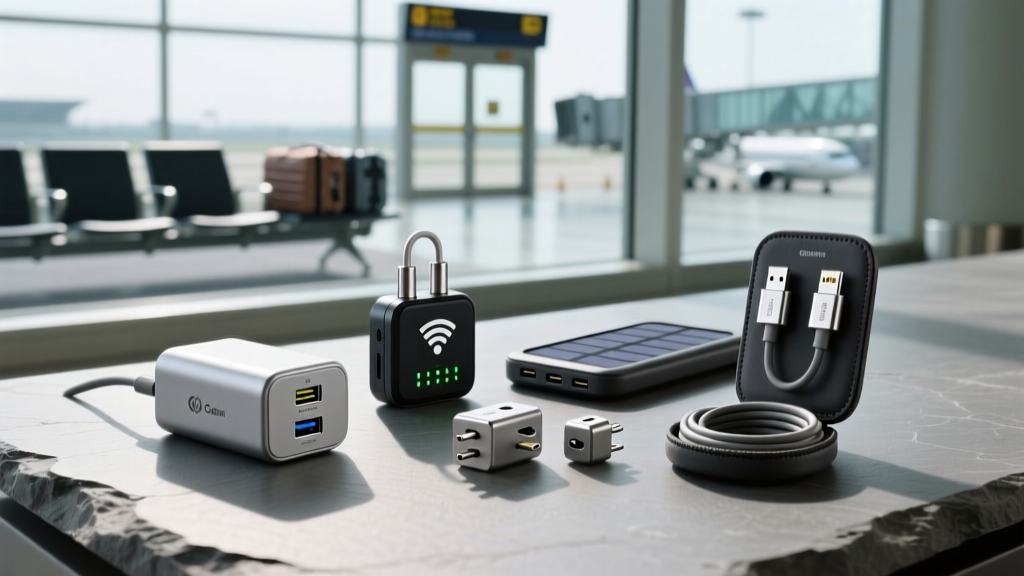
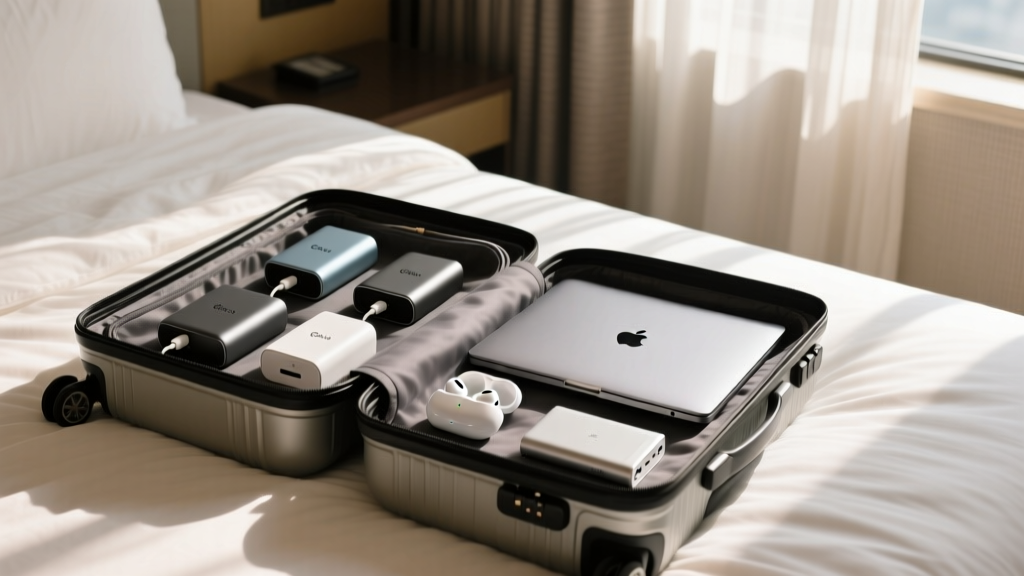
Airlines are aggressively shrinking cabin baggage allowances to maximize ancillary revenue. With budget carriers like Ryanair enforcing a strict 40x20x25cm personal item limit and legacy carriers scrutinizing overhead bin space, the modern gadget traveller can no longer rely on bulky, single-purpose electronics. Every cubic inch of your carry-on must justify its weight and volume. This guide breaks down the exact compact tech solutions, dimensional trade-offs, and space-saving frameworks you need to maintain a full mobile office without checking a bag.
The Power Core: High-Density GaN Charging
Gallium Nitride (GaN) technology has completely replaced silicon in high-end travel chargers, allowing for significantly higher power density. For a multi-device setup (laptop, phone, wireless earbuds, and smartwatch), carrying multiple OEM bricks is a volumetric failure. You need a single, high-output GaN hub.
Charger Comparison Matrix
| Model | Max Output | Ports | Weight | Volume (cm³) | Best For |
|---|---|---|---|---|---|
| UGREEN Nexode Pro 160W | 160W | 4 (3 USB-C, 1 USB-A) | 382g | 148 cm³ | Power users with 2 laptops |
| Satechi 165W USB-C | 165W | 4 (3 USB-C, 1 USB-A) | 454g | 165 cm³ | Apple ecosystem travellers |
| Anker Nano 65W (315) | 65W | 3 (2 USB-C, 1 USB-A) | 187g | 92 cm³ | Ultralight minimalists |
Expert Insight: The UGREEN Nexode Pro 160W (Model CD315) offers the best power-to-volume ratio in 2026. However, be aware of its power allocation logic: if you plug into the bottom USB-C port while using the top two, the top port drops to 65W. Always plug your primary 100W laptop into the top-most USB-C1 port to guarantee full PD 3.1 negotiation.
Connectivity on the Go: Pocket-Sized Networking
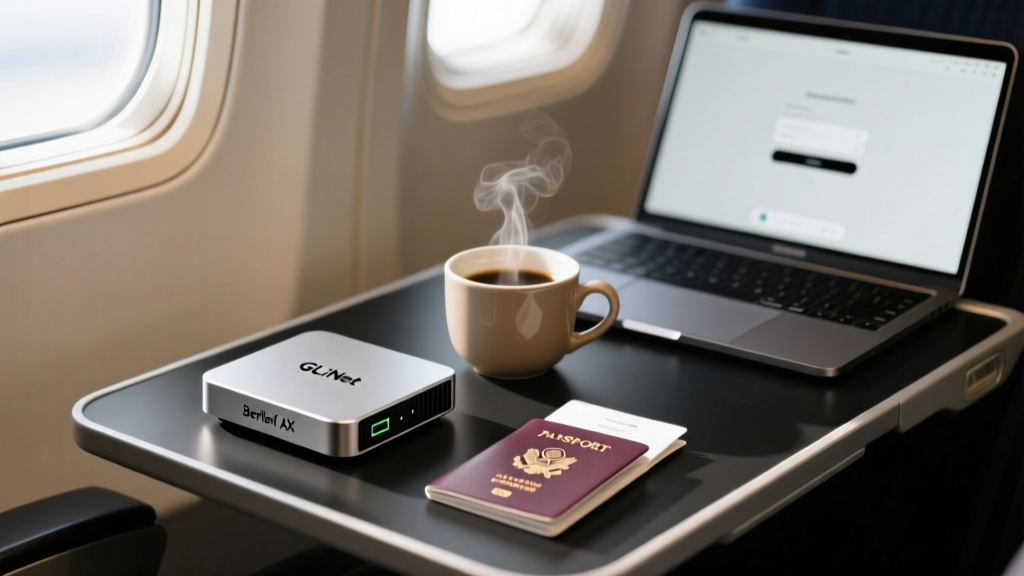
Hotel Wi-Fi in 2026 remains notoriously congested and heavily throttled. Relying on public networks introduces both latency and security risks. The solution is a dedicated travel router that fits in your pocket and creates a secure, private subnet.
The GL.iNet GL-MT3000 (Beryl AX) Advantage
Weighing just 195g and measuring 94x58x25mm, the Beryl AX is the undisputed king of travel routers. It supports Wi-Fi 6 and features a 2.5G Ethernet port. But its true value for the gadget traveller lies in its software capabilities:
- Captive Portal Bypass: Many hotels restrict you to one device per room. The Beryl AX allows you to clone your smartphone’s MAC address. Authenticate your phone on the hotel portal, then switch the router to the cloned MAC address, instantly granting internet access to your entire subnet.
- Wireless Repeater Mode: It can connect to the hotel's 5GHz band and broadcast a private 2.4GHz/5GHz network simultaneously, isolating your devices from other guests on the public network.
- USB-C Power: It runs directly off your laptop's USB-C port or your GaN charger, eliminating the need for a dedicated wall wart.
The "Dead Space" Packing Rule
Never pack a rectangular tech item without analyzing the negative space it creates. The UGREEN charger leaves a 15mm gap when placed against a laptop chassis. Slide flat, braided USB-C cables (like the 0.5m Anker 333) and a slim microSD card reader into this exact void. If you can feel empty air inside your tech pouch, you are wasting cubic centimeters.
The Modular Workspace: Low-Profile Input
Productivity on the road requires tactile feedback, but traditional mechanical keyboards are impossibly thick. The NuPhy Air75 V2 solves this. At just 17.5mm thick at its highest point and weighing 310g, it slides directly into the laptop sleeve of your backpack. Unlike scissor-switch alternatives, it offers hot-swappable low-profile mechanical switches, ensuring you don't sacrifice typing speed in cramped economy seats.
Pair this with the Logitech MX Anywhere 3S. While not the absolute lightest mouse on the market (141g), its MagSpeed electromagnetic scroll wheel and ability to track on glass surfaces (like airplane tray tables and hotel marble desks) make it an indispensable, space-efficient tool that eliminates the need for a separate mousepad.
Containment: X-Pac and Dimensional Pouches
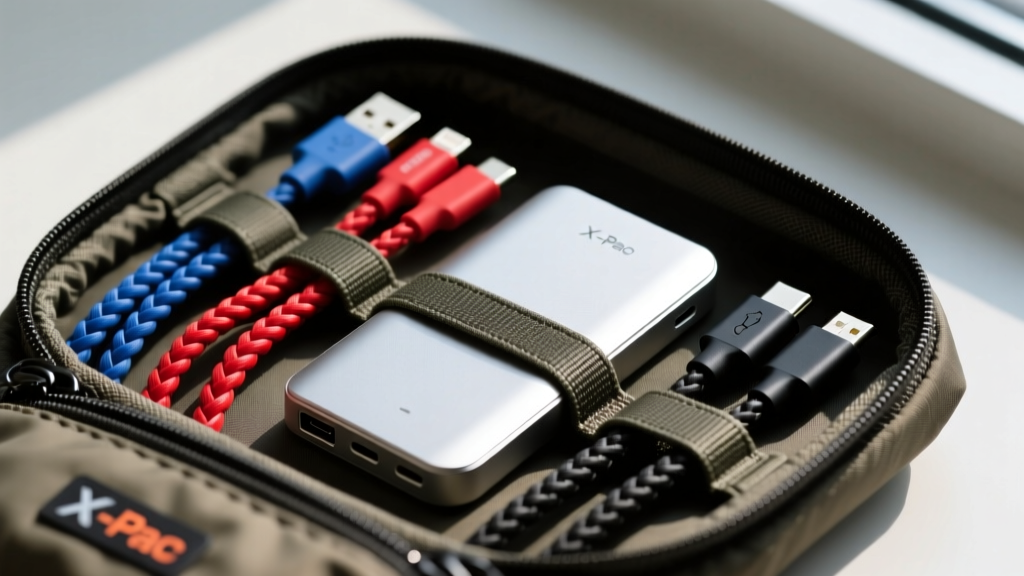
A gadget traveller's organization system must withstand compression. When you stuff a tech pouch into an overhead bin, soft nylon bags collapse, tangling your cables and crushing delicate connectors. You need structured, weather-resistant materials.
Material Spotlight: X-Pac VX21
The Peak Design Tech Pouch utilizes X-Pac VX21 sailcloth. This material features a diamond grid of polyester reinforcement, offering massive tear strength and total waterproofing while remaining incredibly thin. The internal origami-style elastic loops are specifically spaced to hold standard GaN bricks and 2.5-inch SSDs without overlapping, preventing the "cable nest" effect that plagues cheaper pouches.
Storage: Ditch the HDD for NVMe
If you are still packing a mechanical external hard drive, you are wasting space and risking data loss from drop impacts. The Samsung T9 NVMe SSD (4TB) weighs 122g, measures a mere 85 x 60 x 12mm, and delivers read speeds up to 2,000 MB/s. You can transfer 100GB of 4K drone footage in under a minute. Its rubberized exterior survives 3-meter drops, completely eliminating the need for bulky, shock-proof hard cases.
Regulatory Edge Cases: Lithium Limits in 2026
Security agencies strictly regulate lithium-ion batteries in carry-on luggage. According to the TSA battery guidelines and IATA cabin baggage regulations, power banks must be carried in the cabin, not checked, and generally must not exceed 100 Watt-hours (Wh) without airline approval.
How to calculate your power bank's Wh:
Formula: (mAh × Voltage) / 1000 = Wh
Most lithium cells operate at 3.7V. Therefore, a 20,000mAh power bank equals 74Wh (20,000 × 3.7 / 1000). This is safely under the 100Wh limit. However, a massive 30,000mAh brick pushes 111Wh, which will be confiscated at the security checkpoint unless you have pre-arranged airline permission.
Recommended High-Density Power Bank
The Anker Prime 20,000mAh (200W) is the optimal choice. It pushes exactly 74Wh, features a smart digital display showing exact battery health and input/output wattage, and weighs 493g. It can fast-charge a 16-inch MacBook Pro and an iPhone simultaneously without triggering thermal throttling.
What to Leave Behind: The Exclusion Matrix
Space-saving is as much about what you exclude as what you pack. Apply this decision framework before zipping your bag:
- Dedicated Point-and-Shoot Cameras: Unless the camera features a sensor larger than 1-inch (like the Sony RX100 VII), modern flagship smartphones with computational photography will yield better dynamic range and require zero extra packing volume.
- Universal Travel Adapters with Surge Protection: Most "surge protecting" travel adapters are massive and often violate local grid standards. Instead, pack a tiny, non-surge plug adapter (like the Ceptic universal plug, 45g) and rely on your GaN charger's built-in 100-240V voltage regulation and over-current protection.
- Multi-port USB Hubs: Modern laptops and GaN chargers have enough native ports. Adding a 7-port hub introduces cable clutter and failure points. Use a simple, short 2-in-1 USB-C dongle only if you strictly require HDMI out for client presentations.
Frequently Asked Questions
Can I bring my travel router through airport security?
Yes. Travel routers do not contain lithium batteries (they are powered via USB) and do not transmit cellular signals. You can leave it in your bag during X-ray screening, though placing it in a bin is recommended if the scanner uses older CT technology that struggles with dense electronics.
How do I prevent my tech pouch from bulging?
Limit your cable lengths. You rarely need a 2-meter cable in a hotel room. Standardize your kit with 0.3m and 1m braided cables. The reduction in coil diameter saves up to 30% of pouch volume and prevents the rigid bends that cause internal wire fraying over time.
Written by
Tom ReynoldsTom Reynolds holds a CFA (Chartered Financial Analyst) designation and a B.S. in Finance from the University of Texas at Austin. Before entering tech journalism, he spent 6 years as a quantitative analyst at a hedge fund, building cost-benefit models for consumer product investments. Tom has maintained a proprietary database of over 10,000 tech deals for the past 8 years, developing his signature "penny-per-feature" evaluation framework that calculates the true value proposition of every gadget. His budget gadget reviews are known for their financial rigor — he tracks price history across 15+ retailers, calculates cost-per-use over 3-year lifespans, and identifies the exact inflection point where premium features justify their markup. Tom's deal alerts have saved his readers an estimated .3 million since 2018.