Coolest Kitchen Gadgets: Compact Prep Tools for 2026
Discover the coolest kitchen gadgets for small spaces, featuring over-sink cutting boards, TPU prep mats, and vertical surface tools to maximize counters.
The Geometry of Micro-Kitchens: Rethinking the Cutting Board
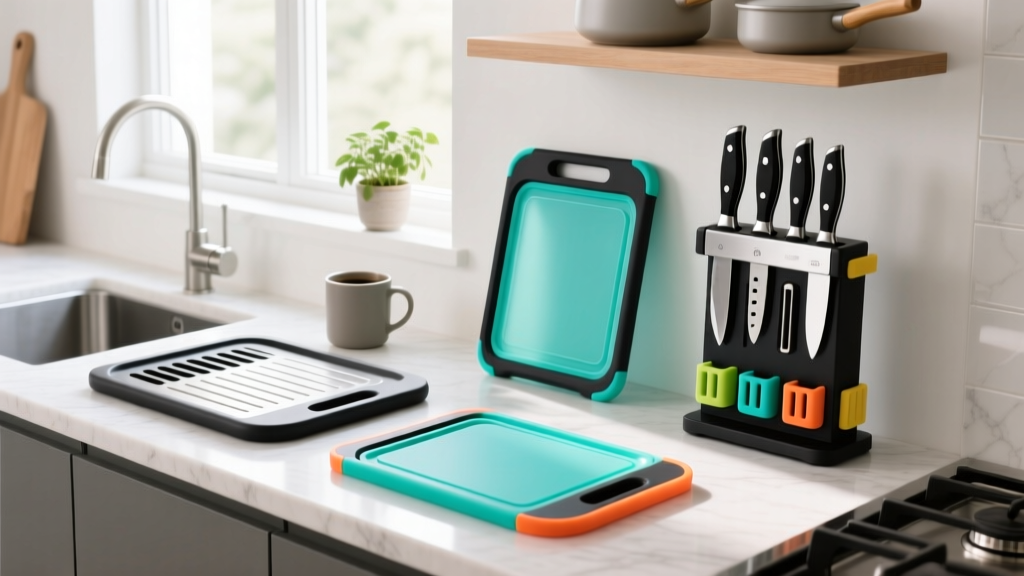
Standard kitchen design allocates roughly 30 to 40 square feet of counter space, but in micro-apartments, galley kitchens, and RVs, that number frequently drops below 15 square feet. A traditional 18-by-12-inch end-grain maple cutting board consumes 1.5 square feet of prime real estate—nearly 10% of your total prep area. When evaluating the coolest kitchen gadgets for compact environments in 2026, the focus has shifted from mere multi-functionality to spatial geometry. The best space-saving surface tools do not just fold away; they actively exploit unused architectural dead zones, such as the airspace above sinks and the vertical plane of the backsplash.
Over-the-Sink Expandable Systems: Reclaiming Dead Space
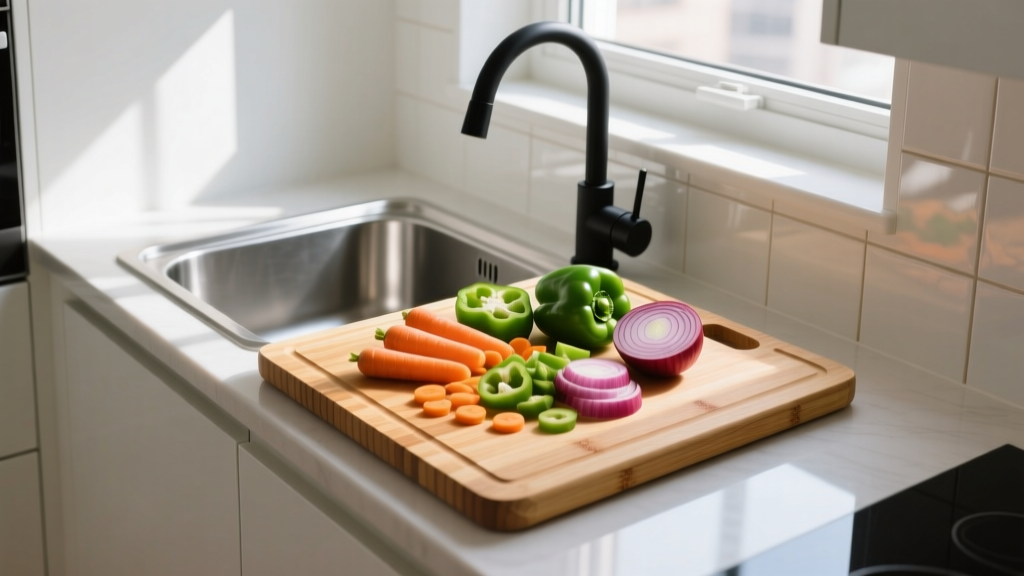
The area directly above your kitchen sink is typically wasted airspace. Over-the-sink cutting boards bridge this gap, converting a 24-inch sink basin into a fully functional prep station while allowing food scraps to be swept directly into an in-sink strainer or garbage disposal. However, structural integrity is the primary failure point for these gadgets. Cheap plastic models bow under the weight of a winter squash, while poorly sealed wood warps from the ambient humidity of the dish rack below.
Top Pick: Gorilla Grip Expandable Bamboo Over-Sink Board
Priced between $32 and $38, the Gorilla Grip Expandable Bamboo board utilizes a telescoping rail system that adjusts from 18 to 24 inches. Bamboo is technically a grass, offering a Janka hardness rating of 1,380 lbf (pounds-force), making it 16% harder than standard red oak and highly resistant to knife scarring.
- Critical Measurement: Ensure your sink lip has at least a 1-inch flat margin on both sides. The board's rubberized feet require a 0.75-inch contact patch to prevent lateral slipping during heavy chopping.
- Failure Mode: Leaving the board resting over a wet sink overnight. The trapped moisture will cause the bamboo staves to delaminate at the glue lines. Always store it vertically against a backsplash when not in use.
Material Science: TPU vs. PVC Flexible Mats
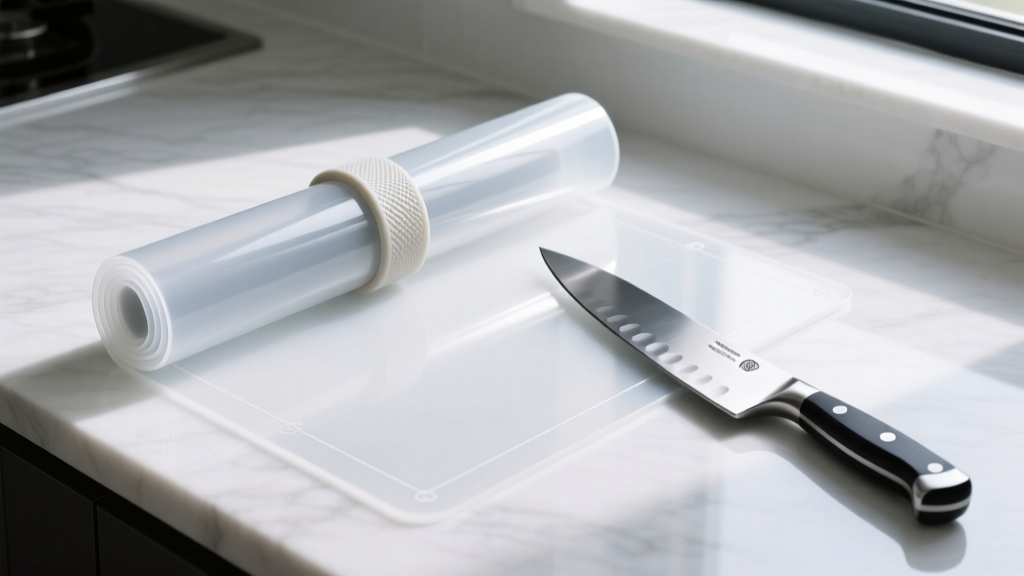
Flexible cutting mats are a staple for small kitchens because they roll into 2-inch diameter cylinders, easily slipping into utensil crocks or junk drawers. However, the polymer composition dictates both the lifespan and the sanitary safety of the mat. Most budget mats are made from PVC (Polyvinyl Chloride) or HDPE (High-Density Polyethylene). When a sharp chef's knife strikes these rigid plastics, it severs the polymer chains, leaving deep micro-grooves.
According to FDA guidelines on cutting board sanitation, these deep grooves harbor bacteria that survive standard dishwasher cycles. The superior alternative for 2026 is TPU (Thermoplastic Polyurethane). TPU has a lower Shore A durometer combined with high elastomeric memory. Instead of severing, the knife blade pushes the TPU molecules aside; the material rebounds, closing the micro-cut by up to 80%. This drastically reduces the surface area available for E. coli and Salmonella colonization, a critical factor when preventing cross-contamination in tight quarters where raw poultry and fresh produce share the same limited prep zone.
Space-Saver Cutting Board Matrix
Use this comparison matrix to identify the exact surface tool required for your specific spatial constraints and cooking volume.
| Tool Type | Footprint (Stored) | Material | Price Range | Primary Failure Mode |
|---|---|---|---|---|
| Over-Sink Expandable | 24' x 12' (Vertical) | Moso Bamboo | $32 - $45 | Humidity warping / Glue delamination |
| Flexible Roll-Up Mat | 2' Diameter Cylinder | TPU (Thermoplastic Polyurethane) | $18 - $25 | Edge curling after 50+ dishwasher cycles |
| Collapsible Colander Board | 14' x 10' x 2' | PP Plastic / Silicone | $25 - $30 | Silicone hinge tearing under heavy load |
| Under-Cabinet Slide-Out | 0' (Hidden) | HDPE (High-Density Polyethylene) | $40 - $65 | Track jamming from flour/crumb buildup |
Integrated Prep Stations: Collapsible Colanders & Chutes
When counter space is non-existent, combining the cutting surface with the washing vessel eliminates the need for a separate colander. The Prepworks by Progressive Collapsible Colander & Cutting Board Set ($28) features a rigid BPA-free polypropylene board that snaps over a collapsible silicone colander. The board includes a built-in sliding chute. You chop vegetables on the flat surface, sweep them into the chute, and they drop directly into the colander below for rinsing. This reduces the workflow footprint by 40% and keeps the surrounding counters dry, a vital feature in galley kitchens where the sink and stove are often less than three feet apart.
Vertical Surface Tools: Reclaiming the Backsplash
A compact kitchen cannot afford a bulky wooden knife block, which typically consumes a 10-by-10-inch square of counter space and harbors dust and moisture. The solution is vertical magnetic storage. However, cheap magnetic strips use weak ceramic magnets that fail to hold heavy forged German knives, leading to dangerous drops.
Top Pick: Misen Walnut Magnetic Knife Strip
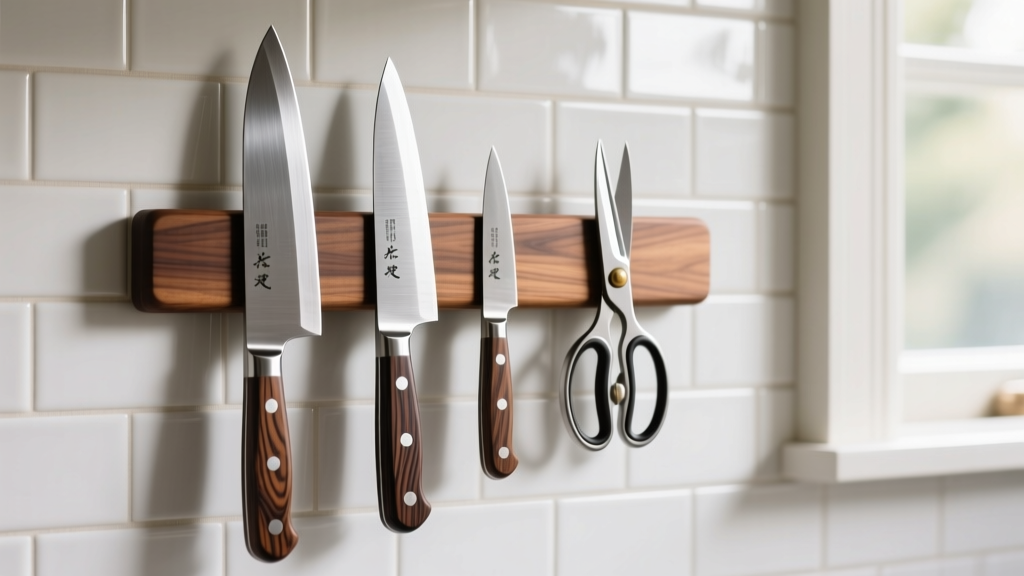
Retailing for $45 to $55, the Misen 12-inch strip conceals high-grade neodymium rare-earth magnets behind a solid walnut facade. The magnetic pull force is calibrated to hold up to 15 pounds of steel, securely anchoring heavy cleavers and Japanese gyutos without exposing the blades to the scratching of metal-on-metal contact.
- Locate Studs: Use a stud finder to locate wall studs behind your backsplash. Drywall anchors are insufficient for the dynamic shear force of pulling heavy knives off the magnets daily.
- Drill Through Tile: If mounting on ceramic or glass subway tile, use a diamond-tipped hole saw bit and apply continuous water lubrication to prevent the tile from shattering from thermal shock.
- Mount at Chest Height: Install the strip exactly 18 inches above the countertop. This provides clearance for an 8-inch chef's knife handle while keeping the blades out of the reach of small children.
Decision Framework: Which Compact Surface Tool Fits Your Layout?
Selecting the right gadget requires matching the tool to your specific architectural bottleneck. Apply this logic tree to finalize your purchase:
- If your sink is a single-bowl undermount (24+ inches wide): Invest in the Over-Sink Expandable Bamboo Board. It provides the largest continuous flat surface and turns a dead zone into a primary prep area.
- If you have zero drawer space but own a deep utility crock: Purchase a 4-pack of TPU Flexible Roll-Up Mats. Assign one color per food group (red for raw meat, green for produce) to maintain strict FDA sanitation standards in a micro-kitchen.
- If your counters are entirely occupied by permanent appliances (air fryer, espresso machine): Install an Under-Cabinet Slide-Out HDPE board. These mount to the underside of your upper cabinets and pull out like a drawer, providing an instant 12-by-10-inch prep shelf that vanishes when not in use.
Optimizing a small kitchen is not about buying smaller versions of standard tools; it is about deploying the coolest kitchen gadgets that fundamentally alter how you interact with your spatial geometry. By moving prep work over the sink, up the backsplash, and into flexible polymers, you can achieve the functionality of a 200-square-foot kitchen within a 50-square-foot footprint.
Written by
Lena ChenLena Chen earned her M.S. in Human-Computer Interaction from Carnegie Mellon University and a B.S. in Electrical Engineering from the University of Washington. She has spent the past decade specializing in smart home architecture and IoT ecosystems, helping over 200 homeowners design fully connected living spaces. Lena is a certified Matter protocol consultant and has published peer-reviewed research on voice-first interface design in the ACM Digital Library. Her reviews of smart home products combine deep technical analysis with real-world usability testing, evaluating everything from Zigbee mesh stability to Alexa skill responsiveness. She regularly speaks at CEDIA Expo and CES smart home panels.