Best RV Gadgets Buyer's Guide: Top Tech for 2026 Trips
Upgrade your rig with our 2026 RV gadgets buyer's guide. Discover top-rated smart leveling, solar tech, and security gear for ultimate road trip comfort.


The 2026 RV Tech Landscape: Beyond Basic Upgrades
The era of guessing your battery bank's state of charge or manually cranking a satellite dish is officially over. As we navigate through 2026, the integration of smart home technology into recreational vehicles has shifted from luxury aftermarket mods to essential baseline expectations. According to the Recreational Vehicle Industry Association (RVIA), over 68% of new motorhomes and towables now ship with some form of IoT-enabled climate or power management. However, the real magic happens when you customize your rig with the right aftermarket RV gadgets.
Whether you are a weekend warrior hitting state parks or a full-time boondocker relying on off-grid solar, selecting the correct tech ecosystem is critical. This comprehensive buyer's guide cuts through the marketing fluff to bring you exact model numbers, real-world pricing, and the non-obvious failure modes you need to know before outfitting your rig for the 2026 travel season.
The Essential RV Gadgets Matrix
Before diving into individual product reviews, it helps to categorize your tech investments. The Family Motor Coach Association (FMCA) frequently highlights that balanced tech integration across power, security, and connectivity yields the highest satisfaction rates among full-timers.
| Category | Top 2026 Gadget Pick | Avg. Cost | Primary Benefit | Installation Difficulty |
|---|---|---|---|---|
| Power Monitoring | Victron Energy SmartShunt 500A | $160 | Precise LiFePO4 state-of-charge tracking via Bluetooth | Moderate (Requires busbar wiring) |
| Security & Access | RVLock V4 Keyless Entry | $230 | Eliminates physical keys; integrates with 12V alarm systems | Easy (Direct drop-in replacement) |
| Safety & Towing | TireMinder Smart TPMS (A1A) | $550 | Real-time tire temp and pressure alerts to prevent blowouts | Easy (Screw-on sensors) |
| Connectivity | Starlink Roam (Standard) | $599 + $150/mo | High-speed LEO satellite internet in remote boondocking spots | Moderate (Roof mount & cable routing) |
| Navigation | Garmin RV 1095 | $399 | Custom routing for low clearances, weight limits, and propane tunnels | Easy (Suction cup or hard mount) |
Power & Energy Management Systems
Upgrading to a Lithium-Iron-Phosphate (LiFePO4) battery bank is only half the battle. If you cannot accurately monitor your power consumption, you will inevitably strand yourself with a dead BMS (Battery Management System). Factory-installed analog voltmeters are notoriously inaccurate for lithium chemistry, which maintains a flat voltage curve until it is nearly empty.
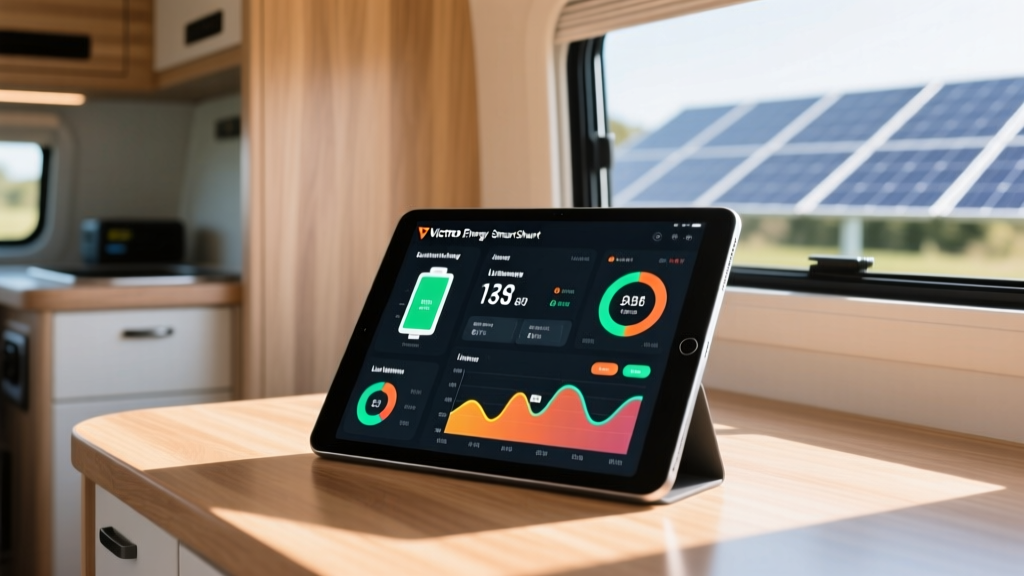
Victron Energy SmartShunt 500A/50mV
Retailing around $160, the Victron SmartShunt is the undisputed king of RV battery monitoring. Unlike cheap shunt monitors that only measure voltage, the SmartShunt tracks actual amp-hours in and out of your battery bank.
- Real-World Insight: The SmartShunt connects via Bluetooth to your smartphone. However, in a 2026 metal-skinned Airstream or aluminum-framed travel trailer, Bluetooth signals can struggle to penetrate the Faraday cage effect. Plan to install a Victron GlobalLink 520 ($140) if you want remote cellular monitoring while away from the rig.
- Installation Tip: Mount the shunt as close to the battery bank's negative terminal as possible. Ensure all DC loads pass through the shunt's load side, or your state-of-charge calculations will drift over time.
Security, Access, and Exterior Monitoring
Fumbling for a physical key in the dark while carrying groceries or dealing with a frozen lock cylinder in sub-zero temperatures is a relic of the past. Furthermore, tire blowouts remain one of the most dangerous and expensive hazards on the highway, often causing thousands of dollars in sidewall and wheel well damage before the driver even notices.
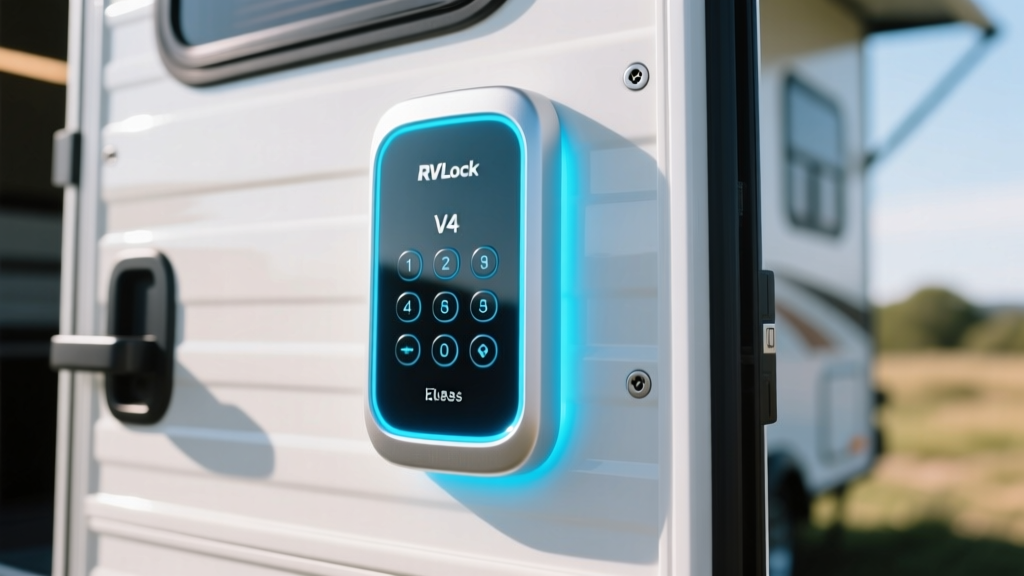
RVLock V4 Keyless Entry Handle
The RVLock V4 ($230) is a direct replacement for the standard 275mm x 375mm TriMark handles found on 90% of modern travel trailers and fifth wheels. It features an illuminated keypad, RFID fob support, and a mechanical override.
Expert Warning: The V4 runs on 4 AA batteries. A common failure mode reported by Good Sam Club members is battery corrosion due to condensation inside the exterior housing. Apply a thin layer of dielectric grease to the battery terminals during installation and swap the batteries every 6 months, regardless of usage.
TireMinder Smart TPMS (A1A System)
For rigs with dual rear wheels or heavy Class A motorhomes, the TireMinder A1A system ($550 for a 6-sensor kit) is non-negotiable. It monitors both pressure and temperature, alerting you to a slow leak or a sticking brake caliper before a catastrophic failure occurs.
- Cap vs. Flow-Through: TireMinder offers both. Flow-through sensors allow you to add air without removing the sensor, but they require metal valve stems. Never install flow-through sensors on flexible rubber valve stems; the weight of the sensor will cause the rubber to fatigue and snap at highway speeds.
- Signal Repeater: If your rig is over 30 feet long, or if you are towing a boat behind a fifth wheel, you must install the included signal repeater in the rear of the RV to ensure the cab monitor receives data from the rear axles.
Connectivity: Starlink Roam vs. 5G Cellular Boosters
Remote work from an RV is entirely dependent on your connectivity stack. In 2026, the debate has settled into a two-tiered approach: LEO Satellite for remote boondocking, and 5G Cellular for resort and suburban camping.
Starlink Roam (Standard Actuated)
At $599 for the hardware and $150/month for the Regional Roam plan, Starlink has democratized high-speed internet in the backcountry. The Standard Actuated dish automatically levels itself and finds the optimal satellite constellation.
- The Obstruction Reality: Starlink requires a clear view of the sky. If you prefer camping under dense pine canopies in the Pacific Northwest or deep hardwood forests in the Appalachians, Starlink will constantly drop packets. You will need a telescoping pole mount (like the RV Roam Pole, $180) to elevate the dish 15-20 feet above the treeline.
Winegard ConnecT 5G
For those who stick to RV parks and developed campgrounds, the Winegard ConnecT 5G ($650) acts as an omnidirectional antenna and WiFi extender. It pulls in weak 5G cellular signals from distant towers and broadcasts a strong, secure local network inside your rig. It is a one-time hardware cost, though you will still need to insert an active SIM card from a provider like T-Mobile or Verizon.
Navigation and Route Planning
Using a standard smartphone GPS in a 40-foot motorhome or a truck towing a 10,000-pound fifth wheel is a recipe for disaster. Standard maps do not account for vehicle height, weight restrictions, or roads where propane tanks are legally prohibited.
Garmin RV 1095
Priced at $399, the Garmin RV 1095 features an 8-inch edge-to-edge display and custom routing based on your exact rig profile. You input your height, length, weight, and axle configuration. The device will actively route you away from low-clearance bridges, weight-restricted bridges, and steep grades that could burn out your transmission or overheat your brakes. It also includes a directory of RV parks and services, preloaded with Good Sam data.
Decision Framework: Outfitting Your Rig by Travel Style
Do not buy gadgets just to have them. Tailor your purchases to your specific travel profile to maximize ROI and minimize parasitic power draw.
Profile 1: The Off-Grid Boondocker
- Priority 1: Victron SmartShunt & Solar Charge Controllers (Maximize energy efficiency).
- Priority 2: Starlink Roam (Essential for remote work outside cell zones).
- Priority 3: Compost Toilet or Nature's Head (Eliminates the need for black tank hookups).
Profile 2: The Resort Hopper & Tailgater
- Priority 1: Winegard ConnecT 5G (Leverages park infrastructure and urban towers).
- Priority 2: RVLock V4 (Convenience for frequent comings and goings).
- Priority 3: Garmin RV 1095 (Safe routing through busy tourist corridors and unfamiliar cities).
Frequently Asked Questions (FAQ)
Do smart RV gadgets cause excessive parasitic battery drain?
Yes, if not managed properly. Devices like the Starlink router, smart TPMS monitors, and IoT climate controllers draw continuous milliamps. In a standard 100Ah lithium bank, a combined parasitic draw of 500mA will drain about 1.2Ah per day. While negligible for short trips, full-timers should install a master kill switch for IoT devices when storing the RV for the winter.
Can I install these gadgets myself, or do I need a certified RV technician?
Drop-in replacements like the RVLock V4 and Garmin RV 1095 are easily handled by DIYers with basic hand tools. However, integrating a Victron SmartShunt requires working with heavy-gauge DC wiring and busbars. If you are not comfortable crimping 2/0 AWG wire and using a torque wrench to manufacturer specifications, hire an ABYC or RVDA-certified technician to prevent fire hazards.
Will upgrading my RV tech void my manufacturer warranty?
Under the Magnuson-Moss Warranty Act, a manufacturer cannot void your entire RV warranty simply because you added an aftermarket gadget. However, if your DIY wiring of a battery monitor causes a short circuit that fries your inverter, that specific repair will not be covered. Always use marine-grade tinned copper wire and proper ANL fuses for any 12V upgrades.
Written by
Ryan TanakaRyan Tanaka holds a B.S. in Mechanical Engineering from Oregon State University and is a certified AWS Solutions Architect. He has built over 80 custom electronics projects ranging from CNC machines to IoT sensor networks, and has reviewed development boards, 3D printers, soldering equipment, and maker tools for the past 6 years. Ryan is an active contributor to 12 open-source hardware projects on GitHub and teaches monthly workshops at three hackerspaces across the Pacific Northwest. His reviews combine engineering rigor with accessibility — he evaluates products not just on specs but on documentation quality, community support, and learning curve for beginners. He has presented at Maker Faire Bay Area, Open Hardware Summit, and the Adafruit community showcase, and maintains a popular blog documenting his build processes.