Essential EV Road Trip Gadgets & Utensils for 2026
Master outdoor cooking and charging with our 2026 guide to EV V2L gadgets, smart utensils, and essential overlanding accessories for electric vehicles.
The V2L Revolution: Turning Your EV into a Mobile Basecamp
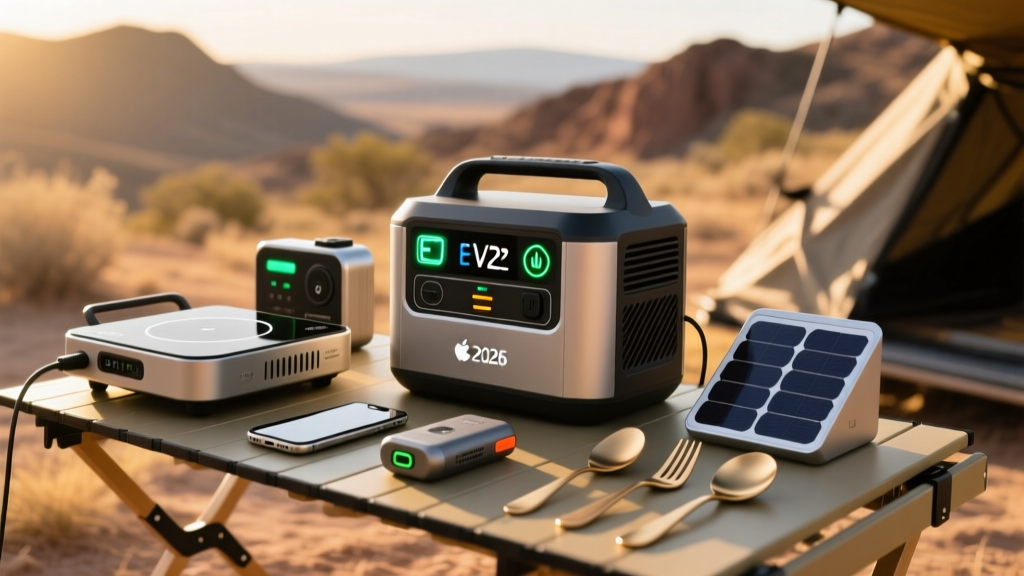
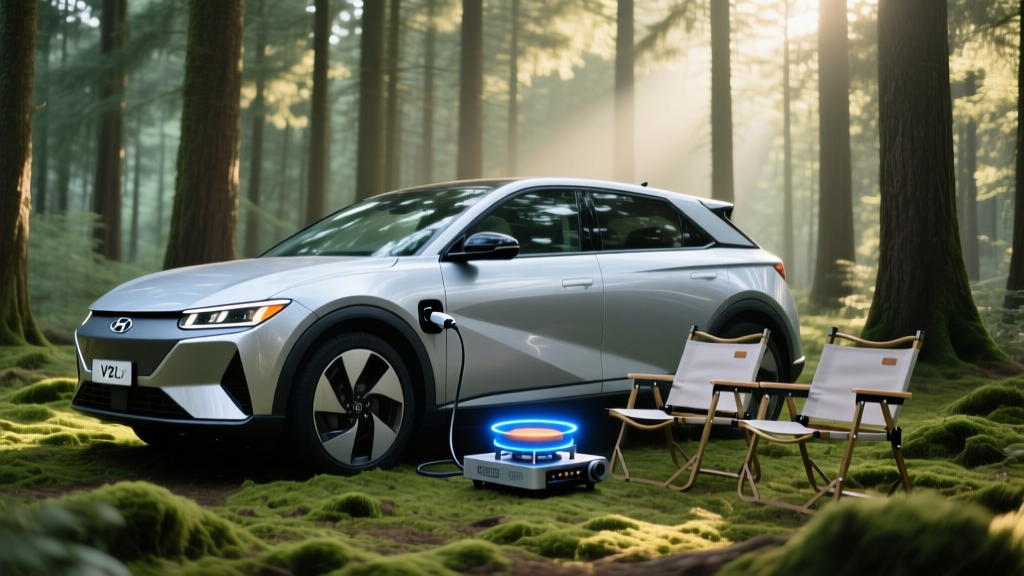
The era of hauling noisy, gas-guzzling generators into the wilderness is officially over. As we navigate the 2026 outdoor season, the intersection of electric vehicle (EV) technology and high-end camping gear has birthed a new category of overlanding. By leveraging Vehicle-to-Load (V2L) capabilities, modern EVs act as massive, silent, mobile power stations. But having a 77kWh battery on wheels is only half the equation; selecting the right EV road trip gadgets and utensils is what transforms a standard campsite into a luxury basecamp.
Whether you are tailgating in a Cybertruck, overlanding in a Rivian R1S, or car-camping in a Hyundai Ioniq 5, managing power draw and utilizing smart culinary tools requires a strategic approach. According to the Alternative Fuels Data Center, understanding your battery's thermal management and discharge limits is critical before you plug in your first appliance. Let us break down the exact hardware, power math, and seasonal strategies you need for your next off-grid excursion.
Understanding Vehicle-to-Load (V2L) Limits
Not all V2L systems are created equal. Before purchasing high-draw gadgets, you must know your vehicle's continuous output ceiling:
- Hyundai/Kia (E-GMP Platform): Capped at 3.6kW (approx. 16A at 230V or 12A at 120V). Ideal for small appliances and smart utensils.
- Ford F-150 Lightning (Pro Power Onboard): Up to 9.6kW (240V/40A). Can run heavy-duty tools, large induction ranges, and multiple fridges simultaneously.
- Tesla (Cybertruck/Powershare): Up to 11.5kW total, with specific limits per bed and cabin outlet.
Expert Insight: If your EV lacks native V2L (like older Model Ys), you can use a third-party inverter connected directly to the 12V battery, but this is limited to roughly 150W—enough for charging laptops and small USB-C utensils, but useless for cooking.
Top EV Charging Gadgets for the Trail
When you are not using your EV to power your camp, you need to replenish its cells. Destination charging at remote campsites requires specialized EV charging gadgets that adapt to unpredictable infrastructure.
1. Lectron V-Box Pro 48A Portable Charger
Priced around $450, the Lectron V-Box Pro is a non-negotiable for serious EV overlanders. It features a NEMA 14-50 plug and a 21-foot cable. The Edge Case: Many state parks only offer TT-30 (30A, 120V) RV outlets. To use the V-Box Pro here, you need a TT-30 to 14-50 adapter. However, the physical adapter does not magically increase the amperage. You must manually dial down the V-Box via its companion app to 24A to prevent tripping the park's breaker. Failing to do this is the number one reason EV campers experience charging faults in the wild.
2. Emporia V2L Adapter (J1772 to 15A Outlet)
For EVs without a native 120V bed outlet, the $150 Emporia V2L adapter plugs directly into your charge port, tricking the car into thinking it is charging while safely routing up to 15 amps of AC power to a standard 3-prong outlet. It includes built-in GFCI protection, a vital safety feature when cooking outdoors in damp conditions.
Electric Culinary Utensils & Cooking Gear
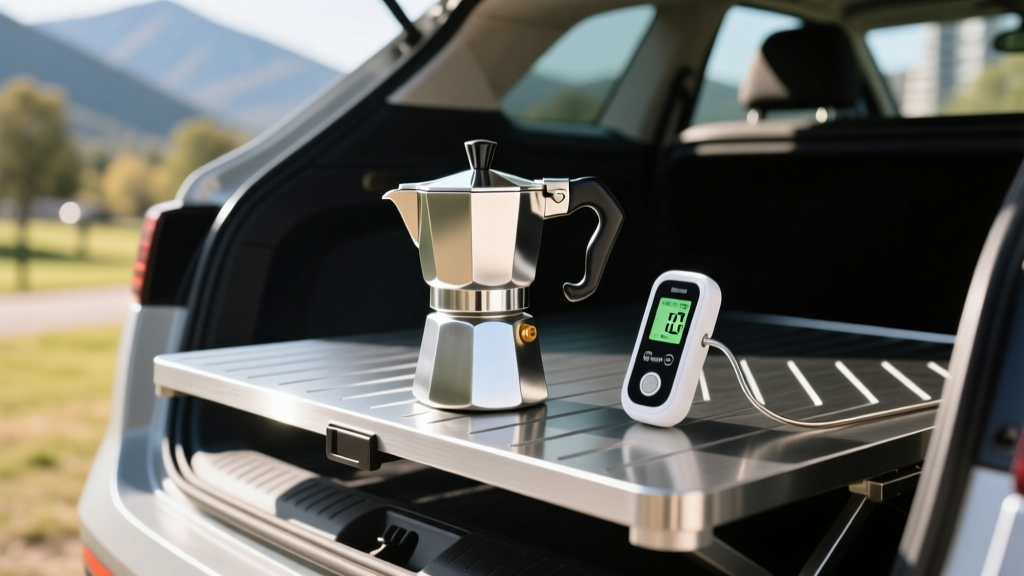
The true magic of V2L shines when you unpack your cooking gear. Gas stoves are banned in many high-fire-risk national forests during the summer, making electric culinary gadgets and utensils a legal and practical necessity.
The Smart Thermometer & Blender Combo
Forget manual basting and guesswork. The MEATER Block ($330) is a premium smart meat thermometer that operates entirely wirelessly. It connects via Bluetooth to your phone and charges via a USB-C bamboo dock. Plugging this dock into your EV's USB port ensures your probes are always at 100% when you start smoking a brisket. Pair this with the Ninja Blast Portable Blender ($60), which also charges via USB-C, allowing you to whip up trail-side smoothies or marinades without draining dedicated battery banks.
Power Draw Comparison: V2L Cooking Gadgets
How much range are you actually sacrificing to cook a meal? The table below illustrates the real-world impact on a standard 77.4kWh battery (e.g., Kia EV6 or Hyundai Ioniq 5) assuming an 80% usable V2L discharge limit.
| Gadget / Utensil | Max Wattage | Typical Usage Time | Energy Consumed | Range Impact (Approx) |
|---|---|---|---|---|
| Dometic Portable Induction Cooktop | 1800W (Run at 1200W) | 45 mins (Dinner) | 0.9 kWh | ~3.5 miles |
| EcoFlow Glacier Fridge (Compressor) | 65W (Avg 25W) | 24 hours | 0.6 kWh | ~2.3 miles |
| Electric Kettle (1.0L) | 1500W | 4 mins (Boil) | 0.1 kWh | ~0.4 miles |
| Smart Utensils (MEATER, Blenders) | 15W - 60W | Charging Cycle | 0.02 kWh | Negligible |
Pro-Tip: Never run a 1800W induction cooktop on maximum on a 15A V2L circuit (which maxes out at roughly 1800W continuous). Sustained max-draw will cause thermal throttling in the adapter or trip the vehicle's internal safety relay. Set your cooktop to medium-high (approx. 1200W) for a sustained, safe boil.
Power Management: Don't Strand Yourself
The golden rule of EV overlanding is the 20% Buffer. Modern EV software allows you to set a V2L discharge limit. Always set this to 20% or 30%. This ensures that no matter how many gadgets and utensils you run overnight, the vehicle will automatically cut power to the outlets before depleting the battery below your safe driving threshold to reach the nearest DC Fast Charger.
Field Note: V2L discharge is not 100% efficient. The vehicle's onboard inverter experiences a 5-8% energy loss during the DC-to-AC conversion. Factor this into your power budget if you are running high-draw appliances like space heaters or large portable fridges in extreme temperatures.
Seasonal Considerations: Winter vs. Summer Overlanding
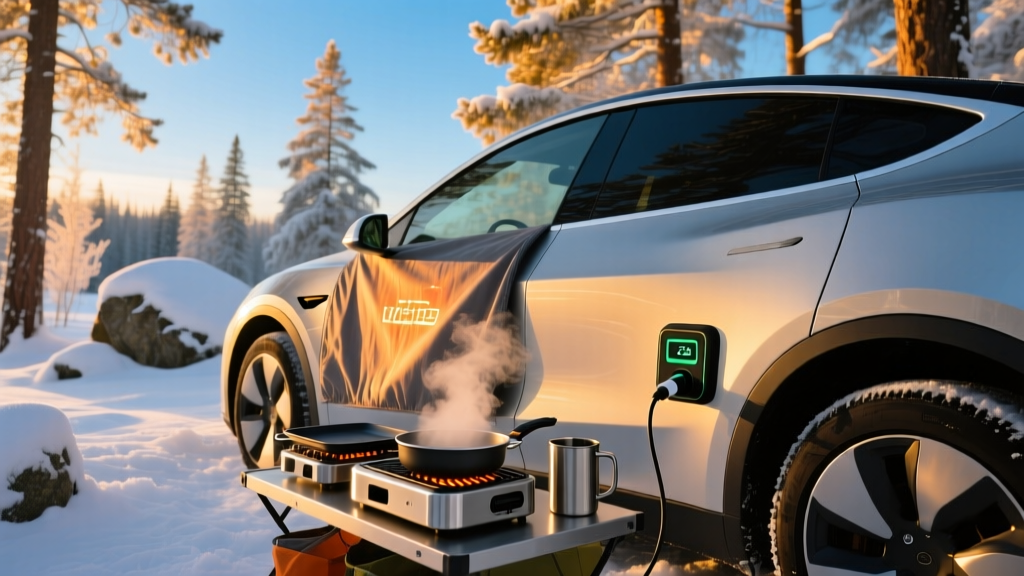
Your EV gadgets and utensils setup must adapt to the seasons. Lithium-ion batteries are highly sensitive to temperature extremes, and your power strategy must reflect the environment.
Summer: The Cooling Tax
In peak summer, your EV's thermal management system (TMS) will actively use battery power to cool the cabin and the battery pack, especially if you utilize "Camp Mode" to keep the AC running for sleeping. A portable fridge like the Dometic CFX3 45 ($900) will draw more wattage as ambient temperatures rise. Position your EV in deep shade to reduce the TMS load, freeing up more juice for your electric cooking utensils.
Winter: The Preconditioning Imperative
Cold weather reduces battery efficiency by up to 30%. If you are winter camping, your V2L gadgets should include a battery warming blanket if you are parked in sub-zero temperatures for days. More importantly, when it is time to leave, you must use your EV's app to precondition the battery while still plugged into a campsite pedestal. If you rely solely on the battery to precondition itself for a fast charge on the highway, you will lose an additional 5-10% of your range just heating the cells.
FAQ: EV Outdoor Essentials
Can I use my EV to power an electric grill?
Yes, but with caution. A standard George Foreman indoor/outdoor electric grill draws about 1600W. This is dangerously close to the 1800W limit of a 15A V2L adapter. We recommend using a portable induction cooktop instead, as it offers precise wattage control, allowing you to dial it down to 1200W to ensure a stable, uninterrupted power draw.
Will using V2L degrade my EV battery faster?
According to battery health studies cited by Car and Driver, the degradation from V2L usage is negligible. The energy drawn is equivalent to simply driving the car a few extra miles. As long as you avoid deep discharges (dropping below 10% state-of-charge), your battery's long-term health will not be compromised by powering your campsite gadgets.
What is the best way to secure V2L adapters at public campsites?
Theft of EV charging gear is a rising concern at unattended trailheads. Invest in a locking J1772 cable lock or a hardened steel padlock that threads through the release catch of your V2L adapter. Always route your heavy-duty extension cords under your vehicle's chassis where they are out of sight and difficult to snatch.
Written by
Jake MorrisonJake Morrison holds a B.S. in Electrical Engineering from UC Berkeley and an MBA from Stanford Graduate School of Business. With over 12 years of hands-on experience in consumer electronics, he previously served as a senior product engineer at a Silicon Valley startup before transitioning to tech journalism. Jake has personally tested and benchmarked over 3,000 gadgets across categories including smartphones, wearables, smart home devices, and audio equipment. His durability testing methodology — involving controlled drop tests, thermal cycling, and water submersion — is widely cited by major tech publications. He is a certified CompTIA A+ technician and a contributing editor to the IEEE Consumer Electronics Magazine.