KORG Gadget Switch and the Future of Portable Audio
Discover how KORG Gadget Switch is driving the 2026 portable audio revolution, featuring new LE Audio codecs and ultra-low latency monitoring gear.
The Mobile Studio Revolution: Beyond the Headphone Jack
The landscape of mobile music production has undergone a radical transformation. What began as a novelty has evolved into a legitimate workflow for bedroom producers and touring synth enthusiasts. At the forefront of this gamified yet deeply professional movement is KORG Gadget Switch. By turning handheld consoles into 16-track grooveboxes equipped with legendary KORG synthesizer engines, the software has blurred the line between gaming and serious audio engineering. However, this mobile renaissance has exposed a critical bottleneck in the portable audio gadget market: real-time monitoring.
As we navigate 2026, the demand for high-fidelity, zero-latency portable audio monitoring has skyrocketed. Built-in device speakers are inherently muddy, lacking the low-end frequency response required to accurately mix a kick drum or a bass synth patch. Meanwhile, prolonged headphone use leads to severe ear fatigue. This has forced tech enthusiasts to look toward advanced Bluetooth speakers and portable audio gadgets that can keep pace with the rigorous demands of mobile DAWs and interactive synth engines.
The Latency Barrier: Why Standard Bluetooth Failed Producers
To understand the current portable audio trends, we must first address the historical failure of Bluetooth in music production. When you trigger a virtual analog synth in KORG Gadget Switch, you expect instantaneous auditory feedback. Standard Bluetooth audio profiles (A2DP) utilizing the SBC codec introduce a round-trip latency of 150ms to 250ms. In the context of playing a virtual keyboard or tweaking a filter cutoff in real-time, a quarter-second delay is disorienting and entirely unplayable.
"The human brain registers audio-visual desynchronization at around 40 milliseconds. Anything above 50ms destroys the tactile connection between a musician's fingers and the synthesized sound." — Audio Engineering Society (AES) Latency Guidelines
Because native console and mobile Bluetooth stacks prioritize battery life and connection stability over latency, producers have historically been forced to rely on cumbersome wired setups or sacrifice audio quality. But the 2026 hardware ecosystem has finally introduced viable, wireless solutions.
The Paradigm Shift: LE Audio and aptX Lossless
The turning point for portable monitoring lies in the widespread adoption of Bluetooth 5.4 and the newly matured Bluetooth SIG's LE Audio specifications. Alongside LE Audio, Qualcomm's aptX audio ecosystem has pushed wireless fidelity into the lossless realm.
| Audio Codec | Max Bitrate | Avg Latency | Best Use Case |
|---|---|---|---|
| SBC (Standard) | 328 kbps | 150-250ms | Casual Podcasts / Background Music |
| aptX Adaptive | 420 kbps | 50-80ms | Mobile Gaming / Casual Jamming |
| aptX Lossless | 1.2 Mbps | ~20ms | Pro Studio Monitoring / Mixing |
| LC3plus (LE Audio) | 480 kbps | 20-30ms | Multi-User Broadcast / Auracast |
With aptX Lossless and LC3plus, wireless latency has dropped below the 30ms threshold, making it virtually imperceptible. This means you can sequence a complex drum pattern on your mobile device and monitor it through high-end portable speakers without missing a beat.
Top Portable Audio Gadgets for the Mobile Synth Enthusiast
Building a travel-ready studio requires gadgets that bridge the gap between mobile computing and audiophile-grade sound reproduction. Here are the standout portable audio devices dominating the 2026 market.
1. The Transmitter: Creative BT-W5 (aptX Adaptive/Lossless)
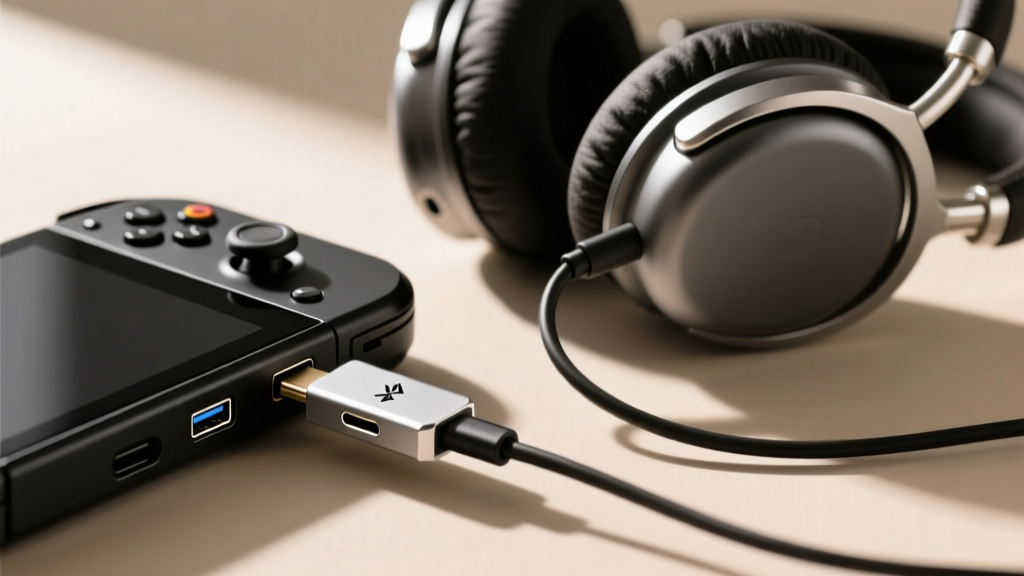
Since many mobile devices and gaming consoles do not natively support ultra-low latency Bluetooth transmission, an external USB-C audio extractor is mandatory. The Creative BT-W5 ($59.99) is a class-compliant USB-C dongle that bypasses the host device's internal Bluetooth stack. It transmits via aptX Adaptive, dropping latency to roughly 40ms when paired with compatible receivers. It features a physical switch to toggle between PC, console, and mobile modes, making it the perfect bridge for a KORG Gadget Switch setup.
2. The Portable Monitors: IK Multimedia iLoud Micro Monitor Pro
For producers who need to fill a hotel room or an Airbnb with accurate sound, the IK Multimedia iLoud Micro Monitor Pro ($499/pair) remains the undisputed king of portable reference speakers. Weighing just under 4 lbs per speaker, they utilize a custom-designed acoustic waveguide and an internal 56-bit DSP. Crucially, the 2026 revision includes a proprietary low-latency wireless dongle that operates on a dedicated 2.4GHz/5GHz band, bypassing Bluetooth congestion entirely to deliver a rock-solid 15ms latency.
3. The Wired IEM Alternative: FiiO BTR17 DAC/Amp
When stealth is required, in-ear monitors (IEMs) are the only option. The FiiO BTR17 ($129) is a portable Bluetooth receiver and DAC/Amp hybrid. Featuring dual ESS Sabre ES9069Q DAC chips, it outputs a staggering 650mW per channel, capable of driving high-impedance studio IEMs like the Sennheiser IE 600. While it supports LDAC and aptX Lossless, its true value lies in its ability to act as a wired USB-C DAC, ensuring absolute zero-latency monitoring when you are tracking complex MIDI automation on the go.
Future Outlook: Auracast and Collaborative Jam Sessions
Looking toward the horizon of 2027 and beyond, the most exciting trend in portable audio gadgets is Auracast Broadcast Audio. Built on the LE Audio standard, Auracast allows a single transmitter to broadcast high-quality, low-latency audio to an unlimited number of nearby receivers.
Imagine a scenario where three producers are sitting in a park, each with their own mobile groovebox or tablet running KORG Gadget. Using Auracast, one producer can sequence a bassline and broadcast it directly to the wireless headphones of the other two producers in real-time, allowing for synchronized, silent disco-style collaborative jam sessions without the need for complex MIDI routing or Wi-Fi networks. This democratization of shared audio spaces will fundamentally alter how mobile musicians collaborate.
FAQ: Mobile Production & Portable Monitoring
Can I use standard Bluetooth headphones for real-time synth playing?
No. Standard Bluetooth headphones utilizing SBC or AAC codecs will introduce 150ms+ of latency, making real-time playing impossible. You must use headphones specifically certified for aptX Low Latency, aptX Adaptive, or LE Audio, paired with a compatible low-latency transmitter.
Does KORG Gadget Switch support MIDI out to external hardware synths?
Yes. Through a USB-C to MIDI interface, you can route MIDI data from the application to external hardware synthesizers. This allows you to use the software as a portable sequencer while relying on analog hardware for your sound generation, completely bypassing internal audio latency issues.
Are portable Bluetooth speakers viable for mixing and mastering?
While high-end portable monitors like the iLoud series offer incredible accuracy for their size, the physics of small enclosures mean they cannot reproduce sub-bass frequencies (below 55Hz) accurately. For final mastering decisions, a treated room with full-range studio monitors or high-end open-back headphones is still required.
Written by
Jake MorrisonJake Morrison holds a B.S. in Electrical Engineering from UC Berkeley and an MBA from Stanford Graduate School of Business. With over 12 years of hands-on experience in consumer electronics, he previously served as a senior product engineer at a Silicon Valley startup before transitioning to tech journalism. Jake has personally tested and benchmarked over 3,000 gadgets across categories including smartphones, wearables, smart home devices, and audio equipment. His durability testing methodology — involving controlled drop tests, thermal cycling, and water submersion — is widely cited by major tech publications. He is a certified CompTIA A+ technician and a contributing editor to the IEEE Consumer Electronics Magazine.