Off-Grid Solar Power for Your Star Citizen Mining Gadget Setup
Learn how to build an off-grid solar power station to run a high-end PC for Star Citizen. Expert picks for LiFePO4 batteries and pure sine inverters.
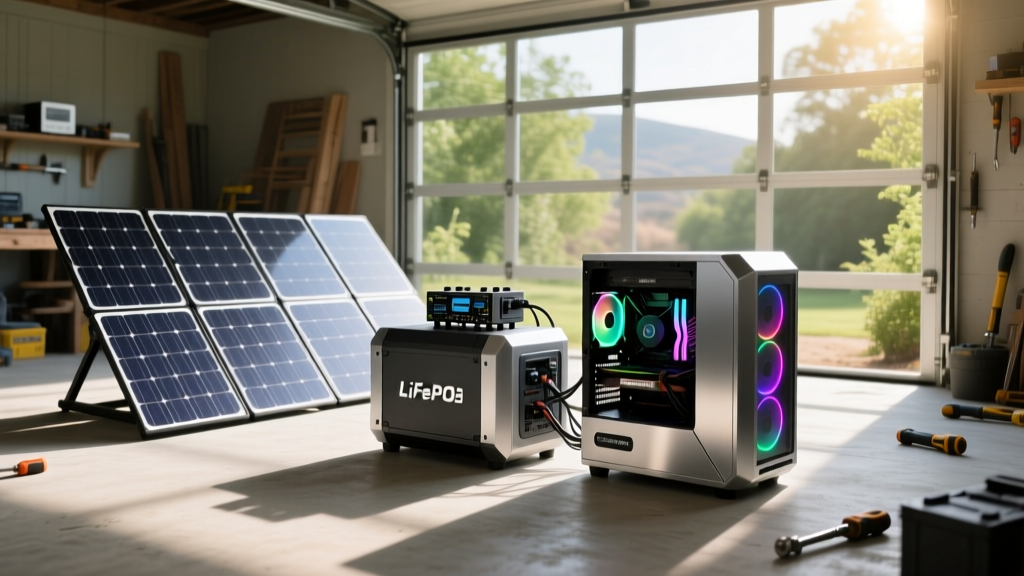
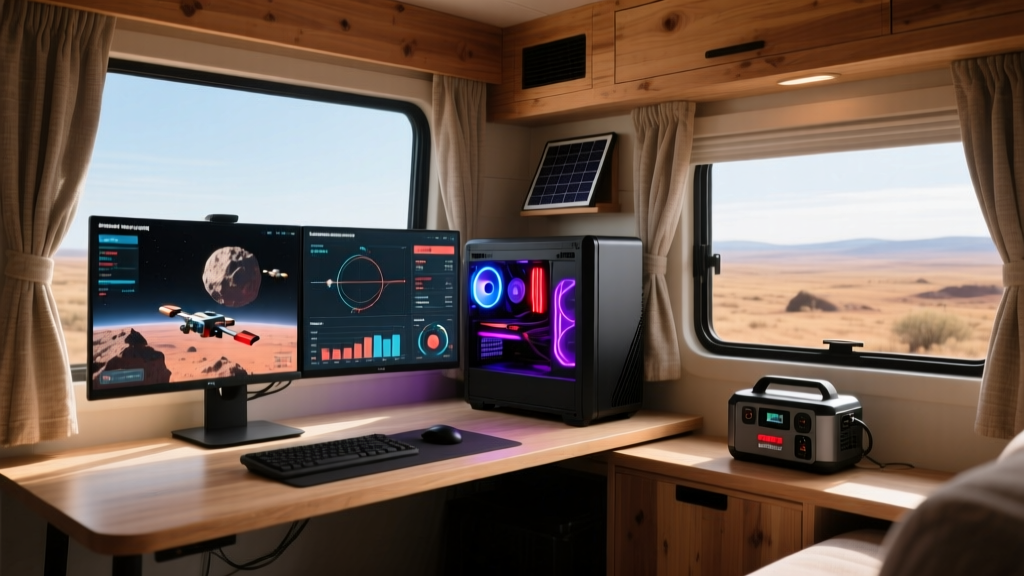
The Wattage Problem: Why Space Sims Drain Batteries Fast
Taking your high-end gaming rig off-grid is the ultimate dream for tech enthusiasts living in RVs, remote cabins, or off-grid homesteads. But running a modern, power-hungry PC on solar energy presents a unique set of engineering challenges. Space simulation games are notoriously unoptimized and hardware-intensive. When you are configuring your real-life power supply to match your favorite in-game mining gadget, Star Citizen players know that the Prospector ship isn't the only thing drawing massive wattage—your physical GPU and CPU are working just as hard to render the Stanton system.
A typical high-end 2026 gaming rig featuring an Intel Core i9-14900K or AMD Ryzen 9 7950X3D paired with an NVIDIA RTX 5090 can easily pull 650W to 800W of continuous system power during heavy load. Add two 32-inch 4K monitors (80W), a mechanical keyboard with RGB lighting, powered speakers, and a Wi-Fi router, and your continuous draw sits comfortably around 850W. If you plan on a standard five-hour deep-space mining session, you need a minimum of 4,250Wh (4.25 kWh) of usable battery capacity, assuming zero solar input during your session.
Sizing Your Off-Grid Solar Array for a Gaming Rig
To sustain this load without depleting your batteries, you must calculate your solar recharge rate against your consumption. According to data from Tom's Hardware's GPU power hierarchy, modern flagship graphics cards alone can transient spike up to 600W. Your solar array and inverter must handle both the continuous load and these micro-second transient spikes.
| Component | Continuous Draw (W) | 5-Hour Total (Wh) | Required Solar Input (Assuming 5 Peak Sun Hours) |
|---|---|---|---|
| RTX 5090 + Ryzen 9 7950X3D | 650W | 3,250Wh | 650W |
| Dual 4K Monitors & Peripherals | 120W | 600Wh | 120W |
| Networking & Ambient Lighting | 80W | 400Wh | 80W |
| Total System | 850W | 4,250Wh | 850W (Minimum 1200W rated panels to account for 30% loss) |
The Hidden Trap: Active PFC and Inverter Waveforms
Here is where most off-grid gamers fail. Modern high-end ATX power supplies (like the Corsair HX1000i or Seasonic Vertex) utilize Active Power Factor Correction (PFC). Active PFC power supplies require a Pure Sine Wave AC input. If you plug an Active PFC power supply into a cheap 'Modified Sine Wave' inverter, the PSU will detect the dirty power waveform, trigger its internal protection circuits, and instantly shut down to prevent hardware damage. In some cases, it can permanently blow the PSU's capacitors.
The Solution: You must invest in a high-capacity Pure Sine Wave inverter with a surge rating of at least 2.5x your continuous draw to handle the inrush current when the PC's capacitors charge upon booting.
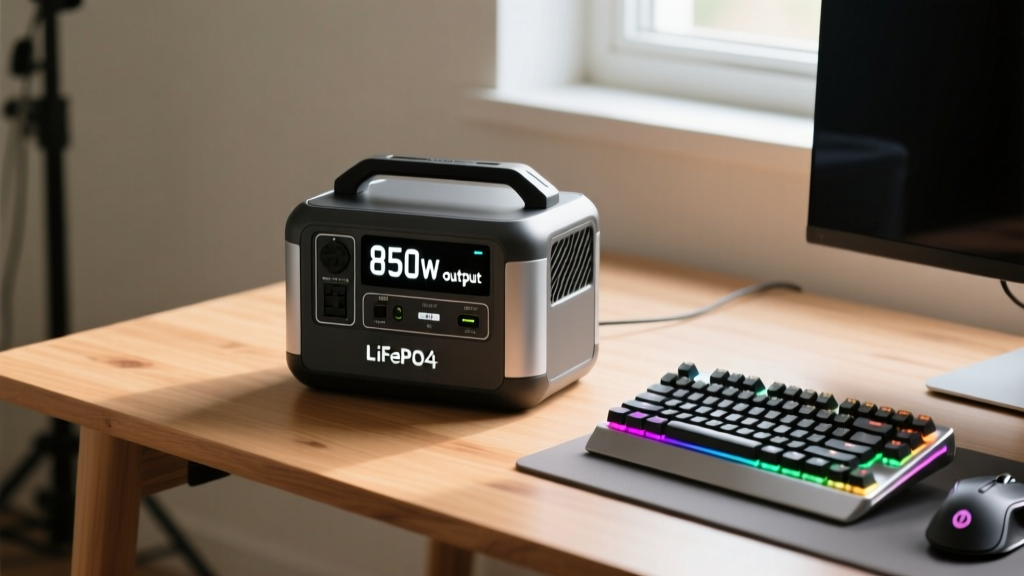
Practical Picks: Portable Power Stations for Off-Grid Gamers
For a plug-and-play solution that guarantees pure sine wave output and LiFePO4 (Lithium Iron Phosphate) battery chemistry—which offers over 3,500 charge cycles before degrading to 80% capacity—here are the top 2026 picks for off-grid gaming.
1. EcoFlow Delta Pro Ultra (Base + 2kWh Battery)
- Capacity: 6kWh (Base) expandable to 90kWh
- Output: 7200W continuous / 10,800W surge
- Solar Input: Up to 5600W via dual MPPT controllers
- Price: ~$5,198 (Base + one battery)
- Pros: Unmatched solar input speed; can recharge a fully depleted 6kWh battery in just over an hour with maxed-out roof panels. The UPS switchover time is <3ms, meaning your PC won't even flicker if a cloud passes over and the grid drops.
- Cons: Heavy footprint; the internal cooling fans can reach 45dB under heavy continuous load, which might interfere with in-game audio if placed directly under your desk.
2. Bluetti EP500 Pro
- Capacity: 5100Wh LiFePO4
- Output: 3000W continuous / 6000W surge
- Solar Input: 2400W max
- Price: ~$3,999
- Pros: Extremely quiet operation; split-phase 240V output capability for running heavy off-grid appliances alongside your PC. Excellent app-based monitoring.
- Cons: Slower solar recharge times compared to EcoFlow; heavier single-unit chassis makes it difficult to move solo.
Configuring Your Real-Life Mining Gadget: Star Citizen Off-Grid Setup
'While you might be obsessing over the optimal yield and laser settings for your favorite in-game mining gadget, Star Citizen players must remember that the real-world hardware running the simulation is just as demanding. A sudden power drop during a quantum travel sequence or a deep-core extraction doesn't just ruin the immersion—it can corrupt your local game cache and SSD partition tables if the power cuts out mid-write.'
To prevent this, integrate a hardware UPS (Uninterruptible Power Supply) between your solar generator and your PC. Even with a 3ms switchover time on high-end solar generators, adding a dedicated CyberPower CP1500PFCLCD (which natively supports pure sine wave) acts as a secondary buffer, ensuring absolute voltage stability for your motherboard's VRMs.

Step-by-Step: Wiring Solar Panels to Your Gaming Inverter
If you are building a custom roof array to feed your portable power station, follow this framework to maximize efficiency and minimize voltage drop.
- Panel Selection: Opt for 4x 400W N-Type TOPCon monocrystalline panels (e.g., Renogy or BougeRV). N-Type cells perform roughly 5-8% better in low-light and high-temperature environments than older P-Type cells.
- Wiring Configuration: Wire the four panels in a 2S2P configuration (two strings of two panels in series, then paralleled). This keeps the voltage under the 60V DC limit of most portable power station MPPT inputs while maximizing amperage.
- Cable Sizing: Use 10 AWG UV-resistant solar cables for runs under 15 feet. If your roof-to-inverter run exceeds 20 feet, step up to 8 AWG to prevent voltage drop, which directly translates to lost gaming hours.
- MC4 Connectors: Always use a dedicated MC4 crimping tool. Pliers will create a high-resistance connection that can melt under the 30A+ continuous current generated during peak sun hours.
FAQ: Off-Grid Gaming and Solar Realities
Can I game at night using only solar power?
Yes, provided your battery bank is sized correctly. As calculated above, a 5-hour night session requires ~4.25kWh. A 5kWh LiFePO4 battery allows you to drain to 10% Depth of Discharge (DoD) safely, giving you roughly 4.5kWh of usable power. You will need to recharge this entirely the next day, requiring at least 1200W of rated solar panels and 5 hours of unobstructed sunlight.
Will the inverter fan noise ruin my gaming experience?
It can. Inverters generate heat proportional to their load. At 850W continuous draw, a 3000W inverter is operating at roughly 28% capacity. Most premium units (like Bluetti and EcoFlow) use smart temperature-controlled fans that will spin up to a low hum (35-40dB). To mitigate this, place the power station in an adjacent room or a well-ventilated closet, and run a heavy-duty 12 AWG extension cord (rated for 15A/125V) to your desk.
Do I need to worry about cloud cover interrupting my session?
If you are gaming while relying on direct solar pass-through, yes. Heavy cloud cover can drop solar input by 80-90%. However, if you are drawing from the internal LiFePO4 battery bank, the MPPT controller will seamlessly blend the reduced solar input with battery discharge without your PC noticing a thing. Always game off the battery bank, treating the solar panels purely as a charging mechanism, not a direct power tether.
For more in-depth analysis on battery chemistry degradation and off-grid solar sizing, refer to the comprehensive guides at SolarReviews. Building an off-grid gaming rig requires upfront capital and precise math, but the reward of mining quantum cores in deep space while parked in a remote forest is an unmatched tech enthusiast experience.
Written by
Tom ReynoldsTom Reynolds holds a CFA (Chartered Financial Analyst) designation and a B.S. in Finance from the University of Texas at Austin. Before entering tech journalism, he spent 6 years as a quantitative analyst at a hedge fund, building cost-benefit models for consumer product investments. Tom has maintained a proprietary database of over 10,000 tech deals for the past 8 years, developing his signature "penny-per-feature" evaluation framework that calculates the true value proposition of every gadget. His budget gadget reviews are known for their financial rigor — he tracks price history across 15+ retailers, calculates cost-per-use over 3-year lifespans, and identifies the exact inflection point where premium features justify their markup. Tom's deal alerts have saved his readers an estimated .3 million since 2018.