Space-Saving Personalized Kitchen Gadgets: Custom Cutting Boards
Maximize small kitchens with personalized kitchen gadgets. Discover custom-sized cutting boards, over-sink surfaces, and space-saving prep tools.
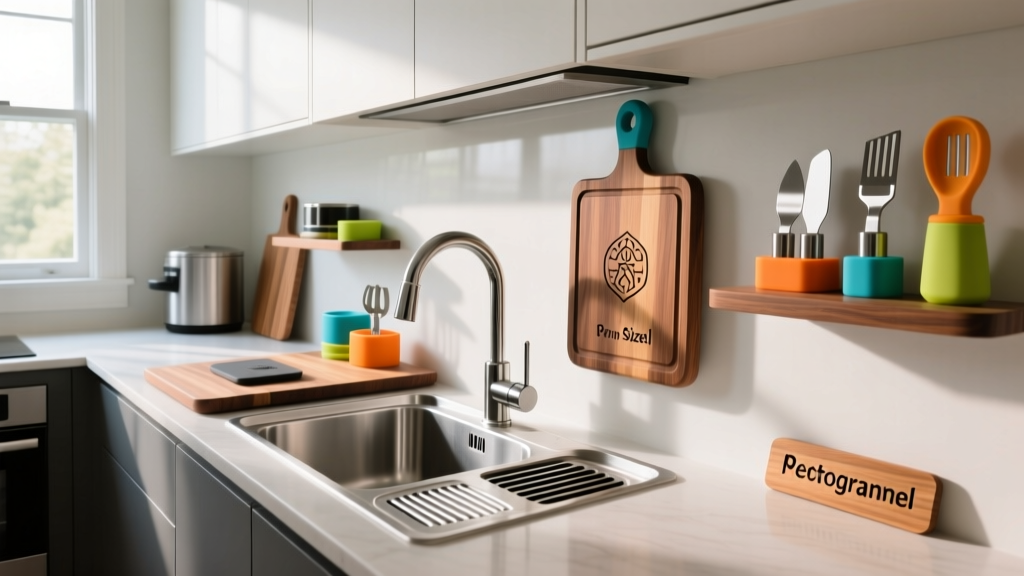
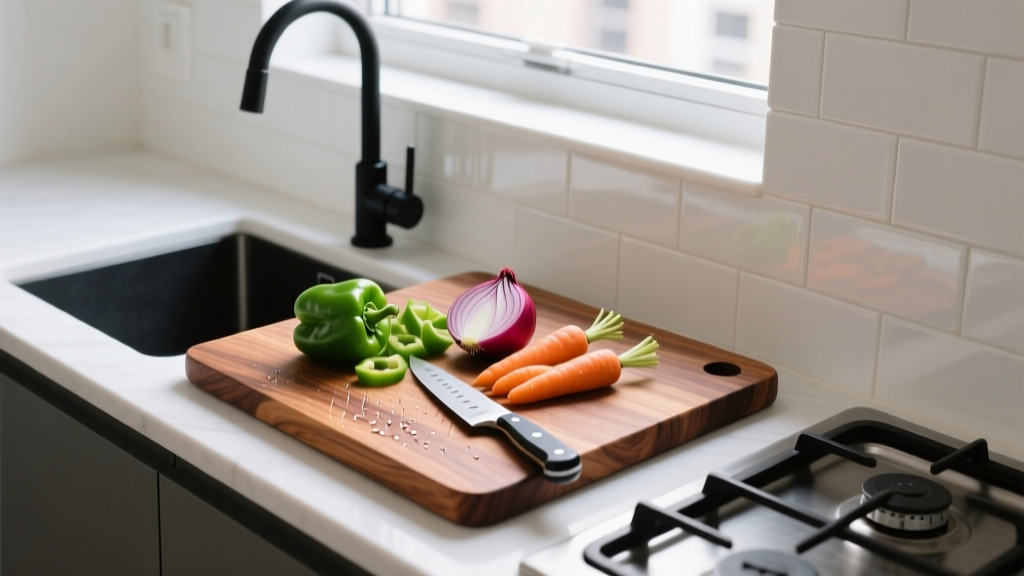
When homeowners and renters search for personalized kitchen gadgets, they often picture laser-engraved wooden spoons or monogrammed aprons. But in the context of compact living, true personalization means something far more functional: tools customized to your exact spatial constraints. As micro-apartments and galley kitchens dominate urban housing markets in 2026, off-the-shelf kitchenware often fails to fit the nuanced dimensions of small-scale food prep.
Cutting boards and kitchen surface tools are the primary casualties of poor spatial planning. A standard 15x20-inch cutting board consumes 2.08 square feet of prime counter real estate—an impossible footprint in a kitchen with only 12 linear feet of total counter space. By shifting toward custom-sized, modular, and over-the-sink surface solutions, you can reclaim your workspace without sacrificing knife feel or prep efficiency.
Over-the-Sink & Foldable Surface Solutions
The most effective way to expand a small kitchen is to utilize dead space. The kitchen sink is essentially a large, empty bowl when not actively washing dishes. Over-the-sink cutting boards transform this void into a primary prep station. However, standard over-sink boards rely on generic extendable tracks that often slip or fail to sit flush on non-standard basin lips.
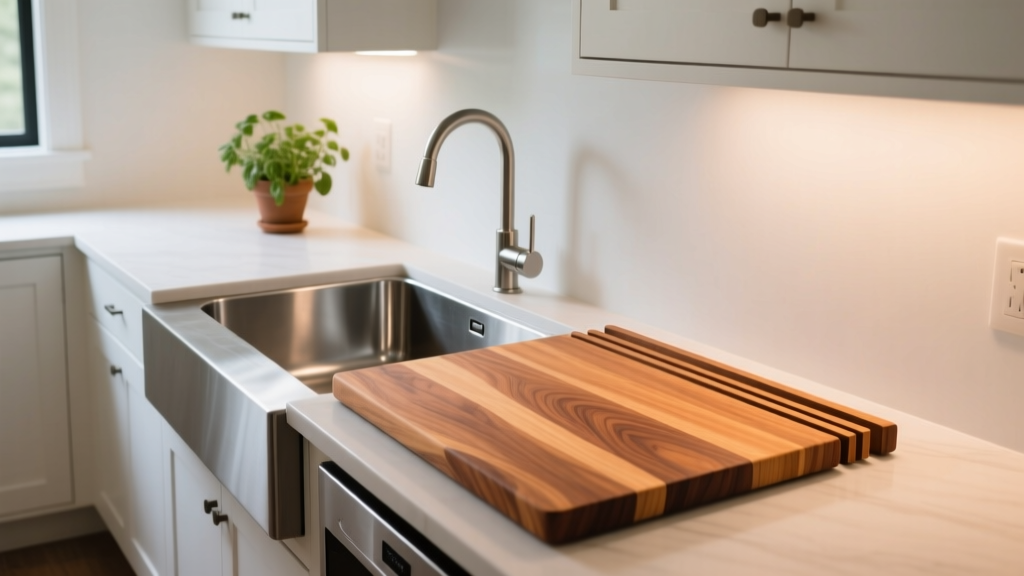
Truly personalized kitchen gadgets in this category are built to the exact outer dimensions of your specific sink model. For example, if you have a Kraus Standart PRO 32-inch undermount sink, the outer lip dimensions differ vastly from a Blanco Precis single bowl. Custom woodworkers can mill the tracking grooves to within a 1/16-inch tolerance of your sink's outer rim, eliminating the wobble that causes cross-contamination and knife accidents.
Pros and Cons of Custom Over-Sink Boards
- Pro: Creates an instant 2 to 3 square foot prep zone over dead space.
- Pro: Allows direct sweeping of food scraps into a sink-mounted compost bin or garbage disposal.
- Con: Requires precise measurement; a sink replacement means the board must be re-milled or discarded.
- Con: Constant exposure to ambient sink humidity requires rigorous oiling schedules to prevent warping.
Material Matrix for Small-Space Boards
Not all woods and synthetics behave well in the high-humidity, tight-clearance environment of a compact kitchen. End-grain walnut boards, while beautiful and excellent for knife edges, are incredibly heavy and thick (often 1.5 to 2 inches), making them difficult to slide into shallow drawers or store vertically. Here is a comparison of the best materials for space-constrained, personalized surface tools.
| Material | Thickness | Janka Hardness | Space-Saving Factor | Best Use Case |
|---|---|---|---|---|
| Edge-Grain Teak | 0.75" | 1,155 lbf | High (Water-resistant, thin profile) | Over-sink boards, daily prep |
| Hinoki Cypress | 1.0" | 500 lbf | Medium (Lightweight but thick) | Precision slicing, soft knives |
| TPU (Thermoplastic Polyurethane) | 2mm - 3mm | N/A (Flexible) | Extreme (Rollable, drawer-storable) | Secondary prep, raw meats |
| Acacia Wood | 0.5" | 2,300 lbf | High (Very thin, stiff) | Charcuterie, light chopping |
According to data from the Wood Database, Teak's high natural silica content and tight grain make it exceptionally resistant to the moisture and steam inherent to small kitchens where dishwashers and stovetops are inches away from prep zones. For flexible options, modern TPU mats offer a non-porous surface that can be rolled and stored vertically in a 3-inch wide drawer slot, completely eliminating counter clutter.
Multi-Functional Surface Tools: Beyond the Cutting Board
Space-saving personalization extends beyond the cutting board itself. In 2026, the most efficient compact kitchens utilize custom-fit silicone counter mats and modular prep trays. These tools protect limited counter space from heat damage and knife scratches while acting as organizational anchors.
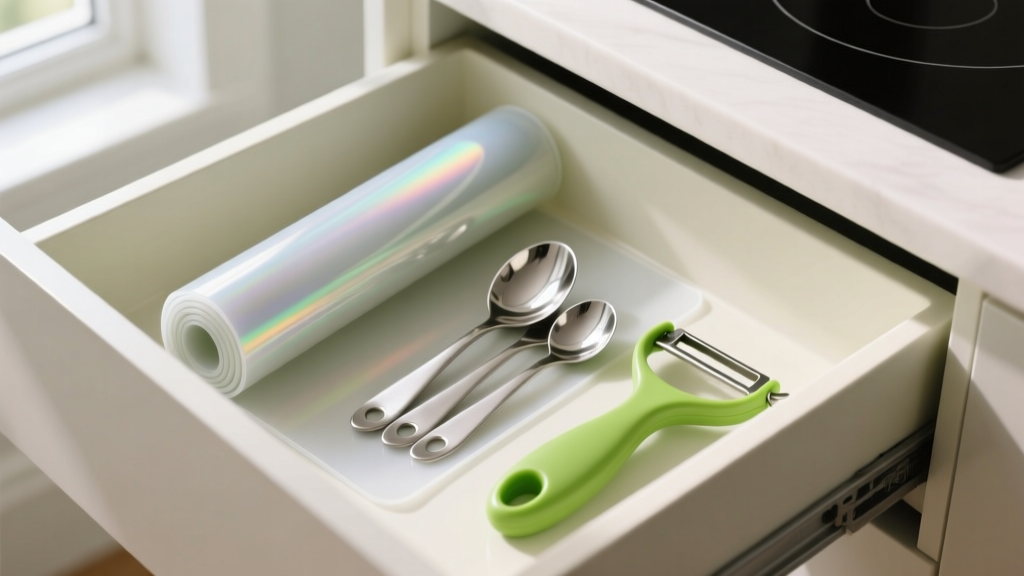
Consider a personalized, custom-cut silicone trivet and prep mat combo. By providing a local CNC fabricator with the exact dimensions of your countertop's 'landing zone' (the area between the stove and sink), you can commission a 2mm thick, food-grade silicone mat that fits flush against the backsplash and stove edge. This prevents crumbs and liquids from falling into the dreaded 'stove gap'—a common pain point in tight apartment kitchens.
Decision Framework: Choosing Your Custom Surface Tool
- Measure the 'Drop Zone': Identify the primary 12x18 inch area where you naturally set down groceries or hot pans.
- Assess Vertical Storage: Do you have a drawer at least 14 inches wide and 2 inches deep? If yes, rigid custom wood boards are viable. If no, pivot to rollable TPU or foldable silicone mats.
- Evaluate Sink Proximity: If your prep space is less than 18 inches from the sink basin, prioritize Teak or synthetic materials over porous woods like Maple, which will absorb ambient splash-back and harbor bacteria.
Sourcing Truly Personalized Kitchen Gadgets
Finding makers who will mill a cutting board to your exact millimeter specifications requires looking beyond big-box stores. Here is where to source custom surface tools in 2026:
- The BoardSmith: A premium US-based maker that allows you to input exact length, width, and thickness down to the quarter-inch. Expect to pay between $120 and $220 for a custom edge-grain Maple or Walnut board. Lead times typically run 3 to 4 weeks.
- Etsy CNC Woodworkers: Search for 'custom CNC cutting board dimensions'. Many independent makers with 5-axis CNC routers will mill a board to your exact CAD specifications for $60 to $110. This is ideal for creating boards with specific corner radii to match your rounded countertop edges.
- Local Cabinetry Shops: For custom silicone or TPU counter mats, local solid-surface fabricators (who normally cut Corian or quartz) can often water-jet cut food-safe silicone sheets to your exact countertop template for under $50.
Maintenance in Tight, Humid Quarters
The number one failure mode for custom cutting boards in small kitchens is not dull knives—it is asymmetric warping caused by proximity to dishwashers and kettles.
In a compact kitchen, your cutting board is likely stored within three feet of a heat and moisture source. The USDA Food Safety and Inspection Service emphasizes that wooden boards must be properly maintained to prevent bacterial harboring in micro-fissures, which are exacerbated by rapid humidity changes.
To protect your personalized investment, implement a strict 'mineral oil and beeswax' schedule. Apply a coat of food-grade mineral oil every 30 days, followed by a beeswax buffer. The wax creates a hydrophobic barrier that repels the steam from your adjacent dishwasher. Never store a custom wood board flat against a cold granite or quartz countertop; the temperature differential between the stone and the ambient kitchen air will cause the bottom of the board to dry out faster than the top, resulting in a concave warp that ruins the flush fit you paid to customize.
Frequently Asked Questions
Can I put a custom-sized TPU mat in the dishwasher?
Yes, TPU (Thermoplastic Polyurethane) is highly heat resistant and dishwasher safe up to 180°F (82°C). However, in compact kitchens, it is often faster to simply wipe it down with a sanitizing spray, as running the dishwasher generates ambient heat that can affect nearby stored items.
How do I measure my sink for a custom over-the-sink board?
Do not measure the inner basin. Measure the outermost lip of the sink flange where it meets the countertop. Subtract 1/8th of an inch from the total width to allow for a smooth sliding track fit without binding.
Are personalized kitchen gadgets worth the premium for renters?
Absolutely, if you focus on portable customization. A custom-sized TPU mat or a precisely fitted over-sink board travels with you. Unlike installed fixtures, these personalized tools adapt your current rental's limitations to your workflow, and can be moved to your next apartment.
Written by
Marcus WebbMarcus Webb served as a U.S. Army logistics officer for 8 years, where he managed field equipment procurement and tactical gear evaluation across three combat deployments. After honorable discharge, he earned a certification from the Professional Knife Makers Association and became a certified Wilderness First Responder (WFR). Marcus has tested over 500 EDC products in extreme environments — from -40°F in Alaska to 120°F in the Mojave Desert — using military-spec testing protocols. His reviews of multi-tools, tactical flashlights, and survival gear are known for their rigorous methodology: controlled drop tests from 6 feet, 120-minute water submersion at 2 meters, and lateral torque testing at 45 Nm. He is a member of the Blade Show judging panel and contributes to OutdoorGearLab.