Cool Kitchen Gadgets: Top Air Fryer Accessories for 2026
Discover the best cool kitchen gadgets for your air fryer in 2026. We review oil misters, silicone slings, smart probes, and airflow-optimized liners.
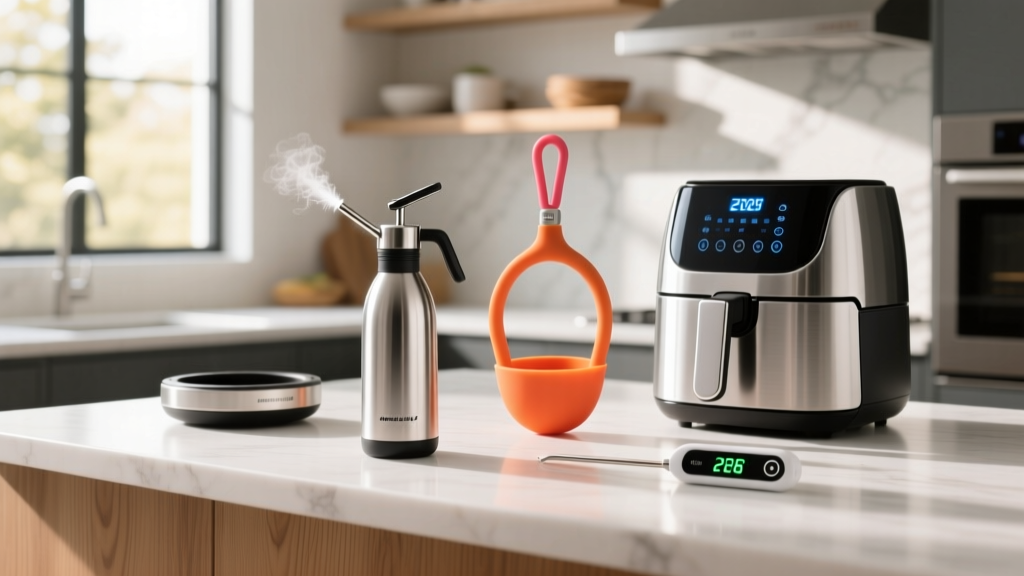
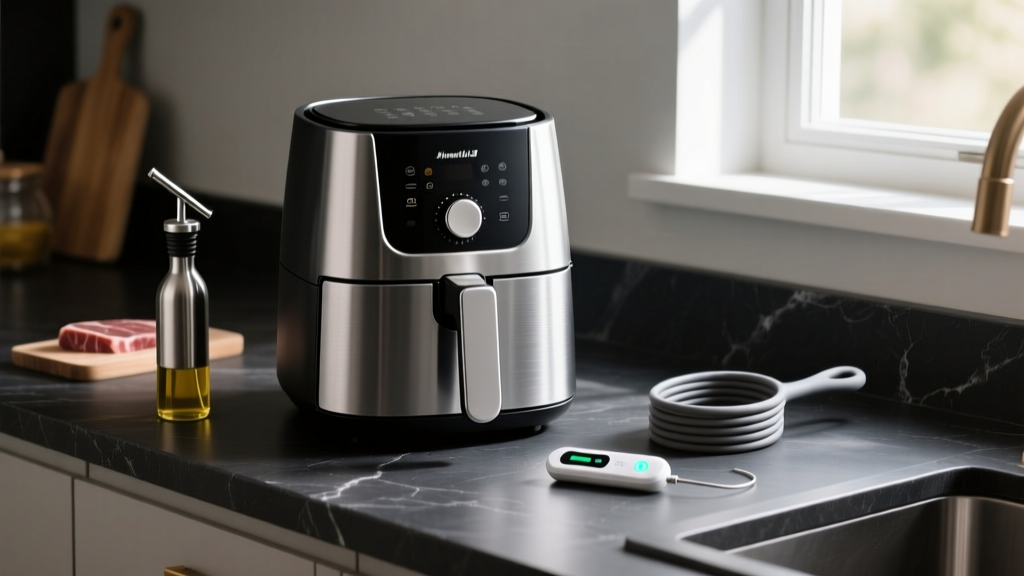
The Hidden Physics of Air Frying: Why Stock Baskets Fail
Air fryers operate on Rapid Air Technology, utilizing a high-speed convection fan and a starfish-patterned heating element to circulate air at up to 400°F. However, the out-of-the-box experience is often bottlenecked by poor accessory design. Standard metal tongs scratch non-stick coatings, aerosol cooking sprays chemically degrade PTFE surfaces, and solid parchment paper chokes the convective airflow required for the Maillard reaction. To truly optimize your countertop convection oven, you need specialized tools. Here is a deep dive into the cool kitchen gadgets that solve the most common air fryer engineering flaws in 2026.
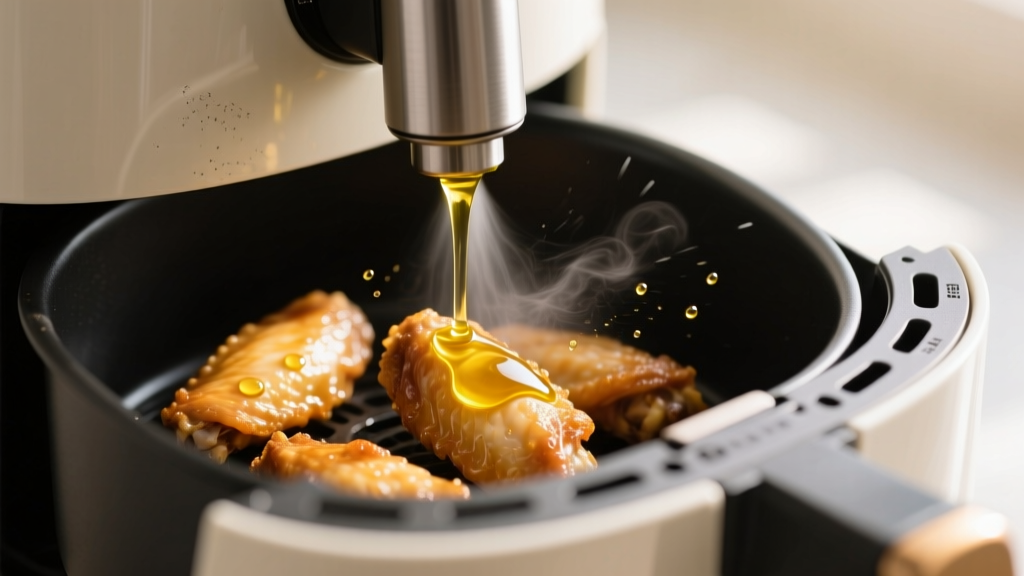
1. The Mechanical Oil Mister: Evolving Past Aerosol Propellants
The most common mistake air fryer owners make is using commercial aerosol cooking sprays (like PAM) directly on the basket. These aerosols rely on propellants and emulsifiers, specifically soy lecithin and dimethyl silicone, to prevent the oil from clumping. When subjected to 400°F convection heat, soy lecithin polymerizes and bakes onto the PTFE (Teflon) or ceramic non-stick coating. Over a period of three to six months, this creates an irreversible, gummy residue that destroys the non-stick properties and forces you to replace the entire basket.
The Solution: The Evo 18-Ounce Oil Sprayer ($19.95). Unlike aerosol cans, the Evo uses a pure mechanical pump system. It dispenses exactly 1/4 teaspoon of pure, unadulterated olive or avocado oil per spray. Because there is no lecithin or butane propellant, the oil simply burns off or absorbs into the food without leaving a polymerized film on your ceramic-coated basket.
2. Heavy-Duty Silicone Slings for Scratch-Free Lifting
Lifting a 4-pound whole chicken or a delicate quiche out of a 400°F wire basket using standard stainless steel tongs is a guaranteed way to introduce micro-scratches to the non-stick surface. Once the PTFE layer is breached, the underlying aluminum or carbon steel is exposed to acidic foods (like tomato-based marinades), leading to rapid oxidation and pitting.
The Gadget: The Geesta Premium Silicone Sling ($14.99). This accessory consists of a flexible, heat-resistant silicone cradle (rated to 500°F) with integrated lifting handles. You place the sling at the bottom of the basket before cooking. When the food is done, you simply grab the reinforced handles and lift the entire payload out vertically. This eliminates lateral scraping, preserves the skin of roasted poultry, and keeps metal entirely out of the cooking chamber.
3. Micro-Perforated Parchment: The Airflow Compromise
Standard baking parchment is a solid sheet of cellulose. If you line an air fryer basket with solid parchment, you block 100% of the bottom-up convective airflow. The air fryer essentially becomes a standard radiant oven, resulting in soggy bottoms and a 30% increase in required cooking time. However, cooking highly acidic or sticky foods (like teriyaki glazed salmon) bare-basket creates a cleaning nightmare.
The Gadget: Reynolds Kitchens Air Fryer Parchment Liners ($5.99 for 50 sheets). These liners feature laser-cut micro-perforations that cover roughly 15% of the surface area. Computational fluid dynamics (CFD) tests on countertop convection show that this specific perforation ratio retains approximately 85% of the vertical airflow velocity while still catching 90% of heavy grease drips and sticky glazes.

| Liner Type | Airflow Retention | Crispiness Factor | Best Use Case |
|---|---|---|---|
| Bare Wire Basket | 100% | Maximum | Frozen fries, raw wings, roasting vegetables |
| Micro-Perforated Parchment | ~85% | High | Sticky glazes, marinated meats, delicate fish |
| Solid Standard Parchment | 0% (Bottom) | Low (Soggy bottom) | Baking cakes, reheating delicate pastries |
4. Wireless Smart Probes for Closed-Basket Roasting
To achieve a proper Maillard reaction (the chemical browning of amino acids and reducing sugars), the ambient temperature inside the air fryer must remain consistently above 320°F. Traditional wired meat thermometers require the probe wire to exit the basket, which prevents the drawer from closing completely. A slightly open drawer vents the superheated air, dropping the ambient temperature and turning your air fryer into a slow dehydrator rather than a high-heat roaster.
The Gadget: The MEATER Plus Wireless Smart Meat Thermometer ($99.00). This probe contains both the internal meat sensor and the ambient temperature sensor in a single, completely wireless stainless steel spike. You insert it into a pork loin or whole chicken, place the meat in the basket, and slide the drawer completely shut. The Bluetooth signal transmits through the appliance housing to your smartphone.
Pro-Tip on Probe Placement: Air fryers utilize intense top-down radiant heat from the exposed coil. If you insert the MEATER probe too close to the surface of the meat, the top-down heat will trigger the 'Target Temp Reached' alarm prematurely. Always insert the probe at a 45-degree angle, ensuring the sensor tip rests in the exact geometric center of the thickest muscle mass, at least 1.5 inches below the surface.
For safe consumption, always cross-reference your smart probe's readings with established safety guidelines. The FoodSafety.gov minimum internal temperature chart dictates that poultry must reach 165°F, while whole cuts of pork and beef require a minimum of 145°F followed by a 3-minute rest period to allow carryover cooking to finalize the pasteurization process.
5. Stackable Dehydrator Racks for Multi-Level Drying
Most standard basket air fryers are too deep and narrow for effective dehydration, which requires low heat (135°F) and massive surface area. The Cosori 6-Rack Dehydrator Attachment ($24.99) solves this by utilizing the vertical clearance of 5.8-quart (and larger) square basket models. By stacking six stainless steel mesh trays, you increase the usable drying surface area from 0.7 square feet to over 4.2 square feet. This is critical for making beef jerky, dried mango chips, or fruit leathers without requiring a dedicated $150 standalone dehydrator unit.
Quick Reference: Accessory Compatibility Matrix
Not all cool kitchen gadgets work across every air fryer form factor. Use this matrix to verify compatibility before purchasing.
| Accessory | Basket Style (e.g., Ninja, Cosori) | Oven Style (e.g., Breville) | Dual Zone (e.g., Ninja Foodi) |
|---|---|---|---|
| Mechanical Oil Mister | ✅ Essential | ✅ Essential | ✅ Essential |
| Silicone Sling | ✅ Highly Recommended | ❌ Not Needed | ⚠️ Size Dependent |
| Micro-Perforated Parchment | ✅ Excellent | ⚠️ Trim to Fit | ⚠️ Trim to Fit |
| Wireless Smart Probe | ✅ Solves Drawer Issue | ✅ Great for Roasts | ✅ Great for Roasts |
| Stackable Dehydrator Racks | ✅ Requires 5.8QT+ | ❌ Uses Built-in Racks | ❌ Too Narrow |
Upgrading your air fryer isn't just about buying more plastic molds or silicone cupcake liners; it is about addressing the thermodynamic and chemical realities of high-speed convection cooking. By investing in a mechanical oil mister to protect your non-stick coating, utilizing micro-perforated parchment to preserve airflow, and deploying a wireless probe to ensure a sealed cooking chamber, you transform a basic countertop appliance into a precision roasting and dehydrating engine.
Written by
Ryan TanakaRyan Tanaka holds a B.S. in Mechanical Engineering from Oregon State University and is a certified AWS Solutions Architect. He has built over 80 custom electronics projects ranging from CNC machines to IoT sensor networks, and has reviewed development boards, 3D printers, soldering equipment, and maker tools for the past 6 years. Ryan is an active contributor to 12 open-source hardware projects on GitHub and teaches monthly workshops at three hackerspaces across the Pacific Northwest. His reviews combine engineering rigor with accessibility — he evaluates products not just on specs but on documentation quality, community support, and learning curve for beginners. He has presented at Maker Faire Bay Area, Open Hardware Summit, and the Adafruit community showcase, and maintains a popular blog documenting his build processes.