Beyond Normal Gadgets: The 2026 Solar Off-Grid Revolution
Discover how solar-powered tech and off-grid energy solutions are replacing normal gadgets in 2026. Explore trends, top gear, and future outlooks.
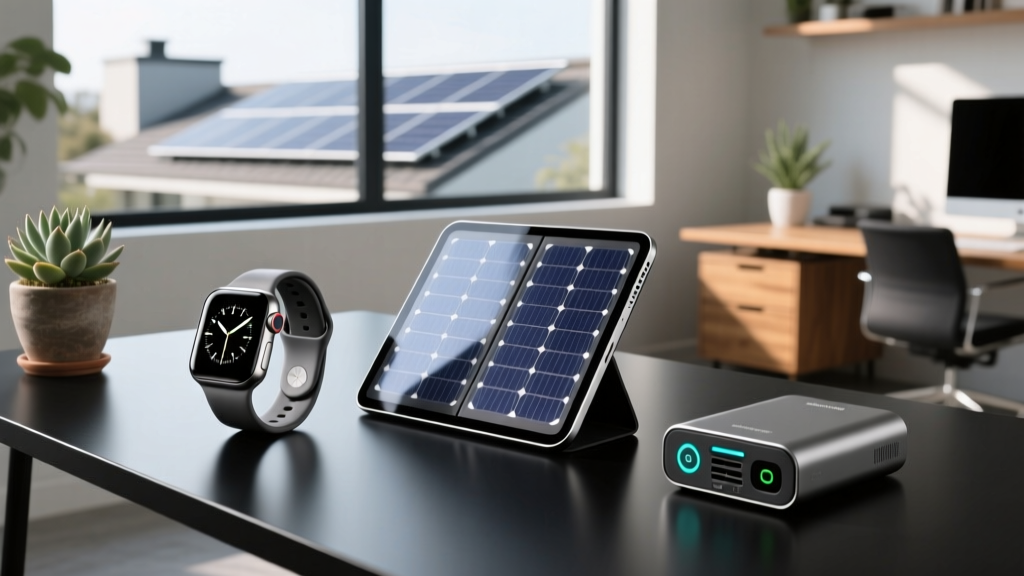

The era of tethered technology is rapidly drawing to a close. As we navigate 2026, the definition of premium portable tech has fundamentally shifted. We are no longer satisfied with normal gadgets that die after 14 hours and demand a wall outlet to survive. Today's tech enthusiasts, overlanders, and remote professionals demand absolute energy autonomy. The convergence of solid-state battery chemistry, perovskite-silicon tandem solar cells, and ultra-efficient MPPT (Maximum Power Point Tracking) charge controllers has birthed a new category of self-sustaining off-grid gear.
This trend report explores the death of the tether, the hardware driving the 2026 off-grid revolution, and the decision frameworks you need to build a truly self-reliant mobile tech ecosystem.
The Death of the Tether: Why Normal Gadgets Are Falling Behind
For the past decade, the tech industry's solution to battery anxiety was simply to pack denser lithium-ion cells into devices. But physics has a hard limit. While normal gadgets rely entirely on finite internal batteries, off-grid solar solutions focus on energy generation and flow. A standard 2024 smartphone might boast a 5,000 mAh battery, but once it depletes in the backcountry, it becomes a glass brick.
The 2026 paradigm shifts the focus from storage capacity to harvesting capability. According to data tracked by the National Renewable Energy Laboratory (NREL), commercial perovskite-silicon tandem solar cells have officially crossed the 31% efficiency threshold in portable form factors. This means a foldable panel that used to yield a trickle charge in overcast conditions now generates enough wattage to actively power a laptop while simultaneously topping off a power station.
The 2026 Reality Check: If your mobile tech stack requires you to cut short a backcountry trip or limit your drone flights because you ran out of grid-charged power, your setup is already obsolete.
2026 Off-Grid Power Architecture: What Has Changed?
To understand the current landscape, we must look at the hardware evolution. The bulky, heavy lead-acid and standard NMC (Nickel Manganese Cobalt) power stations of the early 2020s have been largely replaced by LiFePO4 (Lithium Iron Phosphate) and emerging semi-solid-state architectures. These offer 3,000+ cycle lives and vastly superior thermal stability.
Portable Solar & Storage Evolution Matrix
| Feature | Legacy Tech (2021-2023) | Current Standard (2026) |
|---|---|---|
| Solar Cell Type | Monocrystalline PET/ETFE (22% eff.) | Perovskite-Silicon Tandem (31%+ eff.) |
| Battery Chemistry | NMC Lithium-Ion (800 cycles) | LiFePO4 & Semi-Solid State (3,500+ cycles) |
| Charge Controller | PWM / Basic MPPT | GaN-Integrated AI MPPT (Adaptive shading bypass) |
| Weight-to-Capacity | ~12 lbs per 1000Wh | ~8.5 lbs per 1000Wh |
| Low-Light Harvesting | Negligible output under 10,000 lux | Active trickle generation down to 2,000 lux |
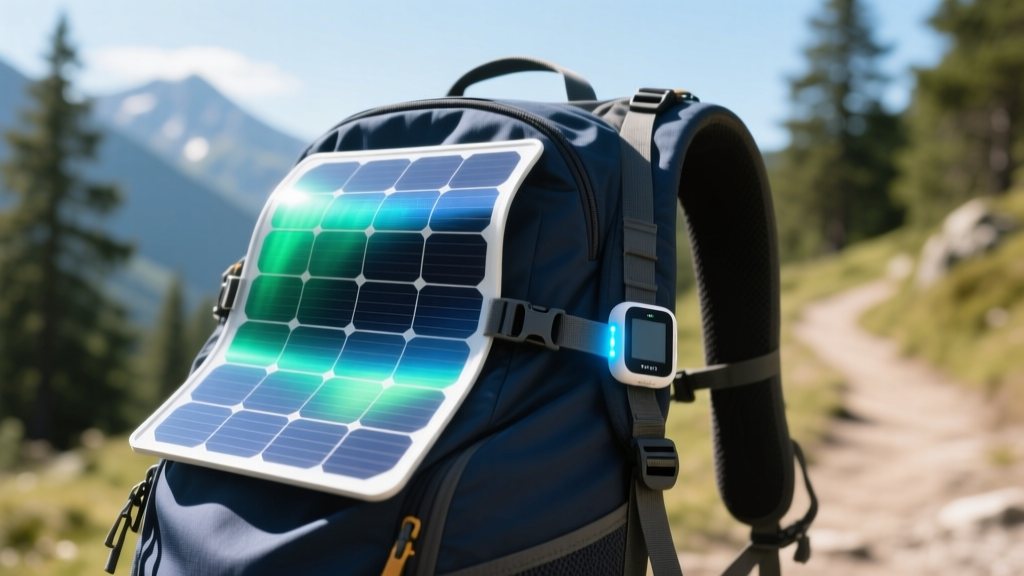
Top Tier Solar-Integrated Gadgets Redefining the Outdoors
The market is flooded with "solar" accessories, but true enthusiasts know that most cheap Amazon solar banks are little more than marketing gimmicks. Here are the heavy-hitting, field-proven devices dominating the 2026 off-grid landscape.
1. The Hub: EcoFlow Delta 3 (1024Wh)
Priced around $1,099, the EcoFlow Delta 3 represents the sweet spot for mobile professionals. It utilizes automotive-grade LFP battery cells and features an AI-driven MPPT controller that can extract power from partial-shade solar arrays up to 220W. When paired with the EcoFlow 220W Bifacial Portable Solar Panel, it can recharge from 0-80% in roughly 5.5 hours of mixed sunlight. Its 1800W output (surge 2700W) easily handles Starlink Mini routers, camera battery charging stations, and portable induction cooktops.
2. The Wearable: Garmin Fenix 8 Solar (51mm)
At $1,199, the Fenix 8 Solar is the pinnacle of wrist-mounted autonomy. Building on the Power Sapphire solar technology seen in the Garmin Instinct 2 Solar lineage, the Fenix 8 utilizes a highly transparent, scratch-resistant solar glass that extends battery life from 29 days to a staggering 48 days in smartwatch mode with 3 hours of direct sunlight per day. For hikers and trail runners, this effectively means the device never needs to be plugged in during a multi-week expedition.
3. The Harvester: Goal Zero Nomad 20 (20W)
Retailing for $129, this isn't a massive array, but a highly targeted, ruggedized panel designed to clip onto a rucksack. The 2026 iteration features an integrated, weather-sealed junction box with a built-in USB-C PD 20W output, bypassing the need for external charge controllers when topping off small devices like satellite messengers (e.g., Garmin inReach Mini 2) or headlamps.
Decision Framework: Sizing Your Off-Grid Array
Buying gear without calculating your load is a rookie mistake. Use this baseline power draw chart to size your solar input and battery storage for a standard 3-day off-grid tech enthusiast setup:
- Starlink Mini (Roam): 25W - 40W continuous draw (approx. 720Wh per 24 hours).
- DJI Mavic 3 Pro (3 Batteries): ~225Wh total charging requirement.
- Mirrorless Camera Rig (Sony A7IV x 4 batteries): ~60Wh total.
- LED Basecamp Lighting & Phone Charging: ~150Wh per day.
The Verdict: For this load, you consume roughly 1,155Wh per day. A 1000Wh power station (like the Delta 3) paired with a 220W solar array generating an average of 1.2kWh per day (assuming 5.5 peak sun hours) will keep you in a state of perpetual equilibrium, entirely off the grid.
Future Outlook: 2027 and Beyond
Where do we go from here? The next frontier is ambient light harvesting and piezoelectric integration. Researchers are currently commercializing indoor-optimized perovskite cells that can harvest energy from standard LED and fluorescent lighting, meaning your off-grid mesh routers and IoT sensors will never require a battery swap, even inside a cabin or tent.
Furthermore, we are seeing the prototyping of hybrid piezoelectric-solar fabrics. Imagine a tent canopy that not only generates power from the sun but also harvests kinetic energy from wind flapping the fabric. While still in the R&D phase for consumer pricing, this hybrid generation will be the final nail in the coffin for grid-dependent portable tech.
FAQ: Transitioning to Off-Grid Tech
Do bifacial solar panels actually work in the backcountry?
Yes, but only if deployed correctly. Bifacial panels (which collect light on both sides) require an albedo effect—meaning they need to be elevated over a reflective surface like snow, light sand, or a specialized reflective ground sheet. If you lay a bifacial panel flat on dark forest soil, the rear generation drops to near zero.
Can I rely solely on solar for winter expeditions?
Winter brings shorter days and lower sun angles. You must oversize your solar array by at least 40% for winter use, and always carry a high-density, cold-resistant LiFePO4 battery, as standard lithium-ion cells can suffer permanent damage if charged at sub-freezing temperatures without internal heating elements.
Are solar-powered power banks worth it?
Generally, no. The surface area of a standard power bank is too small to generate meaningful power (usually yielding less than 1W in direct sun). True enthusiasts rely on separate, foldable 60W+ arrays connected to dedicated, high-capacity power stations for genuine off-grid reliability.
Written by
David OkaforDavid Okafor is an ASE (Automotive Service Excellence) Master Certified Technician with 15 years of professional experience in vehicle diagnostics, aftermarket electronics installation, and fleet management. He holds an Associate Degree in Automotive Technology from Universal Technical Institute and certifications in mobile electronics (MECP Certified Installer). David has installed and reviewed over 800 car tech products — from OBD2 scanners and dash cams to full infotainment system retrofits — in vehicles ranging from economy compacts to luxury SUVs. His popular YouTube channel "AutoTech David" has over 150,000 subscribers and features detailed installation tutorials and product teardowns. He is a regular contributor to the SEMA Show's aftermarket technology showcase and advises two automotive tech startups on product development.