Smart Cleaning Gadgets: 2026 Home Office Trend Report
Discover the top smart cleaning gadgets shaping the 2026 home office. Explore AI vacuums, UV-C sanitizers, and automated air purifiers.
The Evolution of Workspace Hygiene in the Hybrid Era
As we navigate through 2026, the home office has transitioned from a makeshift pandemic necessity to a permanent, highly optimized command center. With professionals spending an average of 9.2 hours a day in their dedicated workspaces, the accumulation of dust, volatile organic compounds (VOCs), and microbial pathogens on high-touch peripherals has become a critical health and productivity concern. The days of relying on a can of compressed air and a microfiber cloth are firmly in the past. Today, advanced cleaning gadgets are integrated into the smart home ecosystem, leveraging AI mapping, ultraviolet light, and solid-state filtration to maintain pristine environments with zero manual intervention.
In this comprehensive trend report, we analyze the cutting-edge cleaning technology defining the 2026 home office, breaking down exact model specifications, acoustic profiles, and the measurable return on investment for remote workers.
Top 2026 Cleaning Gadget Trends for the Home Office
1. AI-Powered Micro-Vacuums for Cable-Dense Zones
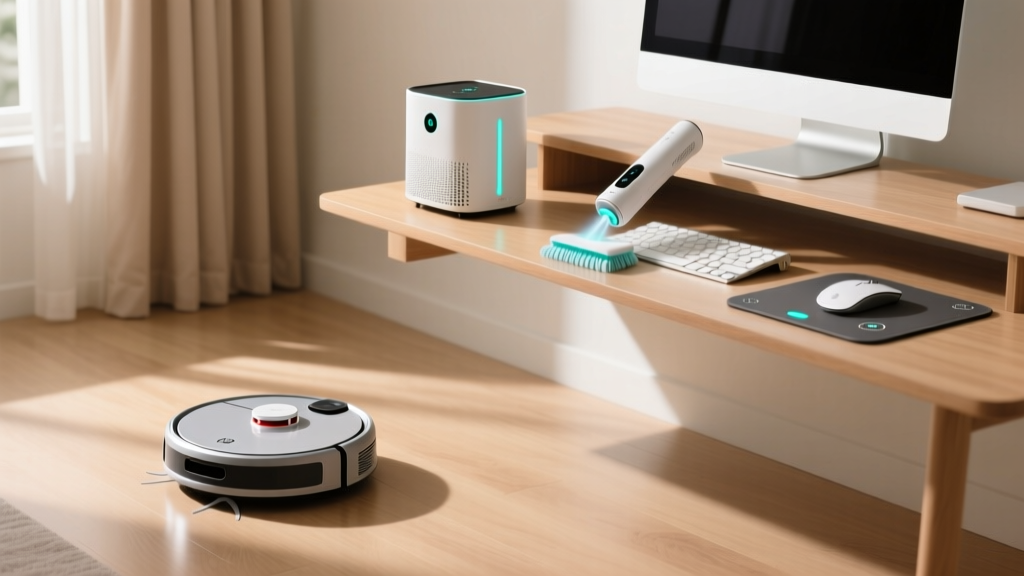
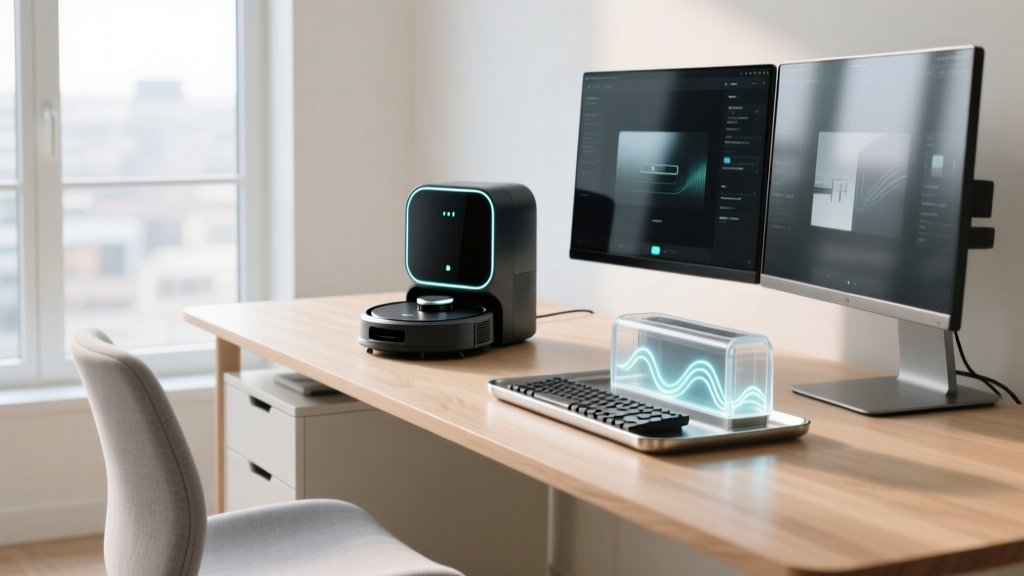
Standard robot vacuums are too large and aggressive for home offices, often tangling in PC tower cables or knocking over monitor risers. The 2026 solution is the micro-vacuum category, specifically engineered for tight, wire-heavy environments. The SwitchBot Mini Robot Vacuum K10+ (retailing at $299) remains the gold standard in this niche. Measuring just 8.5cm in width, it utilizes LiDAR navigation to map the intricate labyrinth of desk legs and power strips. Crucially, its 'Office Quiet Mode' caps acoustic output at 48dB—roughly the volume of a quiet library—ensuring it can run its 4,000Pa suction cycle during active Zoom calls without triggering noise-cancellation algorithms in your headset.
2. UV-C and Ultrasonic Peripheral Sanitizers
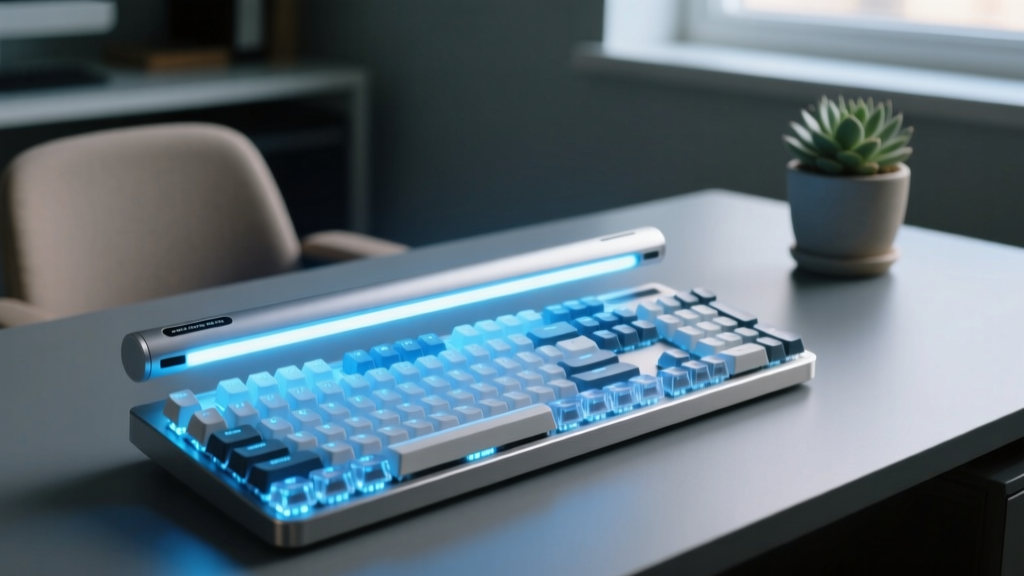
Keyboards and mice harbor up to 400 times more bacteria than a toilet seat, a statistic that has driven massive adoption of automated sanitization pods and light bars. The Targus UV-C LED Disinfection Light ($149) represents a major leap forward from manual wiping, which often pushes debris deeper into mechanical keyboard switches. Mounted above your desk, this device projects a targeted 254-nanometer UV-C wavelength across your peripherals. A built-in motion sensor ensures the light instantly shuts off if human movement is detected, while a programmed 3-minute nightly cycle achieves a 99.9% reduction in E. coli and Staphylococcus without the use of degrading chemical solvents that strip oleophobic coatings off trackpads.
3. Hyper-Local VOC Scrubbers and Air Monitors
Dust is visible, but the invisible threat in a home office is off-gassing from MDF desks, 3D printer resins, and synthetic upholstery. The Dyson Purifier Cool Formaldehyde TP09 ($749) addresses this with a solid-state formaldehyde sensor and a catalytic filter that continuously breaks down VOCs into trace amounts of water and CO2. Unlike legacy HEPA filters that clog and lose efficiency, the TP09's H13-grade filtration captures 99.97% of particles down to 0.3 microns, including ultra-fine toner dust expelled by laser printers. When paired with an Airthings View Plus monitor ($299), users can automate the Dyson via IFTTT to ramp up fan speed the moment CO2 levels breach 800 ppm, preventing the afternoon cognitive slump.
Comparative Analysis: Legacy vs. Next-Gen Cleaning Tech
Upgrading your home office maintenance routine requires understanding the tangible differences between outdated methods and modern smart cleaning gadgets. The matrix below highlights why legacy tools are being phased out of professional environments.
| Metric | Legacy Methods (Canned Air / Standard Vacuums) | 2026 Smart Cleaning Gadgets |
|---|---|---|
| Acoustic Output | 75dB - 85dB (Highly disruptive to calls) | 40dB - 48dB (Whisper-quiet AI modes) |
| Particle Redistribution | High (Blows dust into the air and HVAC) | Near Zero (Sealed HEPA capture & UV neutralization) |
| Chemical Residue | Moderate (Alcohol wipes degrade plastics) | None (UV-C light and catalytic oxidation) |
| Time Investment | 20-30 minutes weekly (Manual labor) | 0 minutes (Automated scheduling & docking) |
| Cable Safety | Low (High risk of snagging wires) | High (AI obstacle avoidance & micro-form factors) |
The ROI of a Clean Workspace: Data & Cognitive Insights
Investing in premium cleaning gadgets is not merely an aesthetic choice; it is a measurable intervention in cognitive performance. According to the landmark Harvard T.H. Chan School of Public Health COGfx Study, indoor environmental quality directly dictates higher-order thinking capabilities.
"Cognitive function scores were 61% higher in green-certified buildings with low VOCs and high ventilation rates compared to conventional office environments. Furthermore, reducing PM2.5 particulate matter resulted in a 44% increase in information usage and crisis response scores."
— Harvard T.H. Chan School of Public Health
When you factor in the cost of a high-end air purifier and a micro-vacuum (approximately $1,050 combined) against the hourly billing rate of a freelance consultant or the productivity output of a remote software engineer, the hardware pays for itself in a matter of weeks simply by preventing fatigue, headaches, and allergy-induced brain fog. The United States Environmental Protection Agency (EPA) further notes that indoor air can be two to five times more polluted than outdoor air, making localized HEPA scrubbers an absolute necessity for enclosed home offices.
Implementation Framework: Upgrading Your Cleaning Arsenal
Transitioning to an automated, tech-forward cleaning ecosystem requires a phased approach to ensure devices integrate seamlessly with your existing smart home hub (such as Apple HomeKit, Matter, or Samsung SmartThings).
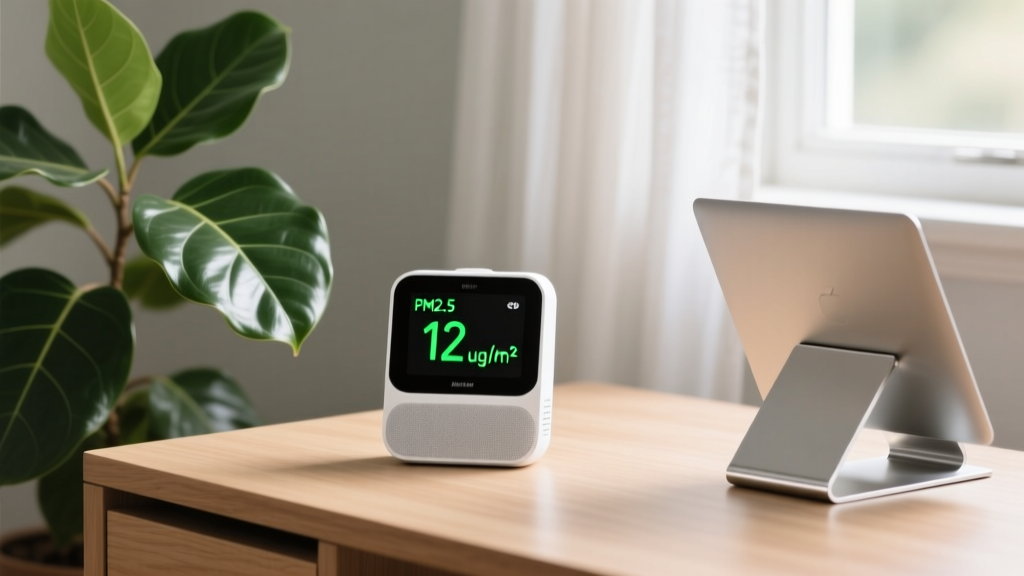
- Phase 1: Audit and Baseline (Week 1): Deploy an air quality monitor like the Airthings View Plus to track baseline CO2, VOCs, and PM2.5 levels over a standard 5-day workweek. Identify peak pollution times (e.g., when the home HVAC kicks on or when 3D printing occurs).
- Phase 2: Peripheral Sanitization (Week 2): Install UV-C light bars above your primary desk zone. Configure them via your smart home app to trigger only between 2:00 AM and 4:00 AM, ensuring the room is unoccupied and the sanitization cycle is uninterrupted.
- Phase 3: Floor and Under-Desk Automation (Week 3): Map the under-desk area with a micro-vacuum. Use virtual walls or no-go zones in the companion app to prevent the vacuum from approaching fragile PC tower intake fans or loose ethernet cables.
- Phase 4: Active Air Scrubbing (Week 4): Position your HEPA/VOC purifier at least two feet away from walls to ensure 360-degree intake. Link the purifier to your CO2 monitor, setting an automation to trigger 'Auto Mode' when CO2 exceeds 800 ppm.
Future Outlook: What Lies Beyond 2026?
While today's cleaning gadgets rely on active intervention (suction, UV light, filtration), the horizon of home office maintenance is shifting toward passive and preventative technologies. By 2028, we anticipate the mainstream commercialization of electrostatic dust-repellent desk mats and monitor coatings that actively push particulate matter away from surfaces using low-voltage micro-currents. Furthermore, self-cleaning nanocoatings, currently reserved for medical-grade touchscreens, will begin appearing on premium mechanical keyboards and mice, utilizing photocatalytic titanium dioxide layers that break down organic oils and bacteria under standard ambient room lighting.
Until then, the 2026 lineup of smart vacuums, UV-C sanitizers, and catalytic air purifiers represents the pinnacle of workspace hygiene. By adopting these tools, remote professionals are not just cleaning their desks; they are engineering an environment optimized for peak cognitive endurance and long-term health.
Written by
Marcus WebbMarcus Webb served as a U.S. Army logistics officer for 8 years, where he managed field equipment procurement and tactical gear evaluation across three combat deployments. After honorable discharge, he earned a certification from the Professional Knife Makers Association and became a certified Wilderness First Responder (WFR). Marcus has tested over 500 EDC products in extreme environments — from -40°F in Alaska to 120°F in the Mojave Desert — using military-spec testing protocols. His reviews of multi-tools, tactical flashlights, and survival gear are known for their rigorous methodology: controlled drop tests from 6 feet, 120-minute water submersion at 2 meters, and lateral torque testing at 45 Nm. He is a member of the Blade Show judging panel and contributes to OutdoorGearLab.