Space-Saving Kitchen Gadgets: Coolest Gadgets 2026
Discover the best space-saving vegetable peelers, graters, and slicers. We review the coolest kitchen gadgets for compact prep and tiny kitchens.
The Drawer Space Crisis: Why Standard Prep Tools Fail
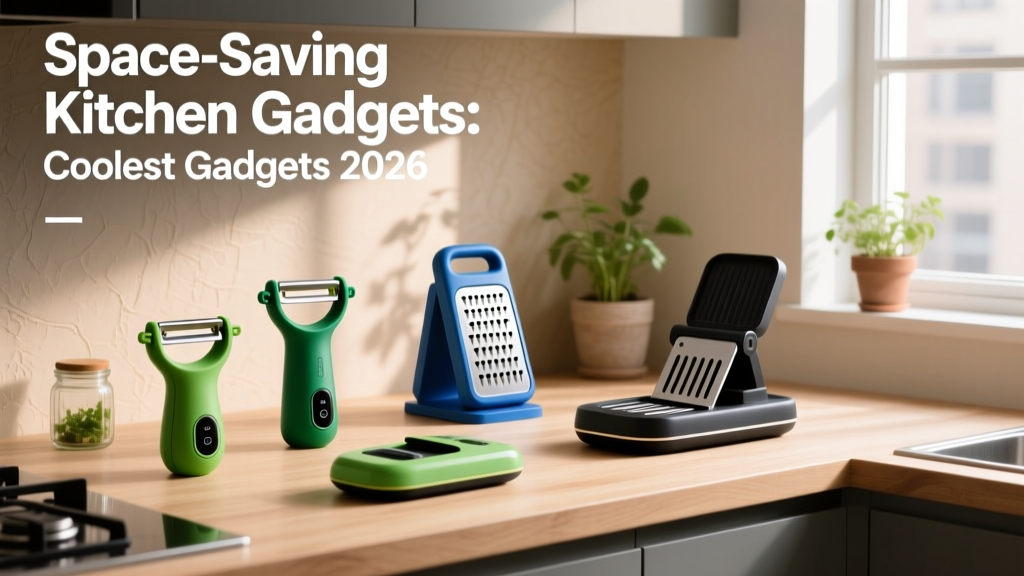
In small-scale culinary environments—studio apartments, RV galleys, and tiny homes—drawer real estate is a finite resource. Standard culinary tools are designed with sprawling suburban kitchens in mind, resulting in a poor footprint-to-utility ratio. A traditional box grater consumes roughly 220 cubic inches of drawer space, while a standard fixed-handle mandoline can span over 16 inches in length. When curating a collection of space-saving kitchen gadgets, the coolest gadgets aren't necessarily the most high-tech; rather, they are the most brilliantly engineered for spatial efficiency. This guide dissects the metallurgy, folding mechanisms, and nesting designs of the most compact vegetable peelers, graters, and slicers available in 2026, providing exact measurements and material specifications to help you eliminate drawer clutter without sacrificing prep performance.
Blade Metallurgy: The Hidden Cost of Compact Tools
Before evaluating specific form factors, it is critical to address the blade steel used in compact prep gadgets. Because space-saving tools often feature smaller, thinner blades, the steel must possess high edge retention to prevent premature dulling. Many budget-friendly compact peelers utilize 420J2 stainless steel. While 420J2 is highly resistant to rust due to its 13% chromium content, its low carbon content (typically under 0.15%) yields a Rockwell Hardness (HRC) of around 50-52. This soft steel rolls and dulls within weeks of daily use.
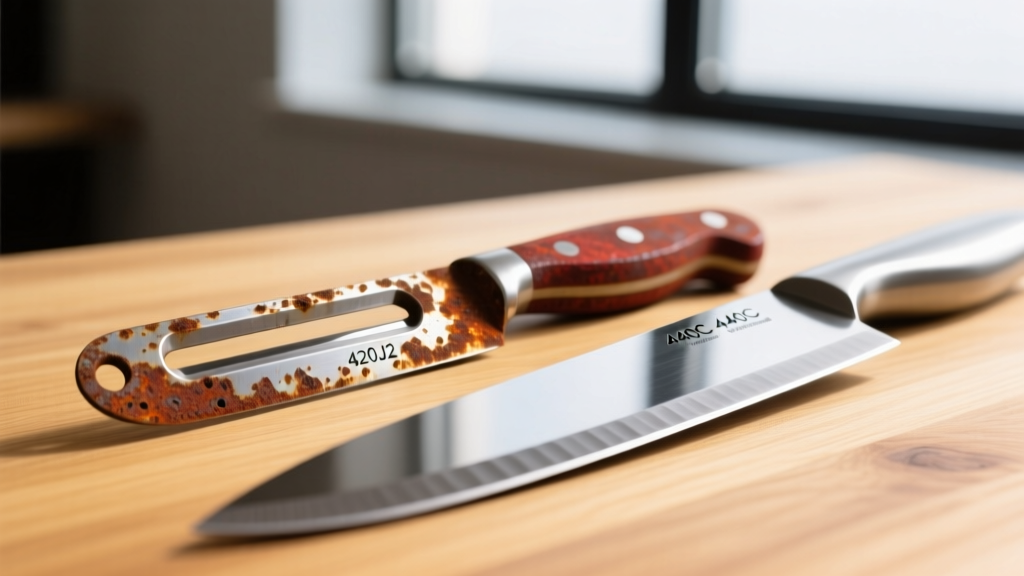
Premium compact gadgets upgrade to 440C stainless steel or Japanese VG-10. These high-carbon alloys achieve an HRC of 56-60, allowing manufacturers to grind thinner, sharper bevels that maintain their bite through hundreds of uses. According to Wirecutter's long-term peeler durability tests, tools featuring hardened 440C or proprietary Swiss alloys consistently outperform standard stamped steel by a factor of three in edge retention, making them mandatory for high-frequency, small-kitchen prep.
Ultra-Compact Peelers: Pivot, Swivel, and Y-Style Showdown
Peelers generally fall into three categories: swivel (straight), Y-peeler, and julienne. For tight spaces, the handle geometry dictates the stored footprint.
1. Kuhn Rikon Original Swiss Peeler (Swivel)
The gold standard for minimalism. Measuring just 4.5 inches long and 0.5 inches thick, it slips into the narrowest utensil dividers. The blade uses a proprietary hardened stainless alloy that easily slices through thick-skinned butternut squash without binding. Its non-stick coating reduces friction, preventing starchy potato skins from clogging the narrow blade gap.
2. Joseph Joseph Pivot Plus Y-Peeler (Folding)
Y-peelers offer superior ergonomic leverage for large batches, but their wide stance ruins drawer organization. The Pivot Plus solves this with a locking hinge that folds the handle flush against the blade head, reducing its stored length from 7.5 inches to just 4.2 inches. The blade is easily removable for deep cleaning, addressing a common hygiene failure point in fixed Y-peelers.
When purchasing folding or multi-part compact peelers, always check if the manufacturer sells replacement blades. Space-saving designs often use proprietary micro-blades. If a blade chips on a peach pit, a tool without a replacement ecosystem becomes instant landfill waste.
Graters That Disappear: Nesting and Flat-Pack Solutions
Box graters are notoriously bulky and dangerous to reach into when disorganized. The solution lies in nesting sets and flat-pack rasp designs.
Joseph Joseph Nest Grater Plus
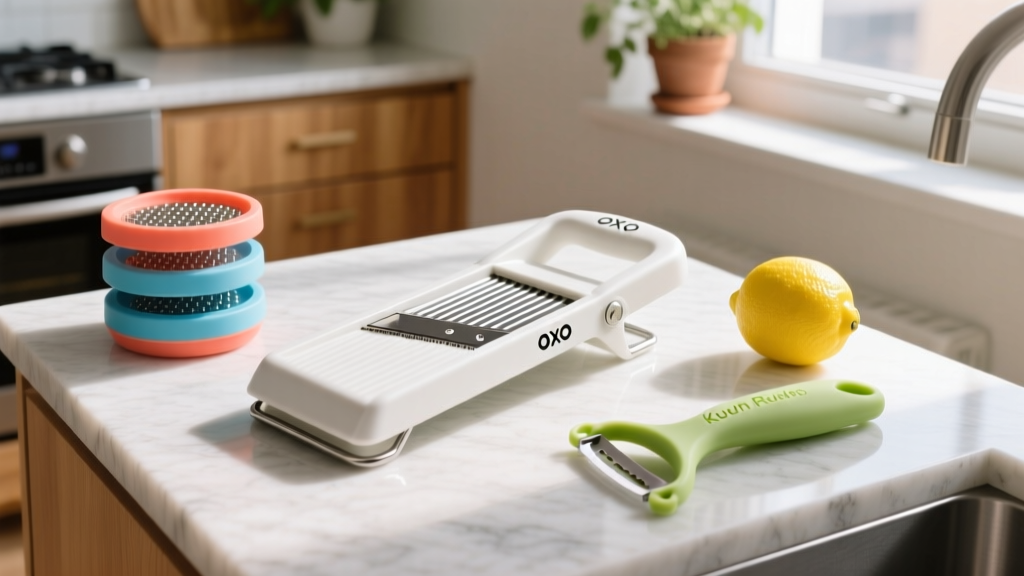
This set includes three distinct grating surfaces (coarse, medium, fine/zesting) that magnetically snap together and nest into a single, non-slip base. The total stored footprint is a mere 4.5 x 4.5 x 2.5 inches. The coarse grater features an integrated slicing blade on the reverse side, effectively replacing a standard mandoline for quick cucumber or radish slicing. The base doubles as a measuring cup with ounce and milliliter markings, eliminating the need for a secondary vessel.
Microplane Specialty Series 4-Sided Box Grater with Storage Lid
If you prefer the stability of a traditional box grater, the Microplane 4-Sided model features a custom-molded, snap-on plastic lid. This allows you to grate cheese or zest citrus directly into the grater, seal it, and store it in the refrigerator, bypassing the need for separate Tupperware. The blades are surgical-grade stainless steel, photo-chemically etched rather than stamped, ensuring the teeth remain razor-sharp without bending under lateral pressure.
Mandolines and Slicers: Folding Mechanisms and Finger Guards
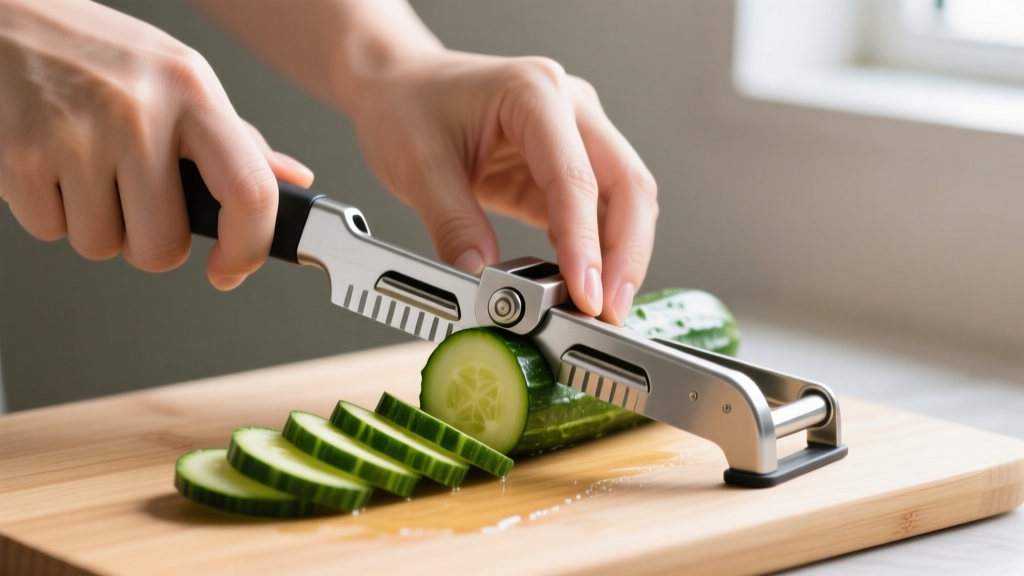
Mandolines are the most hazardous tools in the kitchen, and their large, rigid frames make them difficult to store safely. Modern compact mandolines prioritize retractable blades and folding tracks.
OXO Good Grips Hand-Held Mandoline Slicer
This model features a track that folds completely flat beneath the body, reducing its profile to 1.5 inches thick. It offers three thickness settings (1/16, 1/8, and 3/16 inch) and a dedicated julienne blade that deploys via a side lever. The blade retracts entirely into the housing when not in use, making it safe to toss into a crowded drawer without a sheath. As noted in Serious Eats' comprehensive mandoline testing, hand-held folding models sacrifice some slicing speed compared to heavy French models, but they win decisively on safety and spatial efficiency.
Benriner Super 64 Mandoline
For those who need professional-grade output in a narrow profile, the Japanese-made Benriner Super 64 features a 64mm (2.5-inch) blade width. Unlike wide Western mandolines, its slender, lightweight wooden/composite body slides easily into vertical knife blocks or narrow slots. The blade angle and thickness are infinitely adjustable via side screws, offering precision that click-stop mandolines cannot match.
Footprint & Performance Matrix
| Model | Category | Stored Footprint (LxWxH) | Blade Material | 2026 Price |
|---|---|---|---|---|
| Kuhn Rikon Swiss Peeler | Swivel Peeler | 4.5 x 2.5 x 0.5 in | Hardened Proprietary Steel | $11.00 |
| Joseph Joseph Pivot Plus | Folding Y-Peeler | 4.2 x 3.0 x 1.0 in | 420 Stainless (Optimized) | $14.00 |
| Joseph Joseph Nest Plus | Nesting Grater Set | 4.5 x 4.5 x 2.5 in | Stainless Steel | $28.00 |
| OXO Hand-Held Mandoline | Folding Mandoline | 10.5 x 4.5 x 1.5 in | 420 Stainless Steel | $22.00 |
| Benriner Super 64 | Japanese Mandoline | 12.5 x 3.0 x 2.0 in | High-Carbon Stainless | $68.00 |
Edge Retention and Maintenance Protocol
Compact blades are thinner and more susceptible to micro-chipping and corrosion if maintained poorly. Follow this protocol to maximize the lifespan of your space-saving gadgets:
- Never Use the Dishwasher: Dishwasher detergents contain harsh alkalis and chlorine-based rinsing agents that pit stainless steel and degrade the plastic hinges on folding tools. Hand wash immediately after use.
- Avoid Prolonged Acidic Soaking: Leaving a grater soaked in water with lemon juice or tomato residue will accelerate oxidation, even on 440C steel. Rinse with warm water and a drop of neutral pH dish soap.
- Use a Ceramic Honing Rod: For straight mandoline blades and Y-peelers, lightly run a fine-grit ceramic honing rod (1000+ grit) along the bevel every 10 uses to realign the microscopic edge. Do not use standard steel honing rods, as they will chip the hardened, thin edges of compact blades.
- Dry Thoroughly Before Folding: Moisture trapped in the hinge mechanisms of folding peelers or retractable mandolines leads to internal rust and stiff joints. Air dry completely in the open position before collapsing for storage.
Frequently Asked Questions
Can I sharpen a micro-plane or box grater at home?
Practically, no. Photo-chemically etched grater teeth are too small and numerous to sharpen manually with standard whetstones or files. Once a Microplane or box grater dulls or the teeth bend backward, it must be replaced. This is why investing in high-quality, etched steel rather than stamped metal is crucial for longevity.
Are folding mandolines as stable as fixed-track models?
Fixed-track French mandolines (like the Matfer Bourgeat) offer superior stability for high-volume slicing due to their heavy, wide bases. Folding hand-held mandolines require you to stabilize the tool against a cutting board or bowl. While slightly less stable, folding models are perfectly adequate for household prep and drastically reduce the risk of lacerations during storage.
What is the best compact tool for julienning carrots?
For true, uniform julienne strips, a mandoline with a dedicated julienne blade deck (like the OXO Hand-Held) or a Japanese Benriner with the julienne attachment is required. Standard peelers with 'julienne teeth' often tear the carrot rather than slicing it, resulting in ragged edges and uneven cooking times.
Written by
David OkaforDavid Okafor is an ASE (Automotive Service Excellence) Master Certified Technician with 15 years of professional experience in vehicle diagnostics, aftermarket electronics installation, and fleet management. He holds an Associate Degree in Automotive Technology from Universal Technical Institute and certifications in mobile electronics (MECP Certified Installer). David has installed and reviewed over 800 car tech products — from OBD2 scanners and dash cams to full infotainment system retrofits — in vehicles ranging from economy compacts to luxury SUVs. His popular YouTube channel "AutoTech David" has over 150,000 subscribers and features detailed installation tutorials and product teardowns. He is a regular contributor to the SEMA Show's aftermarket technology showcase and advises two automotive tech startups on product development.