Kitchen Gadgets List: Beginner vs Expert Blenders & Choppers
Compare beginner and expert blenders, food processors, and choppers. This kitchen gadgets list breaks down motor torque, blade steel, and real costs.
The Torque Illusion: Peak Watts vs. Continuous Horsepower
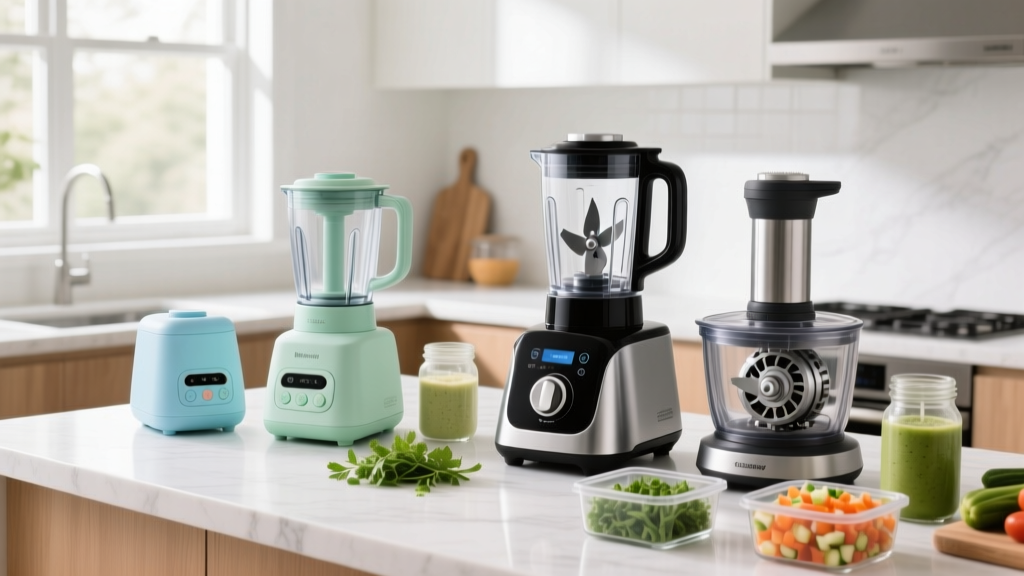
When building a comprehensive kitchen gadgets list, the divide between beginner and expert equipment becomes most apparent in motorized prep tools. The most pervasive marketing myth in the blender aisle is the 'Peak Watts' metric. A $79 beginner blender might advertise 1400 peak watts, while a $649 expert-tier Vitamix A3500 advertises a 2.2-peak horsepower motor (roughly 1640 watts). On paper, they look comparable. In practice, they operate in entirely different mechanical universes.
Peak wattage measures the absolute maximum electrical draw at the exact millisecond the motor stalls or starts. It tells you nothing about sustained blending power. Expert-tier blenders utilize high-torque, continuous-duty motors designed to run for 10 minutes straight without triggering a thermal overload switch. According to Consumer Reports' blender reliability data, budget blenders frequently shut down when processing viscous mixtures like nut butters or frozen acai bowls because their internal thermal fuses trip to prevent the copper windings from melting. Expert models use advanced airflow cooling and aircraft-grade stainless steel blade assemblies that maintain high RPMs under heavy load, creating a true vortex rather than merely spinning at the bottom of the pitcher.
Pitcher Metallurgy and Edge Retention
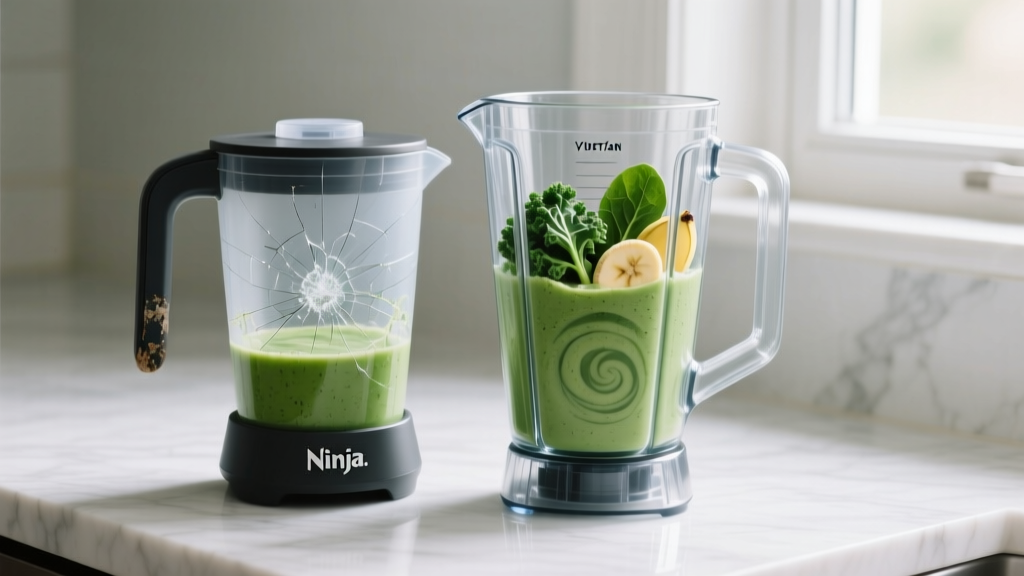
Beginner blenders almost exclusively use injection-molded polycarbonate or standard ABS plastic pitchers. Within six months of blending ice or fibrous greens, the interior walls micro-scratch, creating a cloudy appearance and microscopic grooves where bacteria and food particles lodge. Expert models utilize Eastman Tritan copolyester, a BPA-free, shatter-resistant material that maintains optical clarity and resists impact abrasion. Furthermore, budget blender blades are typically stamped from 420-grade stainless steel, which dulls rapidly and relies on sheer motor speed to pulverize food. Expert blades are forged, hardened, and often deliberately left with a blunt edge; they rely on the sheer kinetic force of a 240 mph blade tip speed to shatter cell walls, meaning they never actually require sharpening.
Food Processors: Feed Tube Geometry and S-Blade Wobble
The food processor is the undisputed workhorse of batch cooking, but the gap between a $50 beginner model and a $400 prosumer unit dictates your actual prep time. The critical differentiator is feed tube geometry and motor stabilization.
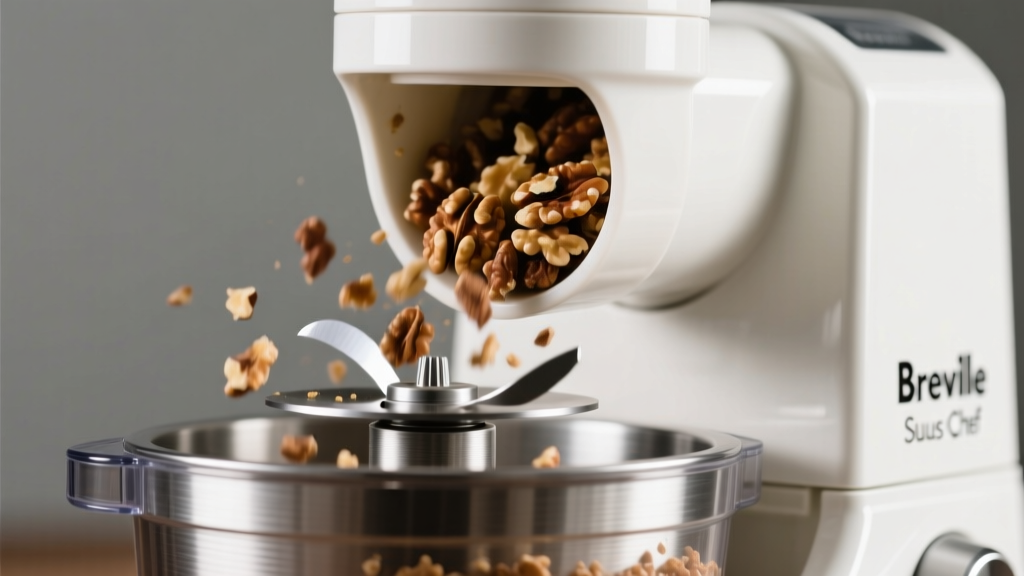
Beginner models, such as the Hamilton Beach 10-Cup Stack & Snap (approx. $49), feature narrow 3-inch feed tubes and lightweight plastic housings. This forces you to pre-cut large vegetables like potatoes or butternut squash into small chunks before processing. Additionally, the lightweight base causes the unit to 'walk' across the counter when kneading dough or processing heavy root vegetables. Expert models, like the Breville Sous Chef 16 Pro ($399), feature a massive 5.5-inch feed tube and a heavy die-cast metal base weighing over 20 pounds. As highlighted in Serious Eats' exhaustive food processor testing, the wider feed tube allows entire tomatoes, onions, and blocks of cheese to be processed whole, reducing active prep time by up to 40%.
The S-Blade Wobble Failure Mode
In budget food processors, the central spindle that holds the S-blade is often made of molded plastic with wide tolerances. When processing hard foods like parmesan cheese or ice, the blade wobbles on the spindle, resulting in uneven chopping and premature wear to the drive socket. Expert models utilize machined metal drive shafts with magnetic or precision-locking blade collars, ensuring zero lateral movement during high-torque tasks.
| Feature | Beginner (Hamilton Beach 10-Cup) | Mid-Tier (Cuisinart Custom 14) | Expert (Breville Sous Chef 16 Pro) |
|---|---|---|---|
| Price Range | $45 - $55 | $199 - $229 | $399 - $449 |
| Motor Type | 500W Standard AC | 720W Heavy-Duty AC | 2000W High-Torque Induction |
| Feed Tube Width | 3.0 inches (requires pre-cutting) | 4.5 inches (medium whole veg) | 5.5 inches (large whole veg) |
| Base Material | Lightweight ABS Plastic | Weighted Plastic / Rubber feet | Heavy Die-Cast Metal (20+ lbs) |
| Slicing Adjustability | None (fixed disc) | None (fixed disc) | Variable (0.3mm to 8.0mm dial) |
Choppers: Pull-Cord Fatigue vs. Electric Mini-Preps
For small tasks—mincing a single clove of garlic, dicing one jalapeño, or chopping a handful of parsley—full-sized food processors are inefficient due to cleanup time. This is where dedicated choppers enter your kitchen gadgets list.
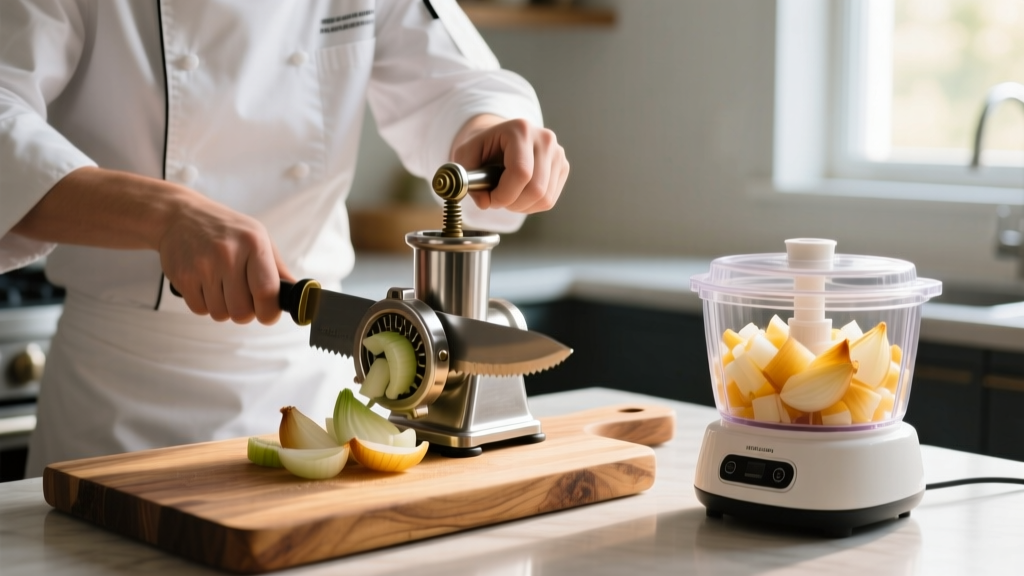
The manual pull-cord chopper (e.g., Chef'n FreshForce, $24) is a staple for beginners and campers. It requires no electricity and relies on a geared internal mechanism that spins the blade multiple times per pull. However, the primary failure mode is string fatigue; the internal nylon cord eventually frays and snaps after 12 to 18 months of heavy use, rendering the entire unit useless since they are rarely user-repairable.
Expert home cooks typically bypass manual pull-choppers in favor of electric mini-prep bowls, such as the Cuisinart Mini-Prep Plus ($39). The critical advantage of the electric mini-prep is the auto-reversing blade. With the touch of a button, the blade spins clockwise for chopping and counter-clockwise for grinding. This dual-directional force keeps food circulating in the bowl rather than packing it against the walls, yielding a much more uniform mince without the manual labor of scraping down the sides every three seconds.
The 2026 Decision Framework: Which Tier Do You Need?
- Stick to Beginner Tier If: You cook 3-4 times a week, primarily make liquid-heavy smoothies, use your food processor only for holiday pie crusts, and have limited storage space.
- Upgrade to Expert Tier If: You batch-prep meals for the week, regularly make nut butters or thick frozen desserts, knead high-hydration bread doughs, or suffer from wrist/joint pain that makes manual chopping difficult.
Upgrading Your Kitchen Gadgets List: The Verdict
Transitioning from beginner to expert motorized prep tools is not merely about brand prestige; it is an investment in mechanical longevity and time efficiency. While a $400 food processor represents a significant upfront cost, the elimination of pre-cutting vegetables and the ability to process 5-pound batches of dough without burning out the motor fundamentally changes your relationship with meal preparation.
'The true cost of a budget kitchen appliance isn't the purchase price; it's the minutes lost to pre-cutting, the frustration of stalled motors, and the inevitable replacement cycle every three years.' — Equipment Testing Directorate, Wirecutter
Frequently Asked Questions
Can a high-end blender completely replace a food processor?
No. While expert blenders like the Vitamix can pulverize dry grains into flour or make perfectly smooth hummus, they lack the precise slicing and shredding discs required for tasks like making coleslaw, grating potatoes for latkes, or slicing cucumbers uniformly. They are complementary tools, not substitutes.
Are glass blender pitchers better than Tritan plastic?
Glass (found on some mid-tier models) is highly scratch-resistant and doesn't retain odors, but it is exceptionally heavy and poses a severe shattering risk if dropped or subjected to extreme thermal shock. Eastman Tritan copolyester remains the industry standard for expert-tier blenders due to its optimal balance of impact resistance, lightweight handling, and durability.
How do I clean the cloudy residue on my beginner blender pitcher?
Cloudiness on polycarbonate pitchers is usually permanent micro-scratching from ice or fibrous foods. However, if it is mineral buildup from hard water or protein films, blend a mixture of warm water, one drop of dish soap, and a tablespoon of white vinegar for 30 seconds, then rinse thoroughly.
Written by
Lena ChenLena Chen earned her M.S. in Human-Computer Interaction from Carnegie Mellon University and a B.S. in Electrical Engineering from the University of Washington. She has spent the past decade specializing in smart home architecture and IoT ecosystems, helping over 200 homeowners design fully connected living spaces. Lena is a certified Matter protocol consultant and has published peer-reviewed research on voice-first interface design in the ACM Digital Library. Her reviews of smart home products combine deep technical analysis with real-world usability testing, evaluating everything from Zigbee mesh stability to Alexa skill responsiveness. She regularly speaks at CEDIA Expo and CES smart home panels.