12 Cool Garage Gadgets to Upgrade Your Workspace in 2026
Transform your automotive workspace with our 2026 buyer's guide to the best cool garage gadgets, featuring smart lighting, EV chargers, and heavy-duty lifts.
The Evolution of the Automotive Workspace
Upgrading a residential garage from a basic parking space to a high-functioning automotive workshop requires targeted investments in power, diagnostics, and environmental control. The market for cool garage gadgets has shifted from novelty items to professional-grade, smart-integrated tools. This guide breaks down the highest-ROI equipment for 2026, focusing on exact specifications, real-world pricing, and installation requirements to help you build a highly capable automotive sanctuary.
Smart Illumination and Power Distribution
Standard builder-grade fluorescent fixtures deliver roughly 30 lumens per square foot—insufficient for detailed mechanical work. The Illuminating Engineering Society (IES) recommends 50 to 100 lumens per square foot for detailed garage tasks. For a standard 400-square-foot two-car garage, you need a minimum of 20,000 to 40,000 lumens to eliminate dangerous shadows under vehicles.
The Upgrade: Philips Hue White and Color Ambiance Base Kit ($199) paired with Hue Lightstrip Plus extensions ($99 per 6.5 feet). While smart bulbs are often dismissed as gimmicks, their utility in a garage lies in color temperature shifting. Switching to 5000K (daylight) provides high-contrast visibility for spotting fluid leaks and wiring faults, while dimming to 2700K reduces glare when detailing paint under LED inspection lights.
For power distribution, the U.S. Department of Energy notes that smart lighting systems can reduce illumination energy use by up to 30% through automated scheduling and motion sensors. Pair this with a hardwired ChargePoint Home Flex EV charger ($699), which requires a dedicated 240V/50A NEMA 14-50 circuit. Always verify your main electrical panel has at least 100 amps of spare capacity before adding high-draw automotive gadgets.
Bi-Directional Diagnostics and Telematics

Basic code readers are obsolete for serious enthusiasts. Modern vehicles require bi-directional scanners capable of actuating components (e.g., cycling ABS pumps, testing fuel injectors) and performing ECU coding.
The Upgrade: Topdon Phoenix Lite 2 ($499). This 8-inch Android-based tablet offers full-system diagnostics, 31 reset functions, and active tests for over 150 vehicle brands. Unlike cheaper Bluetooth dongles that rely on phone processing, the Phoenix Lite 2 features a dedicated 4-core processor and a 6300mAh battery, ensuring it will not die mid-scan. Its VCI (Vehicle Communication Interface) supports CAN FD and DoIP protocols, which are mandatory for diagnosing 2020-and-newer GM, Ford, and Volvo platforms.
Heavy Lifting: Portable Hydraulic Solutions
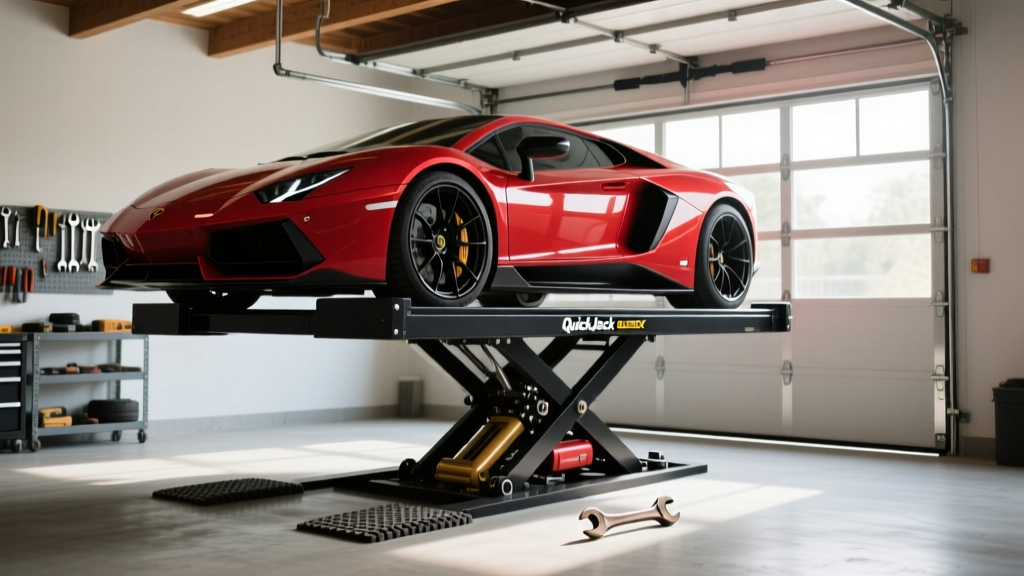
Floor jacks and jack stands limit undercarriage access and introduce catastrophic failure points if placed incorrectly on reinforced pinch welds. Portable hydraulic lifts bridge the gap between cheap floor jacks and $10,000 permanent two-post lifts.
The Upgrade: QuickJack BL-5000SLX ($1,599). This system lifts 5,000 pounds to a maximum height of 21 inches in roughly 45 seconds. The SLX (Side Lift Extension) model includes integrated hydraulic cylinders that eliminate the need for external power units, running off a standard 110V outlet. The setup requires 114 inches of clearance between the two frames, making it ideal for mid-size sedans and sports cars. Note that QuickJack requires a minimum concrete compressive strength of 3,000 PSI; always test your slab before applying full hydraulic pressure.
Comparative Analysis: 2026 Garage Essentials
| Gadget Category | Top Model (2026) | Price Range | Primary Utility | Installation Requirement |
|---|---|---|---|---|
| Smart Lighting | Philips Hue Base + Strips | $250 - $400 | High-CRI task illumination | Standard 120V, Hub setup |
| EV / Power Hub | ChargePoint Home Flex | $699 | Level 2 vehicle charging | 240V/50A NEMA 14-50 |
| Bi-Directional Scanner | Topdon Phoenix Lite 2 | $499 | ECU coding & active tests | None (OBD2 plug-in) |
| Portable Car Lift | QuickJack BL-5000SLX | $1,599 | Full undercarriage access | Level concrete (3k PSI), 110V |
| Air Purification | Alen BreatheSmart 75i | $799 | VOC and particulate removal | Standard 120V |
Environmental Control: Managing VOCs and Particulates
Automotive work generates hazardous airborne compounds. Brake dust contains heavy metals, while solvents, degreasers, and exhaust emit Volatile Organic Compounds (VOCs). The Environmental Protection Agency (EPA) warns that indoor VOC levels can be up to 10 times higher than outdoor levels during and immediately after using chemical products.
Furthermore, OSHA guidelines on ventilation emphasize that enclosed spaces require active air exchange when chemical vapors are present. Relying solely on an open garage door is insufficient for deep-bay work, especially in winter months when the door remains closed.
The Upgrade: Alen BreatheSmart 75i with the Fresh filter ($799). This unit features a True HEPA H13 filter paired with a 3.6-pound activated carbon bed specifically designed to adsorb chemical vapors and odors. It moves 1,300 cubic feet of air per minute (CFM), capable of cycling the air in a 1,000-square-foot garage every 30 minutes. For exhaust extraction, pair this with a VEVOR 115V Exhaust Fan ($189) mounted near the ceiling to actively pull carbon monoxide out during cold-start engine tuning.
Buyer's Decision Framework: Budgeting Your Build
Allocating capital for cool garage gadgets requires prioritizing safety and utility over aesthetics. Use this framework to sequence your purchases based on practical workflow dependencies:
- Phase 1: Safety & Visibility ($500 - $1,000). Start with 5000K LED high-bay lights and a heavy-duty air purifier. You cannot work safely or accurately if you cannot see the fastener or breathe the air without respiratory irritation.
- Phase 2: Access & Diagnostics ($1,500 - $2,500). Invest in the QuickJack and a bi-directional scanner. These tools pay for themselves by eliminating the need for dealership diagnostic fees ($150+/hour) and allowing safe suspension, brake, and exhaust work without the risk of jack stand failure.
- Phase 3: Power & Automation ($1,000+). Add smart power strips, EV chargers, and automated climate control. These are quality-of-life upgrades that should only be executed once your electrical panel has been verified by a licensed electrician and your primary workflow is established.
Written by
Emma LarssonEmma Larsson holds an M.A. in International Relations from Sciences Po Paris and a B.A. in Communications from Stockholm University. A digital nomad since 2017, she has worked from over 45 countries across six continents, building deep expertise in portable power solutions, travel routers, compact computing, and connectivity gadgets that survive international travel. Emma is a certified member of the Travel Technology Association and has advised three travel gear startups on product-market fit for remote workers. Her reviews evaluate products against real travel scenarios — TSA compliance, voltage compatibility across 200+ countries, durability through 50+ checked bag cycles, and battery life under airplane mode vs. active use. She has been featured in Condé Nast Traveler's "Tech-Savvy Traveler" series and speaks at Remote Work Summit events.