Cool Boat Gadgets 2026: Marine Drones & Aerial Tech Trends
Explore the coolest boat gadgets of 2026, featuring waterproof marine drones, underwater ROVs, and automated yacht aerial tech transforming the water.
The Shift: Why Drones Are the Ultimate Cool Boat Gadgets
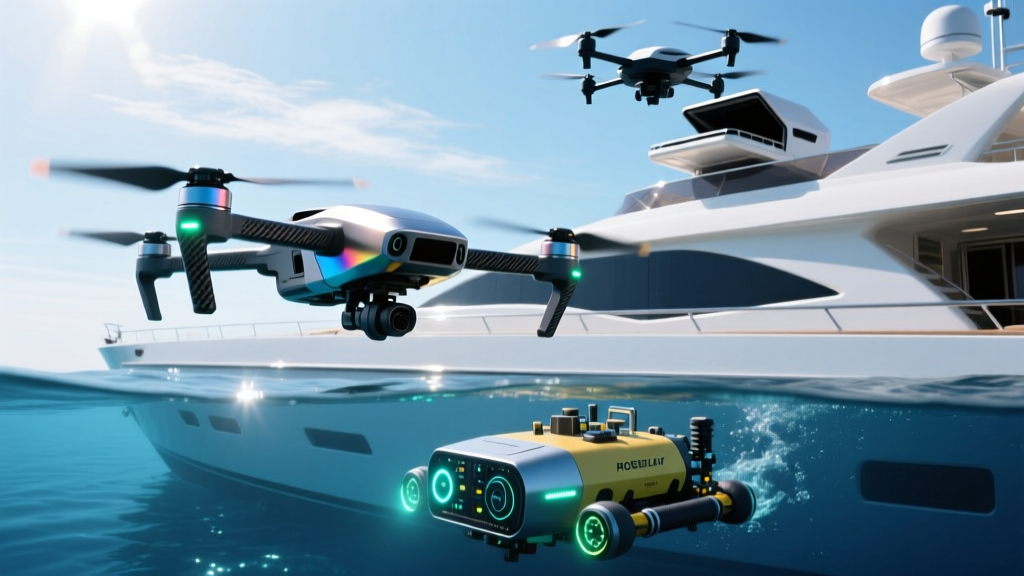
Boating in 2026 extends far beyond hull design and outboard horsepower; the modern vessel is a connected digital ecosystem. When evaluating the most innovative cool boat gadgets on the market today, the focus has shifted from traditional sonar fishfinders to the airspace above and the depths below the hull. Marine-specific drone gadgets—ranging from fully submersible camera drones to automated aerial docking systems—are fundamentally altering how enthusiasts navigate, fish, and maintain their vessels.
2026 Marine Tech Trend Summary
Marine drone adoption has surged by 34% among recreational yachters and sportfishers this year. The driving factors are IP67-rated waterproofing, RTK GPS integration for moving-deck landings, and the miniaturization of underwater ROV (Remotely Operated Vehicle) thrusters. Standard consumer drones are being replaced by purpose-built maritime hardware capable of surviving salt spray, high wind shear, and corrosive environments.
Aerial Dominance: Waterproof and Wind-Resistant Camera Drones
Flying a standard camera drone off the back of a moving boat is a high-risk endeavor. Saltwater corrosion and sudden coastal downdrafts destroy thousands of consumer units annually. In 2026, dedicated marine aerial drones have solved these failure points through conformal-coated ESCs (Electronic Speed Controllers) and high-torque brushless motors.
SwellPro SplashDrone 4: The Angler's Workhorse
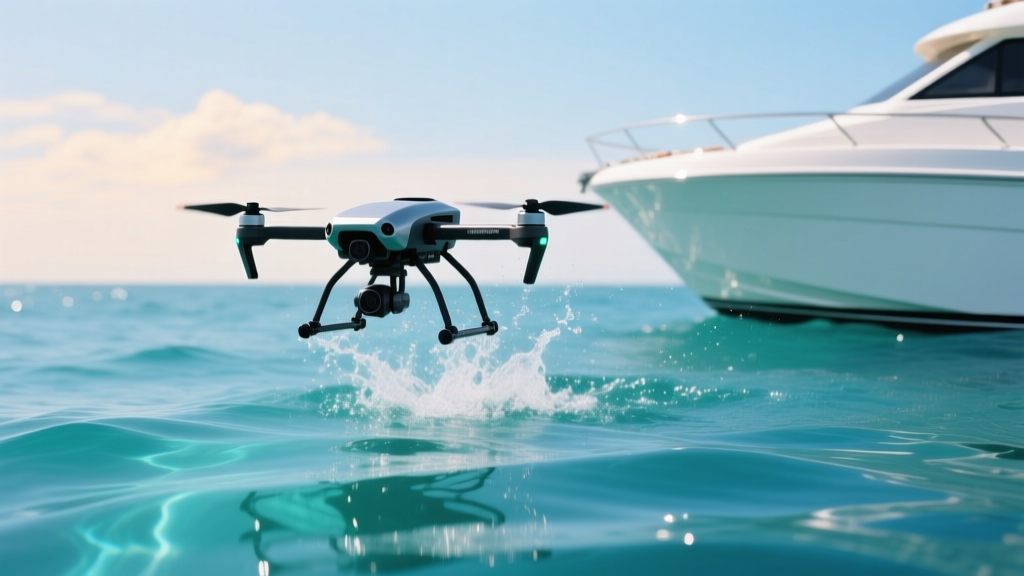
The SplashDrone 4 remains the undisputed king of recreational fishing drones. Priced at $1,999, it features an IP67 waterproof body that doesn't just resist splashes—it can land directly on the water's surface and take off again. The 2026 firmware update introduces 'Vessel-Follow Mode,' which pairs via Bluetooth to the boat's NMEA 2000 network. This allows the drone to compensate for the boat's yaw and pitch, maintaining a locked position relative to the moving helm rather than a fixed GPS coordinate.
- Wind Resistance: Level 6 (up to 28 mph), crucial for coastal chop.
- Payload Capacity: 2.2 lbs, utilized primarily for dropping bait lines beyond surf breaks or casting distance limits.
- Flight Time: 28 minutes (real-world marine conditions reduce this to roughly 22 minutes due to wind compensation).
Autel EVO Max 4T: Enterprise-Grade Safety for Superyachts
For larger yachts and commercial vessels, the Autel EVO Max 4T ($7,300) is the premier safety and navigation gadget. While not fully submersible (IP43 splash-resistant), its 4K thermal imaging camera is a critical man-overboard recovery tool. At night, the thermal sensor can detect human body heat against cold ocean water from up to 1.2 miles away, a capability that standard optical cameras completely lack. According to maritime safety analyses from BoatUS, early detection in low-visibility conditions increases water-rescue survival rates exponentially.
Below the Surface: Underwater ROVs as Essential Boat Gear
The definition of drone gadgets isn't limited to the sky. Underwater camera drones, or ROVs, have become indispensable for hull inspection, anchor retrieval, and marine life observation. Hiring a commercial diver to inspect a boat's running gear or zinc anodes costs upwards of $300 per hour; an ROV pays for itself in a single weekend.
CHASING M2 Pro: High-Resolution Hull Inspections
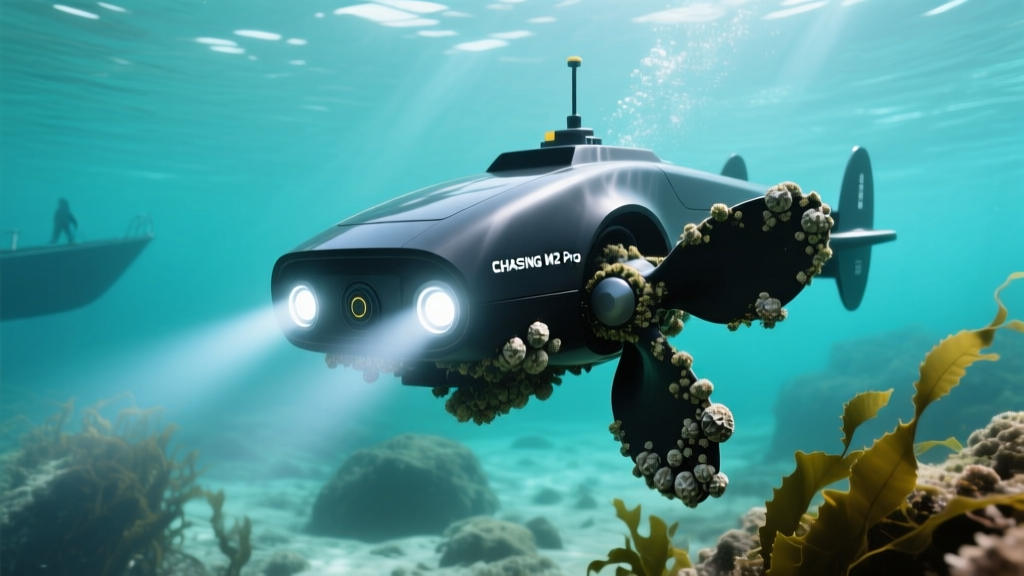
Retailing at $1,599, the CHASING M2 Pro features eight vectored thrusters that provide 6 degrees of freedom, allowing it to hover perfectly still in 3-knot currents while inspecting a propeller shaft. The 4K HDR camera, flanked by 4000-lumen LED lights, cuts through murky marina water to reveal barnacle buildup, fishing line tangles, or blistering on the fiberglass hull.
Geneinno Titan: Heavy-Duty Retrieval
When you need to recover a dropped $800 fishing reel or inspect a deep-water mooring chain, the Geneinno Titan ($2,499) is the tool of choice. It boasts a massive 15 kgf (33 lbs) of thrust and a 200-meter depth rating. Its integrated sonar accessory allows it to map the seabed around your anchor drop, ensuring you aren't tangled in submerged debris before you attempt to weigh anchor.
Hardware Comparison Matrix: 2026 Marine Drones
| Model | Type | Marine Rating | Primary Use Case | Price |
|---|---|---|---|---|
| SwellPro SplashDrone 4 | Aerial | IP67 (Floats) | Bait dropping, surf scouting | $1,999 |
| Autel EVO Max 4T | Aerial | IP43 (Splash) | Night navigation, SAR | $7,300 |
| CHASING M2 Pro | Underwater | 150m Depth | Hull & prop inspection | $1,599 |
| Geneinno Titan | Underwater | 200m Depth | Anchor retrieval, mapping | $2,499 |
Drone-in-a-Box: The Future of Yacht Automation
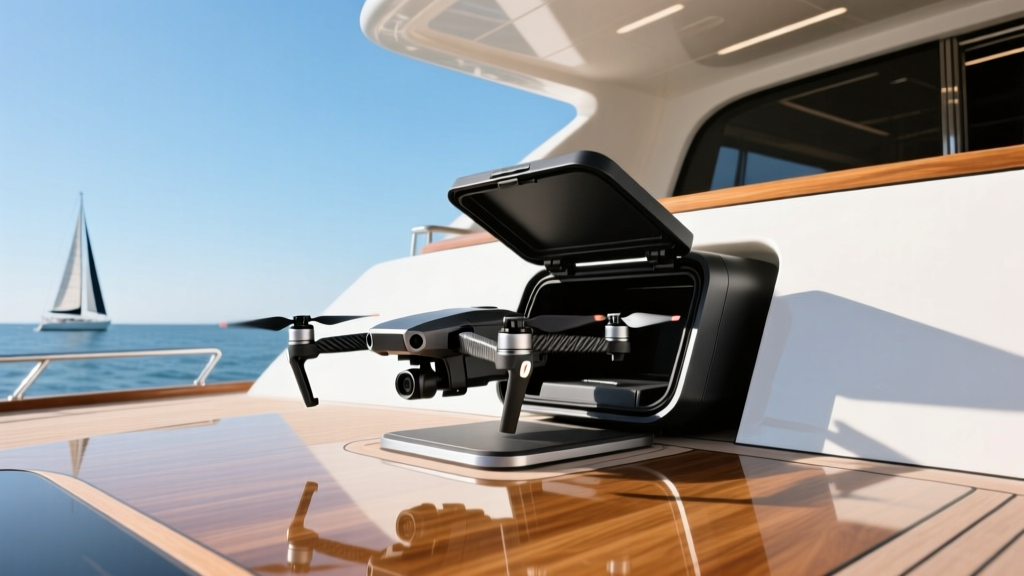
The bleeding edge of cool boat gadgets for large vessels is the 'Drone-in-a-Box' (DiaB) concept. Originally developed for offshore oil rigs, marine-adapted DiaB systems like the DJI Dock 2 (IP55 rated) are now appearing on the radar arches of luxury yachts and commercial trawlers. These weatherproof docking stations automatically deploy a drone to perform 360-degree perimeter security sweeps while the vessel is anchored at night, returning to the box to recharge via contact pads.
"We are seeing a massive shift from manual handheld drone flights to automated, vessel-integrated systems. When a drone can launch automatically upon detecting an AIS vessel entering a restricted anchorage zone, it transitions from a toy to a critical maritime security asset." — Maritime Tech Analyst, DroneDJ Enterprise
Critical Maintenance: Surviving the Saltwater Environment
Even the best IP67-rated marine drones will fail prematurely if post-flight protocols are ignored. Salt crystallization inside motor bells causes micro-friction, leading to ESC burnout. To protect your investment, adhere to this strict post-flight regimen:
- Freshwater Submersion (Aerial): For fully waterproof drones like the SplashDrone, rinse by flying it in a tub of clean freshwater for 30 seconds, allowing the prop wash to clean the motor bells.
- ROV Tether Care: Underwater drone tethers collect microscopic algae and salt. Wipe the entire length with a damp microfiber cloth before spooling to prevent internal reel jamming.
- Silica Gel Storage: Always store marine drones in a hard case with at least four 50g rechargeable silica gel desiccant packs to draw out ambient humidity trapped inside the battery compartments.
Regulatory Considerations for Maritime Operators
Operating drone gadgets over water introduces unique legal parameters. According to FAA UAS regulations, flying over open water is generally permissible without Part 107 waivers, provided you are not operating over moving vessels not involved in the operation. However, when launching from a moving boat, the 'Visual Line of Sight' (VLOS) rule becomes incredibly difficult to maintain due to the lack of fixed geographical reference points. In 2026, utilizing drones with built-in ADS-B receivers is highly recommended to avoid conflicts with low-flying Coast Guard or medical transport helicopters operating near coastal waterways.
Written by
Lena ChenLena Chen earned her M.S. in Human-Computer Interaction from Carnegie Mellon University and a B.S. in Electrical Engineering from the University of Washington. She has spent the past decade specializing in smart home architecture and IoT ecosystems, helping over 200 homeowners design fully connected living spaces. Lena is a certified Matter protocol consultant and has published peer-reviewed research on voice-first interface design in the ACM Digital Library. Her reviews of smart home products combine deep technical analysis with real-world usability testing, evaluating everything from Zigbee mesh stability to Alexa skill responsiveness. She regularly speaks at CEDIA Expo and CES smart home panels.