Top Portable Power Gadgets for the Beach: 2026 Guide
Discover the best portable power gadgets for the beach in 2026. Compare IP68 power banks, heat-resistant solar chargers, and basecamp power stations.
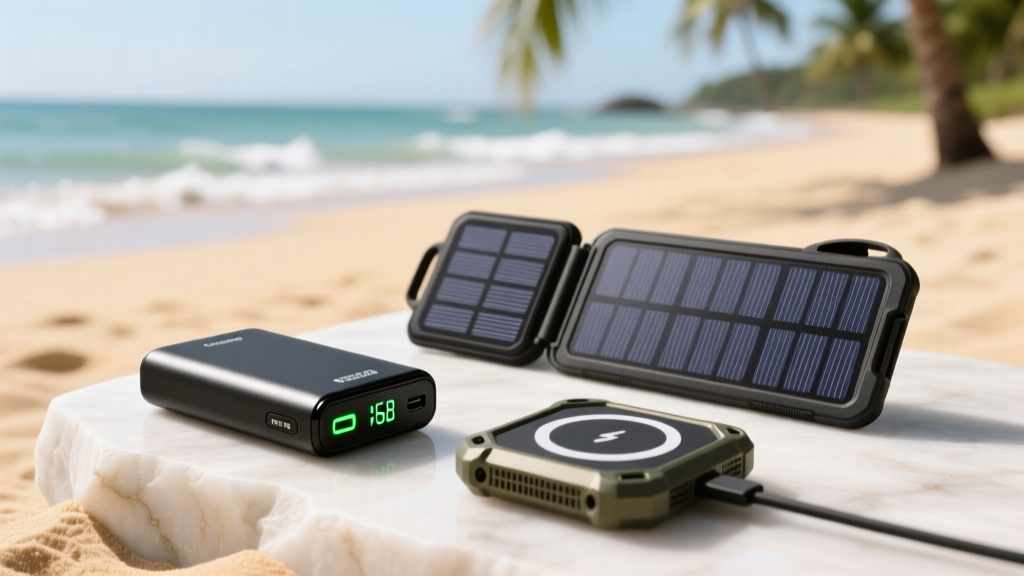
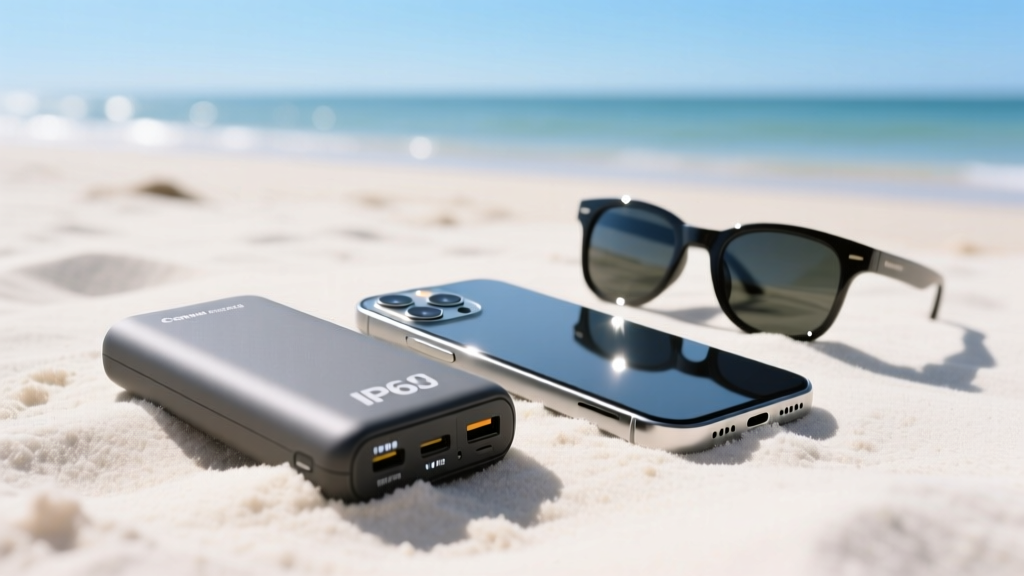
The Hidden Enemy of Beach Tech: Thermal Throttling and Sand Ingress
When selecting gadgets for the beach, portable power is often the most overlooked category. Most consumers focus on waterproof speakers or sand-proof trackers, but the lithium-ion cells powering those devices are highly vulnerable to coastal environments. The primary failure mode for power banks at the beach is not water damage, but thermal throttling and accelerated chemical degradation. Lithium-ion batteries operate optimally between 20°C and 25°C (68°F to 77°F). According to research on battery longevity, exposing these cells to temperatures above 30°C (86°F) permanently accelerates capacity loss, and sand in direct sunlight can easily exceed 60°C (140°F) by mid-afternoon. When a standard power bank's internal temperature management system detects unsafe heat, it artificially throttles the output wattage to prevent thermal runaway, meaning your 65W fast charger may suddenly drop to a trickle charge of 5W.
Fine quartz sand easily bypasses standard mesh port covers. Once inside a USB-C port, sand mixes with ambient humidity and salt spray, creating an abrasive, conductive sludge that can short-circuit the power delivery pins or physically block the connector from seating properly.
Top Waterproof Power Banks for Shoreline Excursions
To survive the beach, a power bank needs more than just a high milliamp-hour (mAh) rating; it requires an IP67 or IP68 ingress protection rating, silicone-sealed port flaps, and an exterior casing that reflects rather than absorbs solar radiation.
BioLite Charge 80 PD
The BioLite Charge 80 PD is engineered specifically for harsh outdoor environments. Featuring an IP67 rating, it can withstand submersion in up to 1 meter of water for 30 minutes—ideal for accidental drops in the surf. Its 20,000mAh capacity provides roughly four full charges for a modern flagship smartphone. The ruggedized, textured exterior provides grip even with wet, sandy hands, and the integrated USB-C cable eliminates the risk of losing your charging wire in the wind. Priced at $129.95, it offers 60W two-way fast charging, allowing you to replenish the bank itself in just 1.5 hours when you return to an AC outlet.
Goal Zero Sherpa 100 PD
For users who need to power larger devices like tablets or mirrorless cameras, the Goal Zero Sherpa 100 PD ($299.95) utilizes an anodized aluminum chassis. Aluminum acts as a passive heat sink, dissipating internal battery heat much more effectively than the polycarbonate plastic used in cheaper alternatives. With a 25,600mAh capacity and a 100W USB-C Power Delivery port, it can keep a laptop charged under a beach umbrella. The built-in OLED display provides real-time telemetry on input/output wattage and remaining runtime, a critical feature when managing limited power off-grid.
| Feature | BioLite Charge 80 PD | Goal Zero Sherpa 100 PD |
|---|---|---|
| Capacity | 20,000 mAh (74Wh) | 25,600 mAh (94.7Wh) |
| IP Rating | IP67 (Submersible) | IP54 (Splash/Sand Proof) |
| Max Output | 60W USB-C | 100W USB-C |
| Casing Material | Ruggedized Silicone/PC | Anodized Aluminum |
| Price (2026) | $129.95 | $299.95 |
Solar Chargers: Understanding Temperature Coefficients
Many beachgoers assume that maximum sunlight equals maximum solar charging efficiency. In reality, photovoltaic cells suffer from a phenomenon known as the temperature coefficient. As documented by the National Renewable Energy Laboratory (NREL) in their module reliability research, solar panels experience a drop in voltage and overall power output as their operating temperature rises above the Standard Test Condition (STC) baseline of 25°C (77°F).
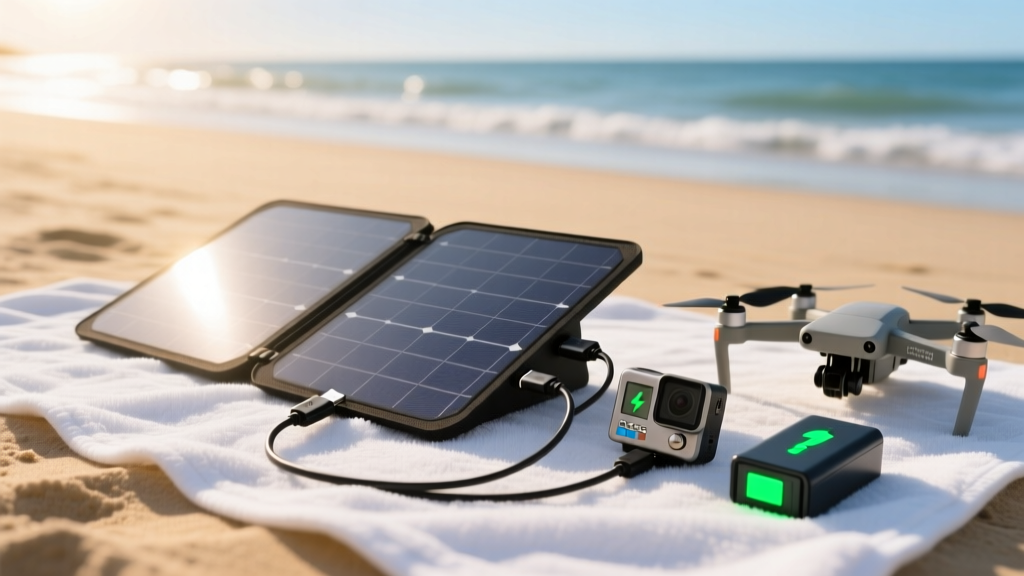
Most portable monocrystalline panels have a temperature coefficient of around -0.3% to -0.4% per degree Celsius. If you lay a 28W solar panel flat on a dark beach towel on a 32°C (90°F) day, the panel's surface temperature can easily reach 65°C (149°F). This 40-degree delta from the STC baseline results in a 12% to 16% efficiency loss before you even factor in suboptimal sun angles or salt-spray film on the lens. To mitigate this, elevate your solar panel using built-in kickstands to allow ambient sea breezes to flow underneath, cooling the cells and recovering up to 15% of your lost wattage.
BigBlue 28W Solar Charger
The BigBlue 28W ($69.99) remains a top-tier choice for coastal environments due to its ETFE (ethylene tetrafluoroethylene) laminated surface. Unlike cheaper PET panels that yellow and degrade rapidly under intense UV exposure, ETFE maintains high light transmittance and resists salt corrosion. It features dual USB-A ports and a single USB-C port with an integrated ammeter, allowing you to physically see the amp draw drop if the panel overheats, prompting you to reposition it for better airflow.
Basecamp Power: Portable Stations for Beach Tents
For large groups, families, or content creators running drones and multiple cameras from a basecamp tent, standard power banks fall short. Portable power stations utilizing LiFePO4 (Lithium Iron Phosphate) chemistry are the superior choice. LiFePO4 cells are inherently more thermally stable than standard NMC (Nickel Manganese Cobalt) lithium-ion cells, making them significantly safer and more durable when ambient temperatures spike.
EcoFlow River 2 Pro
The EcoFlow River 2 Pro ($599.00) packs 768Wh of LiFePO4 battery capacity, capable of running a portable 12V cooler, charging five smartphones simultaneously, and powering a laptop. Its X-Stream fast charging technology replenishes the unit from 0% to 100% in just 70 minutes via AC, but more importantly for beach use, it accepts up to 110W of solar input. When paired with a 110W rigid portable panel, the River 2 Pro's internal MPPT (Maximum Power Point Tracking) controller dynamically adjusts voltage to squeeze every available watt out of the panel, even when passing coastal clouds cause rapid irradiance fluctuations.
Essential Maintenance: Flushing Sand from USB-C Ports
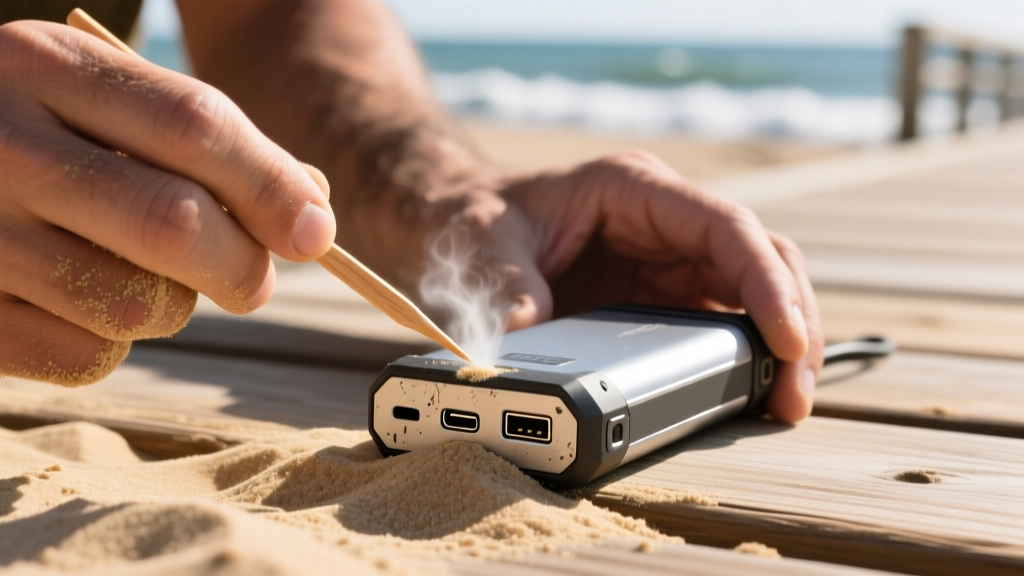
Even with IP-rated gadgets for the beach, fine silica sand inevitably finds its way into crevices. Attempting to force a USB-C cable into a sand-clogged port will bend the delicate internal pins, permanently destroying the power delivery handshake. Follow this exact protocol to clear your ports safely:
- Power Down: Completely shut off the power bank to prevent accidental shorting during the cleaning process.
- Compressed Air Burst: Use a can of compressed air with the precision straw attachment. Hold the can upright and deliver three short, sharp bursts directly into the port to dislodge loose grains.
- Mechanical Agitation: Take a dry, untreated wooden toothpick (never use metal safety pins or paperclips). Gently scrape the bottom corners of the USB-C oval, where sand compacts against the plastic housing.
- Secondary Air Flush: Deliver two more bursts of compressed air to evacuate the loosened debris.
- Isopropyl Alcohol Swab: If salt spray has created a sticky residue, wrap a microfiber cloth over the toothpick, dampen it with 99% isopropyl alcohol, and gently wipe the interior contacts. Allow 5 minutes to evaporate before use.
Matching Your Power Profile
Selecting the right portable power gadgets for the beach requires matching the hardware to your specific usage profile. Solo hikers and swimmers should prioritize the IP67-rated BioLite Charge 80 PD for its submersion safety and compact footprint. Photographers and digital nomads operating under a beach umbrella will benefit from the passive cooling and 100W output of the Goal Zero Sherpa 100 PD. For family basecamps requiring AC outlets and high-capacity thermal stability, the LiFePO4 chemistry of the EcoFlow River 2 Pro is unmatched. By respecting the thermal limits of lithium chemistry and maintaining strict port hygiene, your power infrastructure will reliably outlast the tides.
Written by
Jake MorrisonJake Morrison holds a B.S. in Electrical Engineering from UC Berkeley and an MBA from Stanford Graduate School of Business. With over 12 years of hands-on experience in consumer electronics, he previously served as a senior product engineer at a Silicon Valley startup before transitioning to tech journalism. Jake has personally tested and benchmarked over 3,000 gadgets across categories including smartphones, wearables, smart home devices, and audio equipment. His durability testing methodology — involving controlled drop tests, thermal cycling, and water submersion — is widely cited by major tech publications. He is a certified CompTIA A+ technician and a contributing editor to the IEEE Consumer Electronics Magazine.