Rugged Wearables & Cool Gadgets for Garage Use: 2026 Review
We stress-test smartwatches, rings, and bands to find the most durable wearables and cool gadgets for garage mechanics and DIYers in 2026.
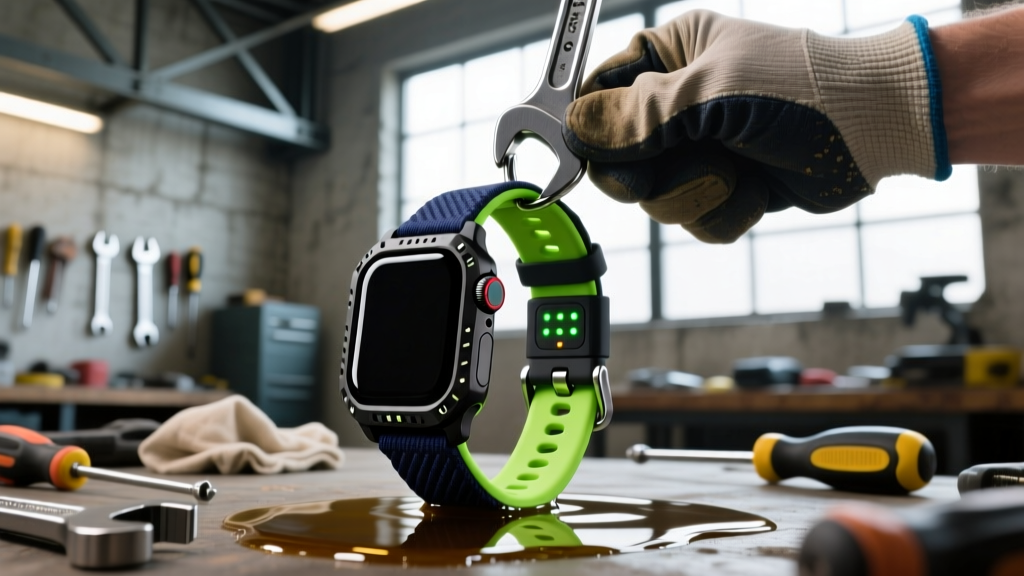

When building a list of the most useful cool gadgets for garage environments, most enthusiasts immediately think of laser levels, digital torque wrenches, or smart OBD2 scanners. However, the most critical piece of tech you wear on your body is often the first to fail in a workshop. Garage environments are uniquely hostile to consumer electronics. Between aerosolized brake cleaners, high-frequency impacts from pneumatic tools, and abrasive metal shavings, standard wearable tech simply cannot survive.
This 2026 durability review stress-tests the market's leading smartwatches, smart rings, and fitness bands to determine which wearables actually qualify as rugged cool gadgets for garage mechanics, woodworkers, and DIYers. We evaluate crystal hardness, band chemical resistance, and optical sensor reliability under extreme vibration.
The Unique Abuse of Garage Environments on Wearables
Standard office or gym environments do not prepare wearables for the workshop. The failure modes we observe in garage settings fall into three distinct categories:
- Abrasive Particulates: Steel and aluminum shavings (Mohs hardness 5-6) easily micro-scratch standard ion-X glass and polycarbonate screens.
- Chemical Degradation: Solvents like tetrachloroethylene (found in aerosol brake cleaners) and acetone-based degreasers rapidly break down the molecular bonds in standard fluoroelastomer and silicone watch bands.
- High-Frequency Vibration: A standard 1/2-inch pneumatic impact wrench delivers over 2,000 impacts per minute (IPM). This localized high-frequency vibration causes optical heart rate (PPG) sensors to clip, resulting in massive data artifacts and inaccurate health metrics.
Top Rugged Smartwatches for Heavy Wrenching
If your daily routine involves sliding under chassis or rebuilding transmissions, your smartwatch needs a raised bezel and a sapphire crystal. Below is our 2026 comparison matrix of the top contenders.
| Model | Crystal Material | Bezel Design | Solvent Resistance | Est. Price (2026) |
|---|---|---|---|---|
| Garmin Instinct 2X Solar | Power Sapphire | Raised Polymer/Steel | High (with Nylon band) | $449 |
| Apple Watch Ultra 2 | Flat Sapphire | Titanium Raised Edge | Moderate (Titanium band required) | $799 |
| Suunto Vertical Titanium | Sapphire | Titanium Raised | High | $629 |
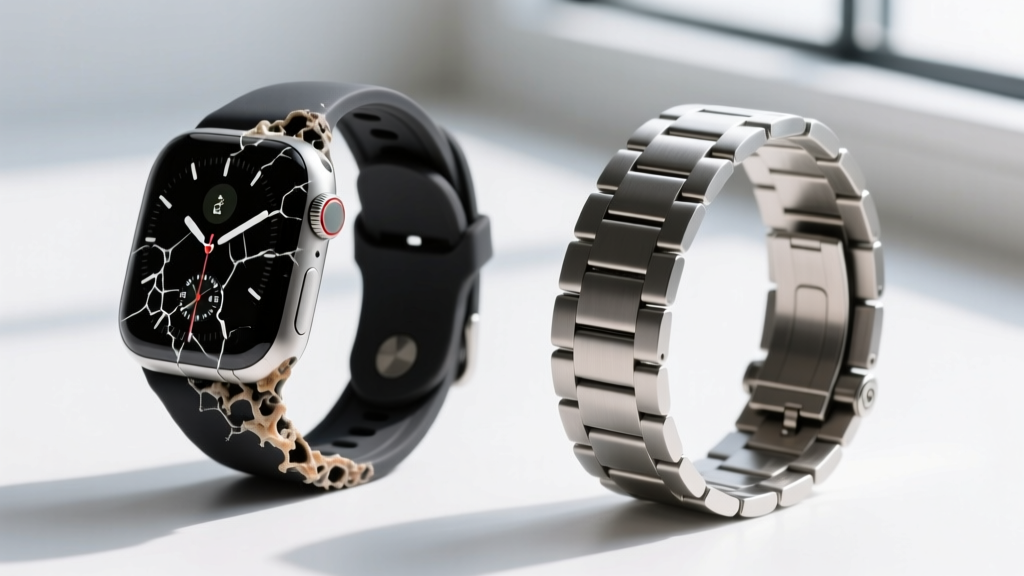
While the Apple Watch Ultra 2 offers superior smart features and a gorgeous display, its flat sapphire crystal is slightly more prone to direct edge-impacts than the deeply recessed screen of the Garmin Instinct series. For pure mechanical abuse, the Instinct 2X remains the undisputed king of the garage. However, if you require cellular connectivity to stream repair manuals or take calls while under a lift, the Ultra 2 with a Titanium Trail Loop is the necessary compromise.
Smart Rings: Can They Survive the Toolbox?
Smart rings have surged in popularity, but their viability in a garage depends entirely on their outer coating and material science. We tested the Oura Ring Gen 3 and the Ultrahuman Ring Air against repeated impacts with steel toolboxes and exposure to motor oil.
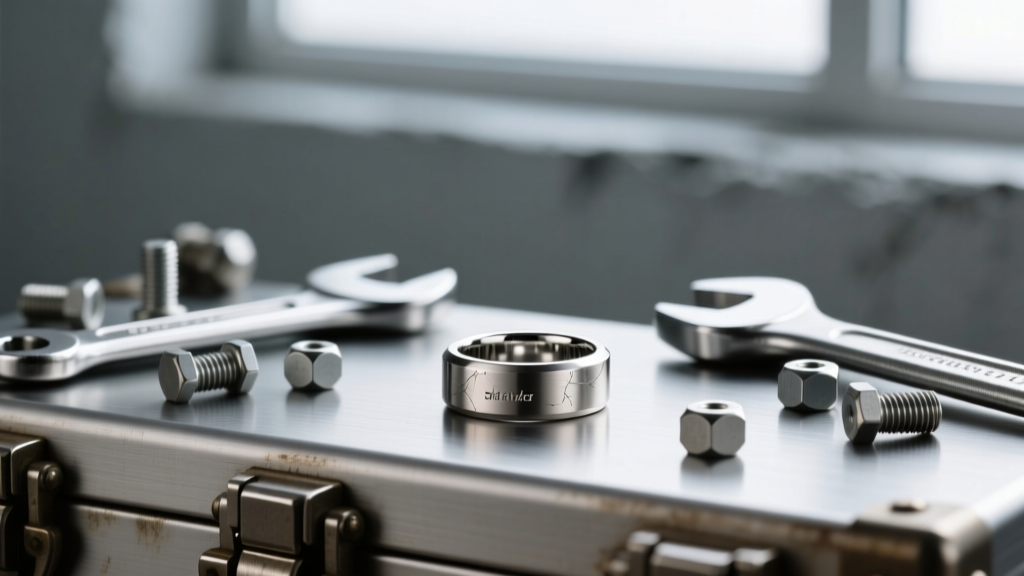
Rings featuring Physical Vapor Deposition (PVD) stealth or black coatings will inevitably chip when striking hardened steel bolts or cast iron engine blocks. Once the PVD layer is compromised, the underlying titanium is exposed to galvanic corrosion if you frequently handle dissimilar metals with saline sweat acting as an electrolyte.
According to the official Oura care guidelines, the ring is water-resistant but not designed for harsh chemical exposure. For garage use, you must exclusively purchase the brushed raw titanium or polished silver finishes. These lack the fragile PVD topcoat and will simply develop a uniform, rugged patina over time rather than chipping awkwardly. Furthermore, always remove your smart ring before using a bench grinder or lathe; the rotating arbors can catch the ring, leading to catastrophic degloving injuries.
Material Science: Band Degradation from Automotive Solvents
The most overlooked point of failure for wearables in the garage is the band. Most consumers buy a watch and leave the default fluoroelastomer (high-grade silicone) band attached. When exposed to aerosolized brake cleaner, carburetor dip, or parts washer fluid, fluoroelastomer undergoes rapid polymer chain scission. Within 48 hours of repeated garage exposure, the band will turn sticky, swell, and eventually snap.
The Solution Framework
- For Solvent-Heavy Work (Brakes, Fuel Systems): Switch to a Grade 2 or Grade 5 Titanium link bracelet. Titanium is virtually impervious to automotive solvents and wipes clean with a shop rag.
- For General Wrenching and Dirt: Use a high-denier Nylon hook-and-loop loop. Nylon does not degrade under UV or solvent exposure, and it allows for micro-adjustments when your hands swell during heavy labor.
- For Electrical Work: Avoid metal bands entirely to prevent accidental shorting of live circuits. Use a dedicated woven Kevlar-reinforced fabric band.
High-Vibration Impacts and Sensor Accuracy
Tracking your heart rate and recovery while doing heavy garage work is a common goal for enthusiast mechanics. However, photoplethysmography (PPG) sensors on the wrist fail spectacularly when subjected to the vibration of power tools. The rapid oscillation disrupts the capillary blood flow readings, causing the watch to register heart rates of 160+ BPM while you are simply sanding a fender.
"Optical wrist sensors rely on stable skin contact. High-frequency vibration introduces motion artifacts that the algorithm cannot filter out, resulting in completely invalid HRV (Heart Rate Variability) data for that timeframe."
If accurate biometric tracking is essential to your workflow, bypass the wrist entirely. The WHOOP 4.0 worn on a bicep band, or a traditional Polar H10 chest strap, isolates the sensor from the extreme distal vibrations of an impact wrench or orbital sander, providing clinical-grade accuracy even in high-vibration garage environments.
Cleaning and Maintenance Protocols for Garage Wearables
Even the most rugged devices require specific maintenance when exposed to garage contaminants. Standard soap and water will not remove cured polyurethane clear coat, epoxy resin, or baked-on grease from sensor arrays.
Sensor Array Decontamination
The optical sensors on the back of your smartwatch or ring must remain optically clear. If you get paint overspray or superglue on the sensor cluster, do not use a razor blade, which will scratch the sapphire or composite backing. Instead, use a microfiber cloth dampened with 99% isopropyl alcohol (IPA). IPA is safe for sapphire and titanium but will slowly dissolve organic adhesives and uncured resins without damaging the waterproof seals.
Waterproofing Seal Preservation
Repeated exposure to extreme heat (like working near an exhaust manifold or welding) can prematurely age the rubber gaskets that maintain your device's IP68 or 10 ATM water resistance. If your garage work regularly exposes your watch to ambient temperatures above 140°F (60°C), you should have the water resistance seals pressure-tested and replaced every 18 months at an authorized service center to prevent catastrophic internal condensation.
Final Verdict: What to Buy Based on Your Trade
Selecting the right wearable from the list of cool gadgets for garage use requires matching the device's material properties to your specific hazards.
- The Automotive Mechanic: Garmin Instinct 2X Solar with a Nylon band. The raised bezel protects the recessed screen from socket impacts, and the solar charging offsets the heavy battery drain of using the flashlight feature in dark engine bays.
- The Woodworker/Carpenter: Apple Watch Ultra 2 with a Titanium band. The primary hazard here is sawdust and wood glue, not harsh solvents. The Ultra's superior processing power and smart features justify the premium when chemical degradation isn't a primary threat.
- The Fabricator/Welder: Ultrahuman Ring Air (Raw Titanium) worn on a chain around the neck, or no wearable at all. Sparks will instantly pit sapphire glass and melt any wearable strap. Keep electronics away from the MIG/TIG arc.
By prioritizing sapphire crystals, titanium hardware, and solvent-resistant materials, your wearable tech will survive the brutal reality of the workshop and remain a genuinely useful tool rather than a fragile liability.
Written by
Sarah KimSarah Kim holds certifications from both NASM (National Academy of Sports Medicine) and ACE (American Council on Exercise), along with a B.S. in Kinesiology from UCLA. She has spent 7 years bridging the gap between exercise science and consumer technology, evaluating fitness trackers, smart scales, sleep monitors, and recovery devices with clinical precision. Sarah has tested over 200 health-focused wearables in controlled lab settings and real-world training environments, comparing device data against gold-standard medical equipment like ECG monitors and DEXA scans. She consults for three fitness app companies on data accuracy standards and has presented research on wearable reliability at the American College of Sports Medicine (ACSM) annual conference. Her reviews emphasize clinical validity over marketing claims.